
The best third-party game on the Virtual Boy came from Atlus, and it wears its heritage openly. Jack Bros. stars the three mascots of the Shin Megami Tensei universe — Jack Frost, the cheerful snowman; Jack Lantern (Pyro Jack), the pumpkin-headed prankster; and Jack the Ripper, the knife-wielding gentleman of Victorian nightmares — in a top-down maze action game about falling: floor after floor of a tower, cleared against a ticking clock, on a Halloween night deadline to return home before the portal between worlds closes. Released in Japan and North America in 1995, it remains the library’s most collectible cartridge and, more importantly, one of its most replayable.
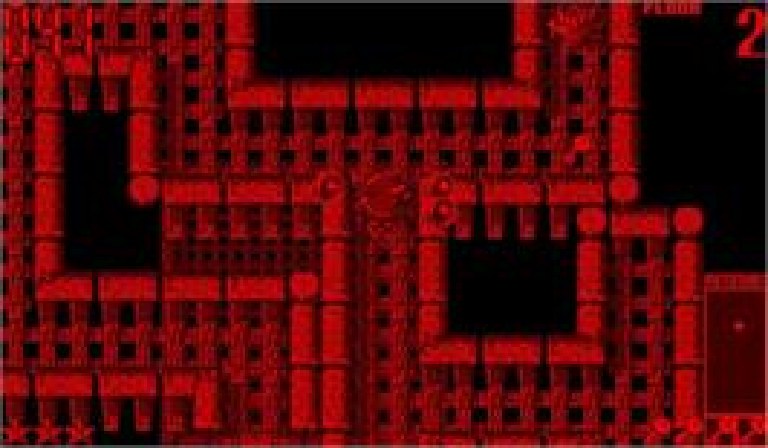
The structure is elegant. Each floor is a maze patrolled by enemies; you must find the key — or keys — and reach the exit before your time expires, and the time is also your health, a single resource that makes every decision double-edged. Getting hit costs seconds; dawdling costs seconds; the special attack that clears a screen costs seconds. Choose Jack Frost for balanced play, Jack Lantern for stronger shots, or Jack the Ripper for a short-range, high-risk knife game that turns the whole design into something close to a roguelike dare. A fourth, hidden character — a fairy companion in the Japanese release’s extended family — awaits players who earn her.
Depth from above
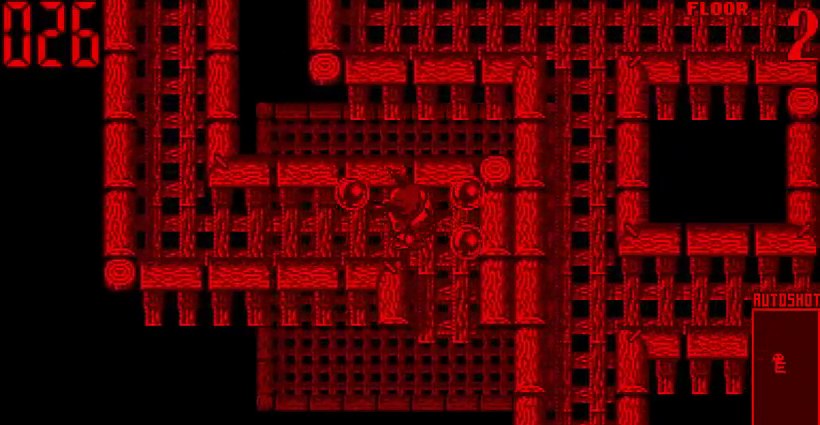
Top-down maze games are not obvious stereoscopy candidates, and Atlus’s solution is tasteful: the floors themselves are the depth. As you descend, each new level drops into view below the last, layer effects give the tower a genuine verticality, and the playfield uses subtle parallax to separate walls, floor and actors. It is the least showy 3D in the library and some of the most effective, because it never interferes with reading the maze — the game understands that the clock, not the spectacle, is the source of tension.
That tension is expertly tuned across the game’s six areas and dozens of floors. Enemy variety builds steadily — chasers, shooters, things that split, things that must not be touched at any price — and the mazes evolve from corridors into genuine puzzles of routing: which key first, which enemy to spend a special on, where the time bonuses hide. Boss encounters cap each area, big sprites that fill the screen and demand the resources you have hoarded. The whole campaign runs perhaps two hours, and it is dense, fair and endlessly restartable.

A Megami Tensei miniature
For Shin Megami Tensei fans, Jack Bros. is a treasure chest of early mascot characterisation. The three Jacks are drawn with real personality — big, expressive sprites, the largest and most characterful in the Virtual Boy library — and the between-area dialogue (in the North American version, Atlus’s localisation leans into the Halloween charm) gives the descent a storybook frame. The soundtrack is a standout: moody, melodic chiptune work that shifts character per area and never repeats itself into irritation across the game’s short, intense sessions.
Historically, the game is also a landmark: the first Shin Megami Tensei-related title released in North America, years before the series’ western breakthrough, smuggled in as a cute maze game for a doomed red console. Its rarity — a short print run for a dying system — made it the library’s grail, but the reputation underneath the price is earned on design, not scarcity.
Three Jacks, three games
The character select is a difficulty system in disguise, and it is the design’s smartest economy. Jack Frost is the rounded beginner’s run: a dependable shot, forgiving special costs, the game as its designers balanced it. Jack Lantern trades agility for firepower, his stronger shots and screen-clearing special turning crowded floors into resource questions — spend the seconds now, or save them for the boss? Jack the Ripper is the connoisseur’s run: a knife fighter in a shooting game, his range so short that every enemy becomes a duel and every maze a risk assessment. That one cartridge contains three genuinely different campaigns is a generosity the Virtual Boy library, with its demos and miniatures, rarely matched. The hidden fourth character — Pixie, unlocked for players who conquer the game — is Atlus tipping its hat to the Megami Tensei faithful years before the West knew it had any.
The floor design evolves with similar discipline. The opening area teaches navigation and key-hunting in mazes that cannot kill you except by clock. Then the vocabulary compounds: enemies that must be herded, floors that split your route into gambles, time bonuses placed where only a player who has stopped fearing the clock will collect them. It is the arcade design language of Gauntlet and its descendants, miniaturised and tightened until every floor is a sentence the player reads at speed. Nothing in the game is padding. In a library where most titles are half an idea stretched, Jack Bros. is a whole idea, compressed.
The Megami Tensei connection
Western players meeting Jack Bros. today often arrive backwards, from Persona and Shin Megami Tensei’s modern prominence, and the game rewards the pilgrimage. The three leads are the series’ mascots in their early, mischievous forms — Jack Frost’s ‘hee-ho’ personality already fully present in sprite and sound — and the game’s structure, a descent through hostile floors toward a deadline with the otherworld, is the series’ dungeon instinct in miniature. Atlus’s North American localisation, the company’s own work, keeps the Halloween flavour and the jokes, making this not merely the first Megami Tensei release in the West but a confident one. Nobody at the time could have predicted the empire these three sprites would front. Playing Jack Bros. now is like finding a future stadium band’s first demo tape, except the demo is excellent.
A word, finally, on the cartridge’s modern life. Jack Bros. is the library’s most expensive North American release by a wide margin, and the market has turned it into a trophy. The reviews written from emulation and flash carts — the way most people now meet it — tell the truer story: strip away the auction prices and what remains is a two-hour arcade campaign of unusual completeness, the rare Virtual Boy game that feels like it shipped from a healthy platform. If the machine had lived, this is the standard its third-party catalogue would have been held to.
A final note on tone, because it is the quality no screenshot conveys: Jack Bros. is funny. Not in a winking, localisation-gag way — though Atlus’s western script has its moments — but in the deep structure of its design, three ridiculous sprites racing a clock through a tower of menace, the whole enterprise pitched exactly between cute and sinister. That tonal control is the Megami Tensei signature in embryo, the same balance the series would spend thirty years perfecting at epic scale. Here it is, complete, in a two-hour maze game on a console made of red light. The library has bigger games. It has no better-balanced ones.
Verdict
Jack Bros. is the complete package the Virtual Boy library rarely managed: a sharp idea, tuned difficulty, personality in every sprite and a structure perfectly sized for its hardware’s short sessions. If the system had hosted more games with this confidence, its story might read differently.
Jack Bros. — 8.5/10. Atlus’s red labyrinth is the Virtual Boy’s finest third-party game — tense, charming and built like a pocket watch.