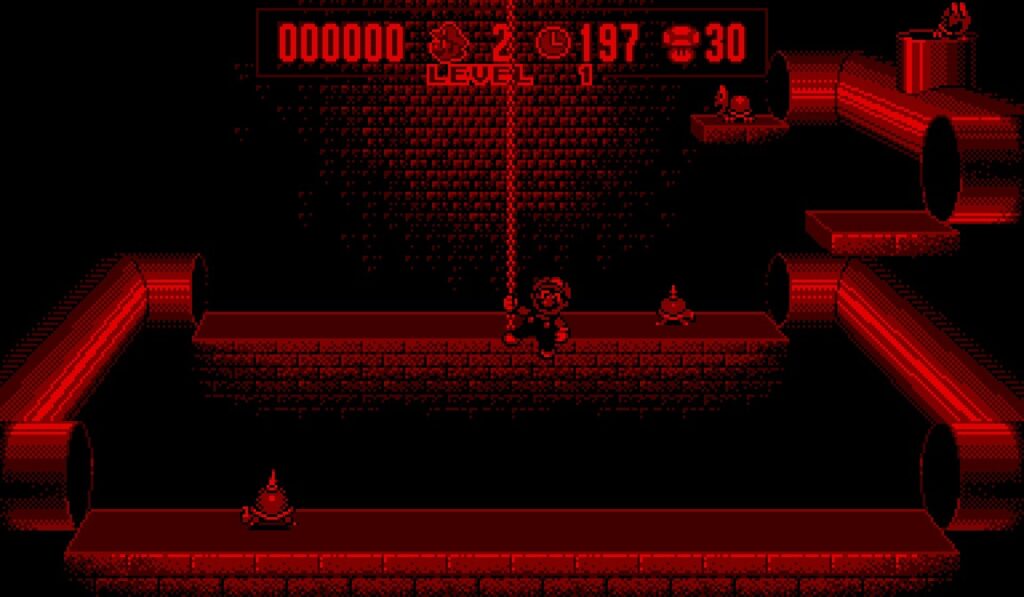
Mario Clash is a remake with the courage to change the thing that mattered. The 1983 arcade game Mario Bros. — two plumbers, one sewer, enemies arriving on platforms to be flipped and kicked — was flat by definition: everything happened on one plane, facing the player. Nintendo R&D1’s 1995 Virtual Boy version splits the playfield into two planes, a foreground platform and a background platform, and rebuilds the entire game around the space between them. Now you stun a Koopa on one plane, grab its shell, and throw it across the depth of the screen to hit an enemy on the other side. When it works, it is the most inventive use of stereoscopy in the library. The trouble is how often the game makes you wait for it to work.
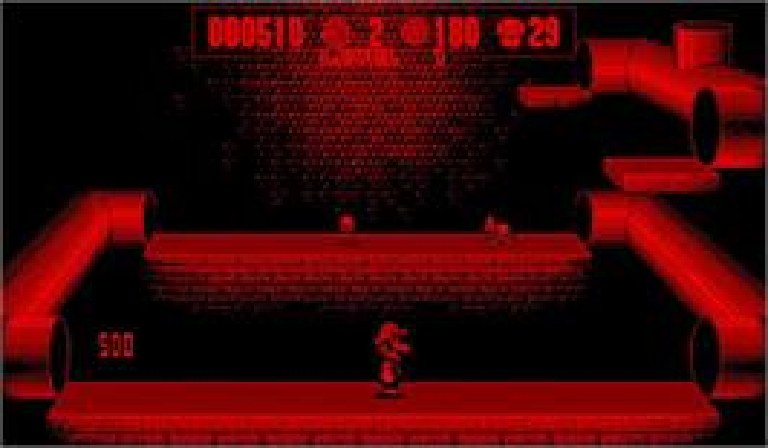
The loop is simple to state and fiddly to master. Enemies emerge from pipes on both planes. Bump them from below — from the platform underneath their feet — and they flip; then kick them away, or better, collect the shell of a Koopa and use it as ammunition across the gap. Some enemies need a cross-plane hit by design, which forces constant movement between the foreground and background via the pipes at either end. The screen becomes a small 3D diorama, and at its best Mario Clash plays like a machine for producing satisfying depth-shots: the shell shrinking into the screen, the crack of contact, the enemy spinning away into the black.
Where the clash frays
Two problems, both well documented by thirty years of players. The first is pacing: stages are cleared enemy by enemy, the waves are not generous with action, and the game’s early levels teach so slowly that the concept feels thinner than it is. The second is control. Mario’s movement and jumping are serviceable rather than joyful — this is R&D1’s functional Mario, not the EAD ballet — and lining up cross-plane throws under pressure exposes the stiffness. Miss a throw and you are repositioning, waiting for another Koopa, watching the stage’s energy leak away.
Persistence is the other absence. There is no save and no password: a run at Mario Clash’s hundred levels is a single-session marathon on a machine that recommended fifteen-minute breaks, an irony the designers can hardly have missed. Most players, then and now, experience the game in its first twenty levels, which is precisely where it is at its least inventive. The design buries its best ideas — enemy combinations that demand genuine two-plane choreography — behind more sameness than the concept can comfortably carry.

The diorama effect
What saves Mario Clash, and keeps it loved, is the charm of the thing as an object. The sprites are big and expressive, the two planes read instantly, and there is a toy-like pleasure to the whole production — it feels like a mechanical diorama of Mario Bros. that someone wound up and set running in red light. The music is cheerful, the bonus stages add a little variety, and as a demonstration of ‘what if our old games had depth?’ it remains a fascinating, playable answer.
It is also a historically pointed game: the first Mario title built for true stereoscopic hardware, arriving the same year as Mario’s Tennis and a year before Super Mario 64 answered the same question — what is Mario in three dimensions? — very differently. Mario Clash is the road not taken, preserved in red.

A remake with a lineage
Mario Clash’s ancestry is longer than one arcade game. Mario Bros. began in 1983 as Shigeru Miyamoto and Gunpei Yokoi’s follow-up to Donkey Kong, was refined through a beloved NES port, and had already been reimagined once for the Virtual Boy’s own extended family — the character and format were in R&D1’s blood. The 1995 remake is best understood as the division asking what its own classic would become in the dimension its new hardware owned. The answer — two planes, cross-plane shell throws, enemies that patrol both levels of the diorama — is a genuine design evolution, not a port with depth paint. When Mario Clash works, it feels like the third Mario Bros. game, the one the timeline skipped.
The enemy design carries the evolution. Koopas provide the ammunition, as tradition demands, but the wider bestiary is built around the two-plane problem: creatures that must be struck from the opposite plane, creatures whose shells behave differently, combinations in the later levels that force you to clear one plane to make the other survivable. The game’s hundred levels do eventually find these combinations — the back third of Mario Clash is a substantially better game than its front — which makes its structural sins (no saves, a stately early pace) the more frustrating. The design knew where it was going. It simply budgeted the journey badly for a machine that rationed its players’ time.
The session problem
That budgeting deserves a paragraph of its own, because it may be the clearest case in the library of a game designed against its hardware’s nature. The Virtual Boy’s manual, its auto-pause features and its entire public reputation insisted on short sessions. Mario Clash demands a marathon: one hundred levels, no passwords, no saves, progress held in a single sitting or not at all. Even in 1995, reviewers noticed the contradiction. The charitable reading is that R&D1 built the game they would have built for any Nintendo machine and let the format be normal; the uncharitable one is that nobody playtested the whole thing in the conditions the hardware imposed. Either way, the consequence is that the best of Mario Clash was the least-seen content in the launch library.
Time has been kind in one respect: modern routes to the game — emulation with save states, Nintendo’s own revival releases — dissolve the marathon problem entirely, and played in sittings of one’s own choosing, Mario Clash’s diorama charms exactly as designed. It becomes what it always wanted to be: a clever, toy-like reimagining of a foundational arcade game, in the only dimension that could have produced it.
One last perspective: Mario Clash is the only game in the library whose reputation has been actively harmed by its own completeness. A shorter, punchier Mario Clash — thirty levels, a password every ten — would be remembered as a minor classic of the launch. The game that exists buries that classic inside a marathon, and the burial is the review’s true subject. It remains recommended here, with the modern caveat attached: play it in the sittings its hardware always wanted, stop when the diorama has delighted you, and know that the version of Mario Clash you enjoyed is the one its designers would probably have shipped if anyone had told them the machine would be gone within the year.
Nintendo has never quite forgotten it — the game resurfaces in WarioWare microgame form and in the company’s own revival selections — and that institutional memory is telling. Mario Clash was not a failure of imagination at Nintendo. It was a good idea given the wrong container, by the only team that could have had the idea at all.
Verdict
A clever core trapped inside a repetitive structure: Mario Clash’s best moments are like nothing else in 1995, and there are not enough of them per hour. Worth playing, worth respecting, hard to love without reservation.
Mario Clash — 7.0/10. The most inventive idea in the launch library, stretched over too many quiet levels. A diorama to admire and, in bursts, to enjoy.