
At a glance: The Jaguar CD · Atari Jaguar CD add-on feature · Atari, 1995 · The format that arrived as the ship was sinking
It looks like a toilet seat. Every Jaguar CD retrospective is obliged to say it, so let it be said first and properly: Atari’s CD-ROM add-on, perched atop the Jaguar console with its lid open, has a silhouette that launched a thousand jokes and at least one era of playground cruelty. But the Jaguar CD’s story deserves better than the joke, because inside that unfortunate shell is the whole tragedy of mid-nineties Atari in miniature — a genuinely capable piece of hardware, launched roughly two years late, into a market that had already chosen its winners, supported by a library so small you can list it in a paragraph, and loved, to this day, entirely out of proportion to its commercial life.
Why a CD, and why then
The Jaguar launched on cartridges in late 1993 into an industry mid-conversion. Sega CD had shown both the appetite for disc gaming and its perils; 3DO had shown the future’s price tag; and everyone in the industry knew the PlayStation and Saturn were coming with CD as standard. Atari’s answer was always planned: a CD-ROM drive that would slot into the Jaguar’s cartridge port, add its own co-processor assistance, use a custom format with more capacity than a standard disc, and arrive — in the plan — while the base console still had momentum. The plan’s fatal variable was time. The Jaguar CD did not reach the market until September 1995, by which point the PlayStation had launched in America, the Saturn was on shelves, the Jaguar’s own software pipeline was thinning, and Atari itself was within months of the reverse merger that ended it as a hardware company.
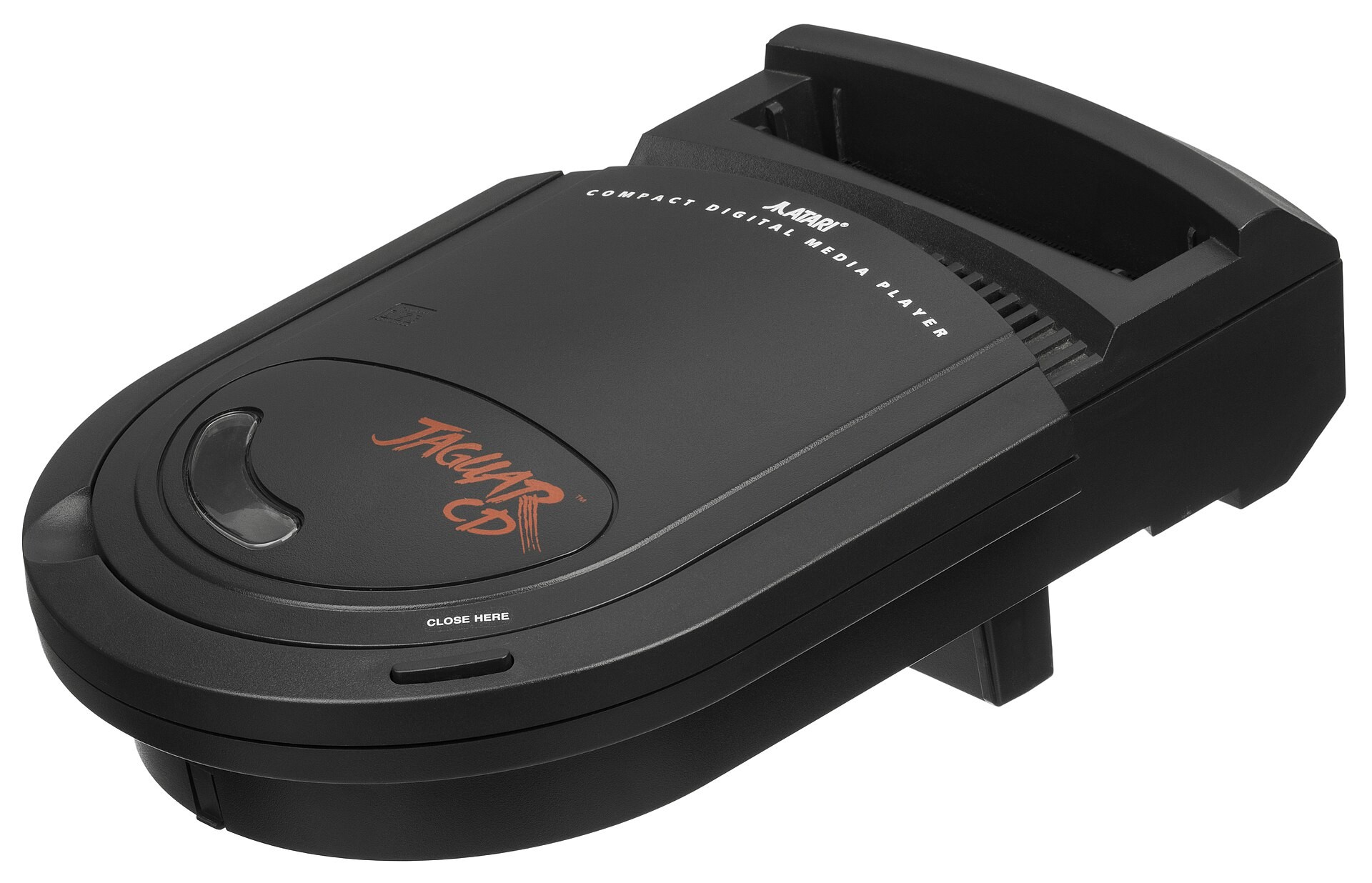
None of that was the hardware’s fault, and the hardware deserves its due. The unit gave developers hundreds of megabytes in an era of 2–4MB cartridges, red-book audio, full-motion video, and — in a touch of pure Jaguar eccentricity — the Virtual Light Machine, a music visualiser built into the firmware by Jeff Minter, which turns any audio CD into a psychedelic light show and remains, pound for pound, the most-used “software” the format ever had. On paper the Jaguar CD was a reasonable machine. It was simply a reasonable machine from 1993, delivered in 1995, by a company running out of money, to an installed base running out of patience. Games needed the base console’s owners to buy an expensive add-on — the add-on economics that had already wounded Sega — and each month of delay shrank the audience the games could be sold to.
A library you can hold in two hands
The official Jaguar CD catalogue runs to roughly a dozen titles, and its shape tells the story. The pack-in was Blue Lightning, a conversion of a Lynx showcase that drew unfavourable comparisons it has never escaped. The strongest original was Battlemorph, Attention to Detail’s Cybermorph sequel, which fixed its predecessor’s faults in public and remains the format’s essential game. Vid Grid turned music videos into a sliding-tile puzzle (a sentence that could only be from 1995). Myst arrived in a handsome conversion. Baldies brought its Lemmings-with-scalps strategy to the disc, Primal Rage and Dragon’s Lair and Space Ace carried the arcade and laserdisc flags, Brain Dead 13 and Hover Strike’s CD edition filled out the shelf, and the format’s posthumous crown, Iron Soldier 2, came from Eclipse by way of Telegames after Atari itself had left the building. There are good games in that list — two or three genuinely good ones — but there is no system-seller, no Doom-scale event, and there was never going to be: third-party publishers looked at the add-on’s price, the base’s sales and the PlayStation’s launch numbers, and did the arithmetic the format’s obituaries are made of.

The unreleased pile is the saddest shelf in Atari history’s saddest decade: projects announced, previewed and in some cases substantially developed for a format whose window closed mid-sentence. Add the notorious practicalities — save games required a separate Memory Track cartridge; the drives themselves were built in modest numbers to modest tolerances, and three decades on, a working unit is a small mechanical miracle — and the Jaguar CD becomes the collector market’s perfect storm: scarce hardware, scarcer software, and a community that never stopped caring about either.
The economics that doomed it
It is worth being precise about the trap, because “the Jaguar CD was bad” is the one explanation the evidence doesn’t support. An add-on’s market is, at best, a fraction of its host console’s base — owners who will pay again for hardware that only plays new games. The Jaguar’s base was itself modest and shrinking through 1995, as the PlayStation’s launch rewrote the industry’s centre of gravity in a single autumn. For a publisher, the Jaguar CD therefore offered the smallest audience in mainstream gaming at the exact moment development costs were leaping to CD-era scale. The result was written before a single disc was pressed: a library assembled from conversions, pack-in showcases and the loyalty of Atari’s remaining in-house and partner studios, rather than the broad third-party support the format needed to justify itself. Every participant in the story behaved rationally. The sum of their rationality was a dozen games and a punchline about sanitary ware. That is usually how format deaths actually work, and the Jaguar CD is simply the purest, smallest, most completely documented case the industry has left us.
The afterlife
Because here is the twist the obituaries miss: the Jaguar CD refused to finish dying. The homebrew and aftermarket scene that sustained the base console sustained the format too — rescued prototypes, new releases, and eventually the RetroHQ GameDrive, whose ability to run Jaguar CD images from a memory card quietly solved the format’s two terminal problems (drive fragility and software scarcity) for anyone who simply wants to play the games. The VLM still gets demonstrated at retro shows to people who cannot believe a 1995 game add-on shipped with a world-class music visualiser in its firmware. Blue Lightning still gets its joke, and Battlemorph still gets its respect.

And the players who were there remember the strangest part fondly: for one brief season, the format made its owners feel like insiders in an alternate timeline — the timeline where the discs arrived on time, the library grew past a paragraph, and the toilet-seat silhouette became as familiar as a Mega-CD’s slab. The Jaguar CD’s cult is not really about the games, in the end. It is about proximity to a future that nearly happened, close enough to hold in two hands.
Judged as a business decision, the Jaguar CD was a late, under-supported add-on for a failing console, and no amount of affection rewrites that ledger. Judged as an artifact, it is something rarer: a complete fossil of the exact moment the games industry changed state — cartridge to disc, sprites to polygons, Atari to history — preserved in black plastic, shaped like a toilet seat, with a light machine in its heart. The Jaguar CD didn’t fail because it was bad. It failed because 1995 happened to it. There is a difference, and the collectors who pay fortunes for working units are, in their way, paying for the difference.