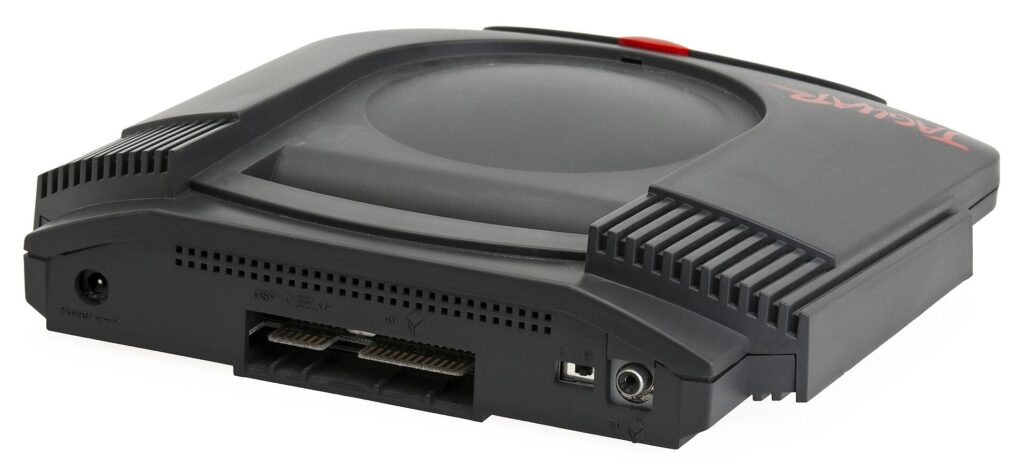
At a glance: “Do the Math” · Atari Jaguar marketing & architecture feature · 1993–1996 · Was it really 64-bit? (Carefully: sort of.)
Three words did more damage to a games console than any faulty chip ever could: DO THE MATH. Atari’s slogan for the Jaguar, launched in North America in November 1993 at $249, was an open taunt at the 16-bit establishment — your SNES is 16-bit, your Mega Drive is 16-bit, we are 64-bit, arithmetic is destiny. It was brilliant advertising and a hostage to fortune, because it invited the entire industry to ask the question this feature exists to answer carefully: was the Jaguar actually 64-bit? The honest answer is genuinely interesting, genuinely contested, and — this is the part the playground arguments missed — mostly beside the point.
What was inside the machine
The Jaguar was not built around a single processor in the way its rivals were. It was a small committee of custom silicon. At its heart sat two 32-bit RISC processors built by Atari itself, nicknamed Tom and Jerry: Tom, the GPU, a graphics-oriented RISC core running the machine’s rendering and general computation; and Jerry, a digital signal processor handling audio and support tasks. Around them sat dedicated hardware that mattered as much as either: the Object Processor, which drew the display by processing lists of sprites and scaled objects, and the Blitter, which moved and filled graphics data at serious speed. Holding a clipboard at the edge of the meeting was a Motorola 68000 — the same 16-bit-generation CPU that powered the Mega Drive — nominally managing the system.

So where does “64” enter it? In several defensible places. The system’s main data bus was 64 bits wide. The GPU’s architecture incorporated 64-bit elements in its design, and the graphics path — blitter and object processor included — moved data in 64-bit quantities. Atari’s claim, in other words, was not fabricated: by the bus-width measure that the industry had loosely used to label generations (the PC Engine’s defenders and the Neo Geo’s marketers had played the same game before), the Jaguar could call itself 64-bit with a straighter face than most. But the counter-argument was always equally honest: the CPUs at the centre of the system were 32-bit designs, the 68000 coordinator was a 16/32-bit chip, and much real-world performance was gated by how well a programmer could orchestrate the whole eccentric committee — which, given the hardware’s complexity and reported bugs in its development tools, few could, or had the time and budget to learn.
The campaign, and the trap inside it
“Do the Math” ran everywhere: print ads doing arithmetic at the SNES and Mega Drive (and then, as the decade turned, at the 32-bit PlayStation and Saturn too — the campaign’s cheek grew as Atari’s position shrank), television spots with a schoolroom sneer, and a general posture that the Jaguar was not competing so much as correcting. As rhetoric it was inspired. As strategy it contained a trap: it defined the Jaguar’s worth by a number its games then had to visibly justify, on screen, next to machines with bigger libraries and bigger budgets. When a Jaguar game was superb — Tempest 2000, Alien vs Predator, the id ports — the number looked prophetic. When a Jaguar game stuttered out at a frame rate the SNES would have been ashamed of — and the library has its famous examples — the slogan was quoted back with interest. Sega and Nintendo’s marketers could hardly have written a better attack line themselves, and the gaming press of the day used “do the math” ironically within a year of its launch.
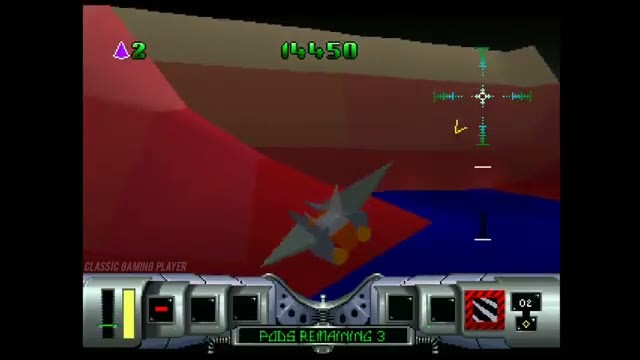
The deeper irony is that the Jaguar’s real strengths had little to do with the number in the slogan. The machine was a monster at exactly the things its custom graphics hardware was built for: huge numbers of scaled sprites, rapid blitting, rich colour — the reasons Super Burnout and Rayman and Defender 2000 feel the way they do. Its weaknesses were equally unbitted: an awkward multi-chip architecture that punished ordinary development, limited memory for textures, a tiny software budget across the industry, and a launch library that had to be built by whoever would take Atari’s call. A Jaguar marketed honestly — “the best 2D hardware ever put in a console, with some fascinating 3D silicon, from a company fighting for its life” — might have been truer. It would not have fit on a T-shirt, and Atari, in 1993, could not afford truth at that length.
The verdict history has settled on
Three decades of documentation, developer interviews and enthusiast archaeology have converged on something like a consensus, which can be stated plainly. The Jaguar’s architecture contained genuine 64-bit pathways, and its graphics subsystem was legitimately advanced — the claim was marketing-aggressive, not fictional. The system was also, in practical terms, a machine whose performance lived in the 32-bit generation’s neighbourhood, because performance is set by the whole design — processors, memory, tools, budgets — and not by the widest bus in the box. Both halves of that sentence are the answer. The playground version (“it was really two 32-bit chips taped together, so it lied”) and the fan version (“true 64-bit, betrayed by history”) are each exactly half right.
The games that answered the slogan
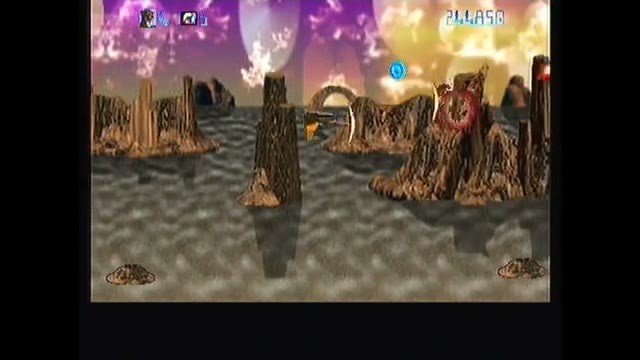
The fairest test of the campaign was always the software, and the software’s testimony is split right down the middle — which is itself the answer. On one side of the ledger: Tempest 2000’s plasma-soaked object storms, Alien vs Predator’s corridors, Rayman’s colour-drunk worlds, Super Burnout’s seamless speed, the Iron Soldier games’ polygon cities — a shelf of titles that made the hardware’s exotic graphics path look, briefly, like the future the slogan promised. On the other: a procession of undercooked conversions and 16-bit hand-me-downs that used the committee of chips like a single tired processor and produced results a Mega Drive would have shrugged at. The difference was never the bits. It was time, tools and talent — the unglamorous variables the slogan existed to shout over. Developers who learned the machine (Rebellion, Eclipse, Llamasoft, ATD by their second attempt) produced the Jaguar’s classics on a curve that was still rising when the money ran out. The tragedy inside the comedy of “Do the Math” is that the curve was real.
There is a postscript the slogan’s critics rarely add: Atari’s rivals were doing the same arithmetic with smaller numbers and straighter faces — the entire industry had agreed to sell its machines by the bit, and Atari’s sin was chiefly one of degree and desperation, committed by the company with the least margin for the joke to fail. The Jaguar’s epitaph was written by its balance sheet, not its bus width.
And in the end, “Do the Math” outlived the company that coined it, which is more than most slogans manage. The Jaguar was the last machine of the bit wars — the final console whose generation was sold as a number — and within three years the PlayStation had made the entire vocabulary obsolete, selling power in polygons-per-second instead. Atari’s taunt stands as the era’s epitaph: confident, clever, half-true, and aimed at an argument the industry was about to stop having. The Jaguar deserved a fairer fight than its marketing allowed it. But my, it could do the math.