
At a glance: Journey · PlayStation 3 · thatgamecompany / Sony Computer Entertainment, 2012 · Adventure · Score: 9.5/10
Journey takes two hours, contains no words, no combat, no failure state worth the name, and a mountain. It is also, by wide agreement, one of the greatest games ever made — the PS3’s purest artistic statement, the winner of shelves of awards against the biggest blockbusters of its year, and a game that players finish in a single sitting and think about for a decade. Thatgamecompany’s third PSN title took the ideas of flOw and Flower — serenity, simplicity, the refusal to punish — and built them into a pilgrimage. If you own a PlayStation 3 and have not played Journey, you have not finished the console.
A figure in the desert
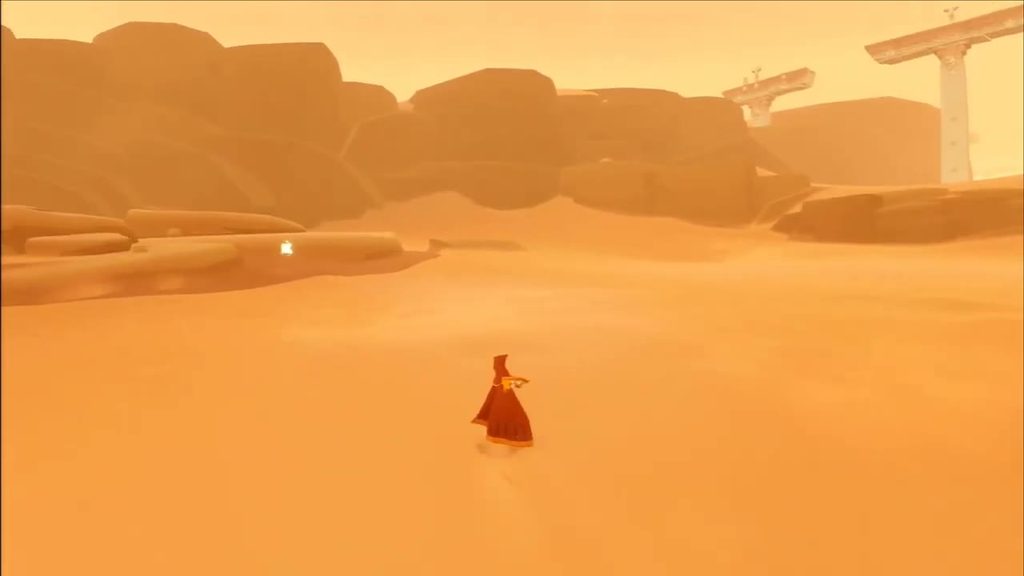
You are a robed traveller in an endless sand sea, and on the horizon a mountain splits the sky with a beam of light. That is the whole briefing. You walk, you slide down dunes like a skier on silk, you chirp a single musical note to wake the ribbons of living cloth that carry you upward, and you piece together a civilisation’s fall from murals in ruins. The control scheme is two buttons and a camera; the movement model — the way the traveller surfs a dune’s lee side, scarf streaming, gathering speed from gravity alone — is one of the great pleasures in games, pure kinesthetics. Each region re-reads the same vocabulary: a sunken city becomes a sand-surfing joyride, a dark underworld introduces the game’s only threat, a mountain ascent turns the wind itself into an antagonist, and the summit sequence, scored by Austin Wintory in the first game soundtrack ever nominated for a Grammy, is as close as the medium gets to transcendence as a designed event.
The companion you never chose
Journey’s famous innovation arrives without announcement: at some point in the desert, there is another traveller. It is another player, matched silently. You cannot speak, cannot see a username, cannot signal except by chirping your one note and drawing shapes in the sand. You can leave at any time. Almost nobody leaves. Something in the design — the shared scarf energy, the way companions recharge each other by singing, the simple fact of another fragile figure in that vastness — produces the most intense cooperative bond in games, with a vocabulary of two syllables. When your stranger waits for you at a hard climb, or leads you to a hidden mural, or dances at the summit, the emotion is real and the game has tricked you into it with almost no tools. Only at the credits do the names appear: the companions you met along the way. Players have met partners, friends and one celebrated wedding proposal out of those two hours. The servers still hum quietly; the mountain still receives pilgrims.
Journey proves that connection in games never needed voice chat, lobbies or friend requests. It needed a desert, a mountain, and one other person who also decided to keep walking.
Art direction as authorship
Jenova Chen’s studio worked in a visual register nobody else attempted: sand rendered as a glittering ocean of light, cloth simulated strand by strand, a palette that travels from gold through rose, teal darkness and blinding white as the pilgrimage darkens and resolves. The PS3’s hardware is not being pushed for polygon counts here; it is being played, like an instrument, for light. Wintory’s score — a cello-led conversation with the player’s actions, swelling and thinning with the journey’s pace — is half the game’s emotional circuitry, and it is no insult to the visuals to say so. The whole work is ninety minutes of pacing so fine that its famous mid-game tonal plunge lands like weather.

Why the original still matters
Journey has been ported widely and beautifully since, and any version is worth playing. The PS3 original is where it happened: a download-only game in 2012, arriving in a console war fought with shooters, that outsold expectations, swept the awards season, and demonstrated to the entire industry that the downloadable indie miniature could stand at the top of the medium’s honours list. Its fingerprints are on everything since — the wordless narratives, the companion mechanics, the pilgrimage structures of a dozen beloved indies. Network features were gentle even then and the PS3’s community is a trickle now, which makes meeting a companion on the original hardware feel, if anything, more miraculous.
The white robes
Completionists get their thread too, gently: hidden glyphs lengthen your scarf, secret murals fill the story’s gaps, and finishing collections across runs earns the white robe of the elder traveller, marking you to new pilgrims as a guide. It is the only progression system the game wants, and it exists purely so that veterans can shepherd strangers. Even its extras are about kindness. There is nothing else like it; there has never been anything else like it; and the attempts to copy its surface have only ever proved how much of it lives below the surface, in pacing, restraint and trust.

The argument it settled
It is worth remembering the weather Journey landed in. Early 2012’s discourse was a shouting match about whether downloadable games were “real” games, whether a title without combat could headline a console, whether two hours could possibly be a complete work rather than a demo with ambitions. Journey answered by accumulation: it reviewed like a blockbuster, sold like one, and then, at the year’s award ceremonies, kept walking onstage — culminating in a haul that included multiple BAFTAs and a Grammy nomination for its score, in a category games were not supposed to enter. The argument did not so much end as evaporate. Every independent miniature since that has been treated as a major work — and there have been many, some of them masterpieces — has lived in a world where the question was already settled by a silent figure in a desert. That is a heavy legacy for two hours of sand and song, and the game carries it without visible effort, perhaps because it never argued for anything. It simply walked toward the mountain, and let everyone decide for themselves whether to walk along. Enough did. The mountain is still there, on the original hardware, with the light still on at the top of it.
How to play it properly
Protocol matters with this one, so let it be stated plainly: play Journey in one sitting, in the evening, with the sound up and your phone in another room. Do not check a guide for the glyphs on your first pilgrimage. If a companion appears, stay with them if you can — the game is gentle about partings and reunions, and the summit means more in company. Then, some weeks later, walk it again. It will not be the same game, and that is not a figure of speech.
The verdict
Journey is the PlayStation 3’s masterpiece in miniature: two perfect hours, playable by anyone, that stand comparison with the console’s biggest productions and, on most days, above them. It is the first game to recommend to anyone who asks what games can be. On its original hardware, it remains flawless.
Score: 9.5/10 — Two hours, one mountain, a stranger’s song. The PS3’s most perfect small game.