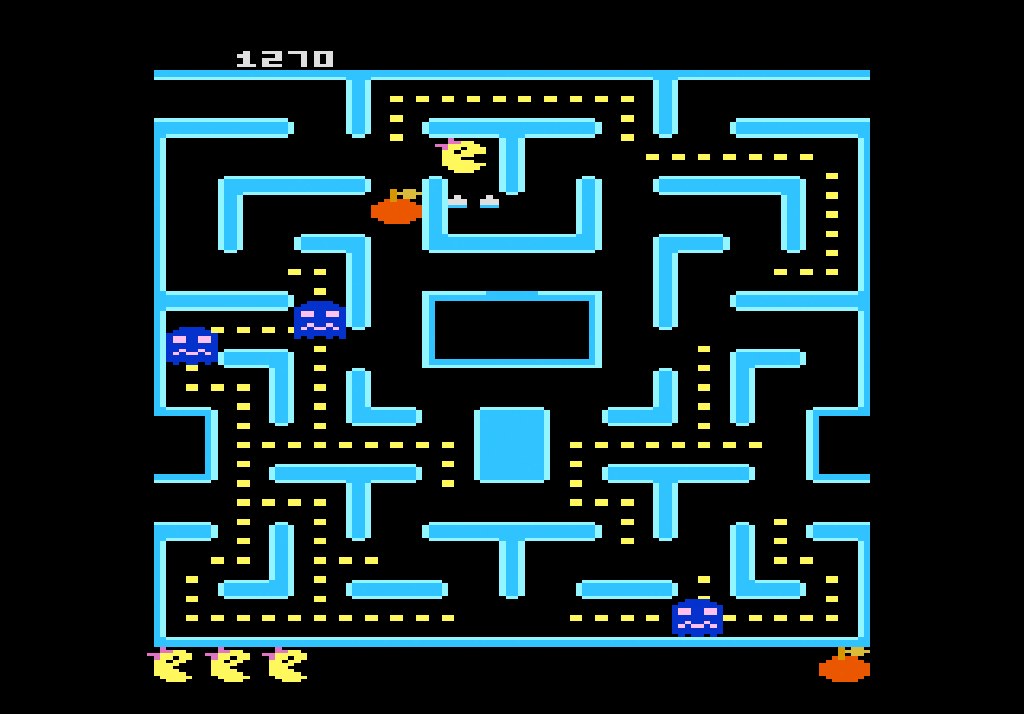
At a glance: Ms. Pac-Man · Atari 7800 · General Computer Corporation / Midway / Atari, 1984 (released 1986) · Maze chase · Score: 9.0/10
There is a beautiful circularity to Ms. Pac-Man on the 7800. The game itself was created by GCC — begun as an enhancement kit called Crazy Otto, transformed with Midway’s blessing into the sequel that outshone Pac-Man. The 7800 console was also created by GCC. And the 7800 port of Ms. Pac-Man was also created by GCC. It is the company’s masterpiece, on the company’s hardware, ported by the company. The result is exactly what you’d hope: the finest home version of Ms. Pac-Man of its entire era, and a small redemption story — after the 2600’s infamous Pac-Man had taught a generation that home ports could betray them, this cartridge was proof of what the same company, given the right machine, could do.
Everything that made the arcade game better than its parent is here. Four different mazes, cycling and changing colour, instead of one maze forever. Fruit that enters the maze and bounces through it — cherry, strawberry, orange, pretzel and onward — a moving bonus that must be intercepted rather than merely reached. Ghosts with the correct personalities and the crucial element of randomness in their early behaviour that made Ms. Pac-Man less solvable than the original’s pattern-perfect mazes. And the intermissions: “They Meet,” “The Chase,” “Junior” — the little cartoon acts that gave the game its heart, present and correct.
The maze queen, studied
Play it attentively and the port’s fidelity keeps announcing itself. The ghosts slow in the tunnels, as they should. The energizers buy you the right amount of time — generous early, stingy later. Ms. Pac-Man’s movement has the arcade’s slight glide through corners, the handling difference that makes her feel like a different driver from her husband rather than a reskin. The fruit’s bounce path obeys the maze’s logic, entering from the tunnels and working toward the ghost house. Even the attract mode runs properly. This is the port as an act of authorship: GCC knew where every one of the arcade’s bodies was buried, because they had buried them.

The presentation seals it. The mazes are drawn tall — using the screen the way the arcade’s vertical monitor did, in proportion if not in orientation — and the colours are the arcade’s colours, shifting as the acts change: pink to light blue to brown to dark blue across the first mazes, with the later boards cycling their own schemes. Compare this with the squashed, flickering compromises of earlier home versions and the generational leap is embarrassing. Ms. Pac-Man on the 7800 doesn’t look like a translation. It looks like the original, let out of the cabinet.
Why she outlasted him
It is worth pausing on why this game, specifically, mattered so much to get right. Ms. Pac-Man was not just a sequel; for many arcade-goers she was the maze game — faster, warmer, less mechanical than Pac-Man, and harder to master because her ghosts refused to be fully memorised. A bad port wouldn’t just disappoint; it would falsify a favourite. The 7800 version is the one that home players of the era could trust, and it arrived as a launch title for the relaunch, doing quiet ambassadorial work: this, it said to anyone comparing shelves in 1986, is what our machine does with a famous name. The tragedy is how few people were watching. The triumph is that the cartridge survived to be judged later, by us, on its merits.

GCC invented her, built the console she runs on, and ported her perfectly. Ms. Pac-Man on the 7800 is the sound of a company showing its own work.
Criticisms, honestly weighed, are close to trivia. The sound is TIA sound — the waka-waka rendered in little electronic bites, the siren simplified — though the port squeezes more character from the chip than most, and the jingles land where they should. The difficulty, as in the arcade, turns severe in the later acts, where ghost speed and short energizers make every dot a negotiation. And maze-game fatigue is a real genre property: this is a score chase of twenty-minute intensities, not a campaign. None of it touches the port’s quality, which is the thing being reviewed.

Acts, mazes and moving fruit
The structure that carries a long game deserves tracing. Ms. Pac-Man unfolds in acts, each act a maze: the pink first board with its twin energizer pockets; the light-blue second, with its reorganised centre; the brown third; the dark-blue fourth — after which the rotation repeats at rising speed, the fruit climbing its famous ladder from cherry through strawberry, orange, pretzel, apple, pear, banana and beyond. The 7800 keeps the ladder whole and the mazes exact, including the two sets of side tunnels whose slow-down effect on the ghosts is a core defensive tool. High-level play becomes a kind of chess with reflexes: route planning around energizer timing, fruit interception lines drawn through live traffic, the calculated risk of clearing the last dots while four ghosts run at full speed. Nothing in the port truncates that endgame. By the boards where the arcade game bares its teeth, this version is indistinguishable in behaviour — which is to say, gloriously unfair in the correct, survivable way.
It matters, too, that this is a two-player alternating game in the classic style, with the second player’s score tracked on the same tall readout. Pac-Man was always a pub sport — one plays, one watches, both argue about the route — and the 7800 version preserves the theatre, intermissions included. “They Meet” still gets its little laugh. Some software is preserved by accuracy; this is preserved by affection, which turns out to be the same thing when the same people do the preserving.
Set beside the 2600’s Pac-Man — the most infamous port in history, made under impossible conditions by a different team — the 7800’s Ms. Pac-Man reads as the other side of Atari’s story: what the company could do when the creators, the hardware and the schedule were aligned. That alignment happened less often than it should have. Here, it happened completely.
A last measure of the port: the ghosts’ faces. In lesser versions, ghosts are blobs with eyes, their expressions a rumour. Here the eyes track, the frightened blue faces wobble with the right anxiety, and the brief, glorious window after an energizer — when the hunted become the hunters — reads at a glance across the tall maze. Score-attack games are information systems before they are anything else, and Ms. Pac-Man on the 7800 never makes you guess. That clarity, multiplied across twenty boards at rising speed, is what mastery feels like from the inside.
She was the best maze game in the arcade, she is the best maze game on this console, and the cartridge that carries her is the one your 7800 will be judged by. That is not a burden. That is a coronation.
The verdict
The best Ms. Pac-Man you could buy for a television in the 1980s, and a top-three cartridge for the 7800 outright. She is fast, faithful, funny and — in the deepest sense — authentic: the creators’ own edition of their own classic. If the 7800 has a signature game, a visiting alien could be shown this one and told: that’s what it was for.
Score: 9.0/10 — The maze queen’s best early port, made by the people who invented her.