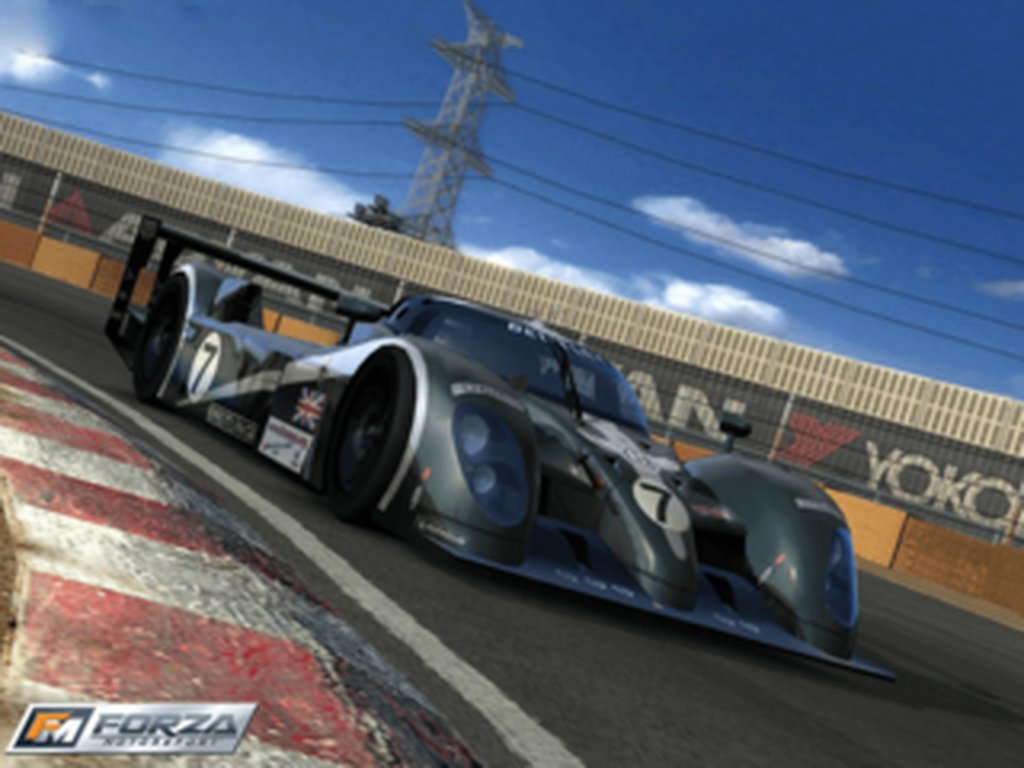
At a glance: Forza Motorsport · Xbox · Turn 10 Studios / Microsoft Game Studios, 2005 · Racing simulation · Score: 9.0/10
Forza Motorsport arrived in 2005 with one openly declared ambition — to do for the Xbox what Gran Turismo had done for PlayStation — and the audacity to succeed at most of it in a single attempt. Turn 10’s debut is a proper simulation: hundreds of licensed cars, real physics with tyre, suspension and aerodynamic modelling, mechanical damage that affects handling, a livery editor of absurd depth, and an artificial intelligence system — the Drivatar — that learned from how you drive and raced your friends when you were not there. That it achieved all this on its first attempt, on hardware in its final year, remains one of the original Xbox’s great technical stories. That it is still deeply pleasurable to drive is the part that matters now.
The handling is the foundation, and it is excellent. Cars communicate through the controller with unusual clarity: you feel weight transfer under braking, the front end wash out as tyres overheat, a rear-drive car begin its slide early enough to catch with confidence. Assists layer sensibly — turn everything on and Forza is a welcoming arcade-adjacent cruise; turn them off and it becomes a stern examiner of throttle discipline. The car list, over 230 machines from everyday heroes to endurance prototypes, is modelled with individual character rather than stat-sheet sameness, and the upgrade system respects real tuning culture: engine swaps, forced induction, aero, gearing, each with consequences the physics engine actually simulates.

The career structure spreads races across point-to-point runs, circuits real and imagined — Laguna Seca, the Nürburgring, Road America alongside fictional alpine and coastal courses — and a class system that keeps your garage relevant as it grows. Money flows sensibly; the game respects your time more than its great rival did, a deliberate design choice Turn 10 advertised and delivered. Damage deserves emphasis because it changed the genre’s manners: hit a wall in Forza and your steering pulls, your aero suffers, your lap is genuinely compromised. Racing clean stops being a courtesy and becomes a strategy, and online — a full Xbox Live suite with car clubs, auctions of a sort through trading, and Drivatar-informed matchmaking — that discipline built one of Live’s most civilised communities.
The livery editor and the Drivatar
Two features mark Forza as a glimpse of gaming’s future. The livery editor — layers, shapes, decals, vinyl groups — turned every car into a canvas, and within weeks the community was producing replicas and originals of professional quality; the entire user-generated-content economy of modern racing games starts here. The Drivatar, meanwhile, was machine learning as a party trick and a promise: the game profiles your cornering, braking and aggression, builds a driver from the data, and lets friends download it. In 2005, on a console, that was science fiction shipped in a box. Neither feature is a garnish. Together they made Forza feel less like a product than a platform — a word the industry would spend the next generation learning.
Gran Turismo asked how faithfully a console could reproduce a car. Forza asked a ruder, better question: what should a racing game do with the internet, a hard drive and your imagination?
Honest debits: the visuals, while sharp and clean, are more clinical than beautiful — Gran Turismo 4’s artistry in light and landscape is not matched here, and some tracks look austere beside PGR2’s postcard cities. The frame rate targets thirty and occasionally reminds you of it in heavy traffic. Load times between events are period-typical, which is to say noticeable. And the AI, Drivatar-trained or otherwise, can be oddly passive in the opening laps before its personality loads. These are the complaints of a simulation finding its feet — remarkably few, for a first step this large.
Sound design is a quiet triumph: engines recorded per car, tyre noise that reports grip honestly, and a menu soundtrack that stays out of the machinery’s way. The Xbox’s hard drive also earns its keep — custom soundtracks from your ripped CDs were a system feature Forza wears well, and the whole package has the solidity of a game built by people who intended to be doing this for twenty years. They were. The series became Xbox’s racing flagship, and its DNA — physics honesty, creative tools, community first — was all present in this first disc.

Built to be lived in
What separates Forza from a dozen competent simulations is how completely it imagines the player’s life around the racing. The career’s region system lets you specialise — a European garage grows differently from an American one — and car rarity creates an economy of desire that the auction-less trading culture of early Live turned into a social scene. The telemetry and replay tools invite study rather than mere admiration; you can watch your own suspension work through a corner and learn from it, a teacherly instinct that runs through the whole design. Even the difficulty architecture is humane: the suggested racing line, adjustable per player, is drawn as guidance rather than law, and the game never punishes experimentation with bankruptcy. Turn 10 trusted players to be curious, and built accordingly.
As a collector’s piece, the original Forza is the founding document of Xbox’s most durable franchise — every Motorsport and Horizon since descends from decisions made on this disc — and it remains the only series entry native to the original hardware. It is inexpensive, its online community survives through revival services, and its offline career is fully self-contained. The one caution is expectation: players raised on the sequels’ 60-frame polish should recalibrate to a more deliberate pace, and be rewarded for it. Depth, here, is not a marketing word. It is the lap-by-lap experience of a simulation that respects physics, players and cars in equal measure.
The garage as autobiography
Every long Forza career becomes a memoir in metal: the humble starter car you refused to sell, the Japanese coupe the Drivatar-era rivals taught you to respect, the prototype that finally made the Nürburgring feel fair. The game’s class and region systems mean no two garages tell the same story, and the livery editor lets the story show on the bodywork. That personal quality — a simulation that remembers you — is the thread Turn 10 pulled through two decades of sequels. It starts here, on a disc that still loads its ambitions without apology.
Newcomers should start with the assists half-on and the damage full: Forza teaches fastest when the consequences are real and the training wheels are honest. Within an evening the suggested line becomes a suggestion you argue with, which is precisely the graduation the game was built to produce.
Verdict
Forza Motorsport is the original Xbox’s essential simulation: deep, fair, forward-thinking and generous, with handling that still teaches and a creative suite that still delights. It does not quite dethrone its inspiration on ambience, and it does not need to — it founded a dynasty of its own. For collectors, it is also the historically important disc: the moment Xbox stopped renting its racing credibility and bought the building. Drive it with the assists off, damage on, and a long evening ahead.