
There is a moment, a few screens into Karateka, when the game stops being a game and becomes a film. Your hero pauses at the edge of a cliff beneath a fortress on a mountain in feudal Japan; somewhere inside, the warlord Akuma holds Princess Mariko; and between you and her stands a line of guards who get better at their jobs with uncomfortable speed. Released by Brøderbund in 1984 and created by Jordan Mechner while he was a student at Yale, Karateka was the first published work of the designer who would later make Prince of Persia — and nearly everything that made that later game revolutionary is already here, in embryo, on a single Apple II floppy.
Mechner’s great insight was borrowed from cinema and animation rather than from other games. He rotoscoped — tracing live footage of karate practitioners, including his own instructor, frame by frame — to give his fighters movement that was fluid and weighted in a way no Apple II game had attempted. He structured the game as a story told in cuts: between fights, brief scenes show Akuma gesturing orders to his guards and Mariko waiting in her cell. There is even a score, composed by Mechner’s father Francis, threading mood through the Apple II’s single buzzy speaker. In 1984, when most action games opened with a score table, this was a different art form arriving early.

One Life, Three Heights, No Mercy
The fighting system is built from pleasingly little. Your hero moves in and out of a fighting stance; in stance he can punch and kick at three heights — high, middle and low — and the same six attacks are available to every opponent. Health for both fighters runs along the bottom of the screen as a row of marks, ticking down with every landed blow, and it refills, slowly, if you stand out of stance and rest — a risk, because a resting hero is a defenceless one, and one clean hit while you are jogging innocently toward the next guard can end everything. Because that is the other thing: you have one life. Not three, not continues — one. A single failed fight, a single careless walk into a falling portcullis, a single moment of disrespect toward Akuma’s trained attack bird, and the game is over and the mountain must be climbed again from its foot.
That severity divides players now just as it did then. Runs are short — a skilled player finishes in well under half an hour — and the design expects mastery through repetition, each attempt teaching you one more guard’s rhythm. The guards are not palette-swapped clones, either; they press differently, retreat differently, and the later ones punish predictable play, reading your favourite height and answering it. The bow matters, too: approach a new opponent and your hero can bow, and most guards bow back — a piece of etiquette Mechner included because the films he loved included it. It does nothing mechanically. It does everything for the fiction.
The Moments Everyone Remembers
Ask anyone who played it in 1984 what they remember and two moments come back before any mechanics do. The first is the eagle: Akuma’s pet hawk, which the warlord dispatches down the mountain and which the hero must punch out of the sky — an encounter so unexpected the first time that it functions as the game’s thesis statement, anything in this fortress can be a fight. The second is the ending’s cruel little joke: reach Mariko’s cell in your fighting stance and she — taking you for one of Akuma’s men — kills you with a single kick, the whole rescue undone by bad manners. Players learned to approach the princess with hands lowered, and the lesson lodged: this is a game that watches how you stand. Between those bookends sit the letter sequences — Mariko’s plea, Akuma’s answering menace, delivered as silent-film intertitles between levels — which give the simple rescue a correspondence, a relationship, and stakes you can feel in your thumbs. No other Apple II action game of 1984 was telling its story in the cuts between fights, let alone in the player’s posture.
The Apple II Original
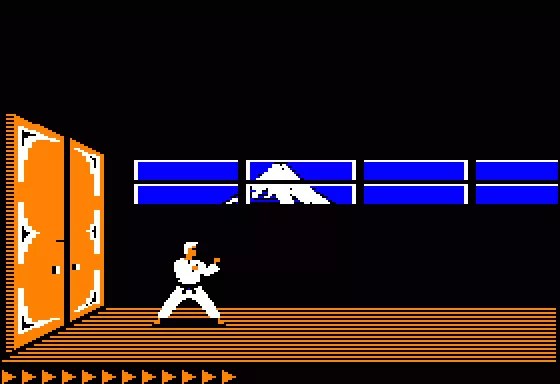
This is an Apple II game first and everything else second — it was developed on the machine, and the hi-res original remains the reference version, with its distinctive colour fringing and those long, smooth strides. The famous joke lives here too: boot the disk from its flip side and the whole game plays upside down, an Easter egg Mechner has cheerfully acknowledged over the years — Brøderbund’s support line, legend has it, was instructed to tell callers who complained that the game was upside down to turn the disk over. Ports followed to just about every 8-bit system going, some excellent, some not, but the Apple II’s combination of animation speed and control feel is the one the others were measured against.
What dates the game is mostly its frame rate by modern standards and the thinness of its move set beside the fighting games that came after. What does not date is its direction. The cliff edge you can back off in the very first scene — an instant, stupid, unforgettable death — announces a designer who thinks in set pieces. The final approach to Mariko’s cell contains one of gaming’s great small jokes, which we will not spoil for the three people who do not know it, except to say: after everything you have endured, remember your manners, and get out of your fighting stance.
The lineage matters too. Mechner took the rotoscoped discipline he practised here — study a body, trace its weight, make the player feel the stance — and spent the rest of the decade arriving at Prince of Persia, whose hero runs, leaps and duels with Karateka‘s DNA in every joint. It is not this site’s business to re-review that later game here; the point is the direction of travel. In 1984 the Apple II got, first, the game that taught an industry that an action hero could be an actor. The journals Mechner kept while making it, published decades later, show a teenager thinking about cinema with a computer — and the computer, obligingly, thinking back in some of the smoothest animation the machine ever produced.
The control scheme repays a final word, because it is the part modern players trip over first. Everything is done from the two stances — moving stance and fighting stance — and within the fight, three heights of punch and kick map to a simple, learnable logic that the game never clutters with combinations. That restraint is the design: your decisions are about distance, timing and nerve, not inputs. On the Apple II’s keyboard or a joystick, the scheme feels austere for ten minutes and then disappears entirely, which is what good controls do. The difficulty is honest — the game is short, and it knows a determined player will finish it in an evening — but mastery, the no-hit run, the perfect duel, is a longer apprenticeship, and the game grades you only in the coin of how the fights felt. They feel wonderful.
Verdict

Karateka is short, stern and utterly singular — a martial-arts film you perform rather than watch, built by a college student who was already thinking like a director. Its one-life structure will frustrate players raised on checkpoints, but that structure is the point: every fight is the whole game, every time. As the foundation stone of Jordan Mechner’s career and one of the Apple II’s defining exclusives-turned-everywhere, it earns its place in any serious collection. Digital Eclipse’s interactive documentary The Making of Karateka has rightly returned it to conversation; the Apple II original is where that conversation should start.
Score: 8.0/10 — At a glance: Developer Jordan Mechner / Brøderbund · Year 1984 · Genre Cinematic martial-arts action · One life, six attacks, endless atmosphere.