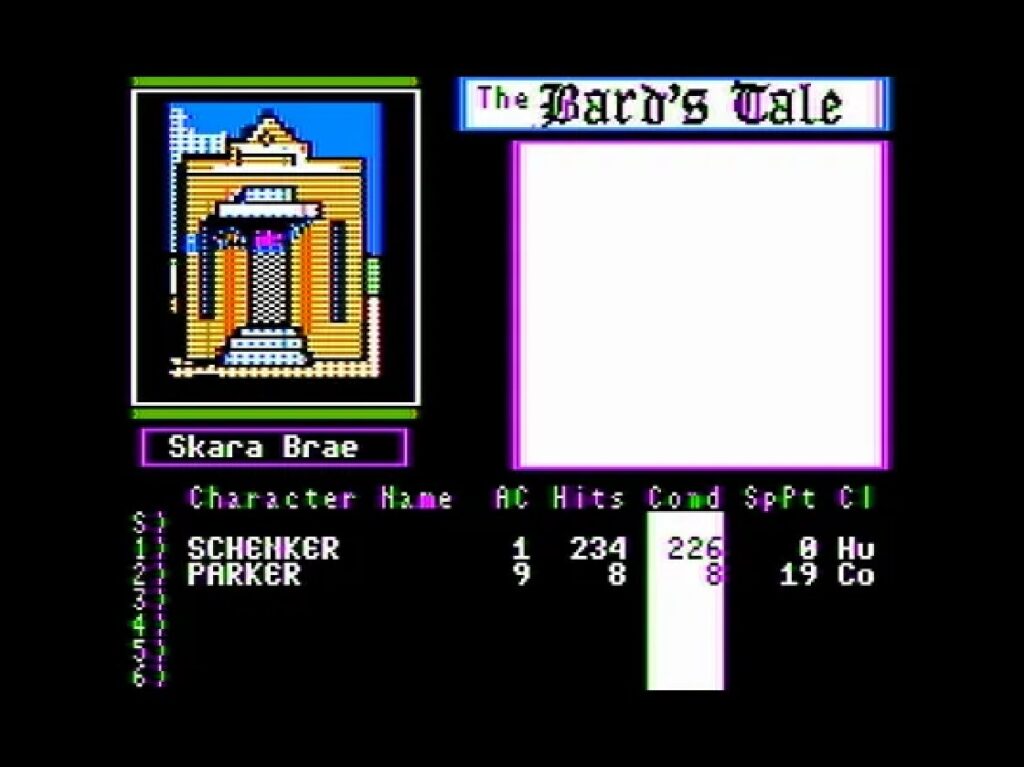
The city is sealed, the winter is unnatural, and the only people having a good time in Skara Brae are the ones in the Adventurers’ Guild with a bard in the party and a song on their lips. The Bard’s Tale — formally Tales of the Unknown, Volume I — was designed by Michael Cranford, developed at Interplay and published by Electronic Arts in 1985, and on the Apple II it landed like a gauntlet thrown at Wizardry‘s feet. Here was a first-person dungeon crawler with a whole town to walk around in daylight, colour graphics that filled far more of the screen, monsters that arrived in their dozens, and a title character who was not decoration but a genuine tactical weapon. Forty years on, it remains one of the defining role-playing games of the 8-bit era.
The plot is cheerfully economical. The wizard Mangar has frozen the city of Skara Brae in eternal winter and cut it off from help; your party of up to six adventurers — rolled up at the Guild from the usual fantasy races and a class list that includes paladins, monks, hunters, rogues, bards and two flavours of spellcaster that evolve into archmages — must fight its way through cellars, sewers, castles and towers to Mangar’s doorstep. Nobody plays The Bard’s Tale for its prose. They play it for the systems, and the systems were generous: hundreds of monsters, dozens of spells with four-letter codes that veterans still remember, magic items, spinners, teleporters, darkness zones and every other instrument of cartographic suffering the decade could devise.

A City, Not a Menu
The break with Wizardry is visible in the first minute. Where Sir-tech’s game presented its town as a menu, Skara Brae is a place: you walk its streets in the same first-person view as the dungeons, passing the Guild, the temples where the dead are raised and the afflicted cured, Roscoe’s Energy Emporium where spell points are bought back at prices that would make a modern microtransaction blush, the weapon shops, the casino, and the all-important taverns where the bard’s songs are set flowing. Daylight matters; so does direction. The city is a dungeon with better manners, and learning it — which street, which turning, which innocuous house is actually the entrance to a tower of horrors — is the game’s first and gentlest mapping exam.
Combat is where the scale changes. Wizardry dealt in handfuls of enemies; The Bard’s Tale deals in mobs — groups stacked in ranks, sometimes scores of creatures in a single encounter, with your front line swinging, your spellcasters choosing between damage, defence and the blessed crowd control of the era, and your bard singing one of a repertoire of songs that protect the party, regenerate, light the darkness or sharpen blades. The bard is the masterstroke of the design: a character class whose magic is music, who must literally be kept in drink to keep singing, and whose songs run continuously while you explore. It gives the game an identity no rival copied cleanly, and it makes the party-building puzzle richer — a bard is a mediocre fighter taking up a precious slot, right up until the moment his song is the only thing between you and a room full of wights.
Two systems deserve their own sentences. The spell book is a ladder of genuine escalation — seven levels each for conjurers and magicians, with the archmage tier waiting for those who master both — and the famous four-letter spell codes turned the manual into a spellbook in its own right: players genuinely learned to chant in abbreviations, and the late-game summons and the world-bending MIBL spell are still name-checked by veterans the way guitarists name-check chords. And then there is the bard. In most RPGs the musician is decoration; here the bard’s songs are a resource system, consuming drinks in Skara Brae’s taverns to keep the magic singing — party-wide armour, light, healing, luck — so that the class the game is named for becomes the axle the whole party turns on. It is a small, perfect piece of design: the title character is not the mascot but the engine.
Mapping Hell, Lovingly
Let us be honest about the dungeons, because the game certainly is not merciful there. Mangar’s realm is five major areas of multi-level mazes, and they are built to hurt your sense of direction: anti-magic zones where your casters are furniture, darkness where your light dies, spinners that rotate you without telling you, teleporters that relocate you without ceremony. Graph paper was not an accessory for this game; it was a peripheral. The Apple II version asks for patience in its disk access too — wandering Skara Brae means the drive will be your constant companion, chattering as buildings and encounters load. Players at the time accepted it as the price of a world this size on a 48K machine, and in truth the chug becomes part of the rhythm: plan, move, load, fight, breathe.
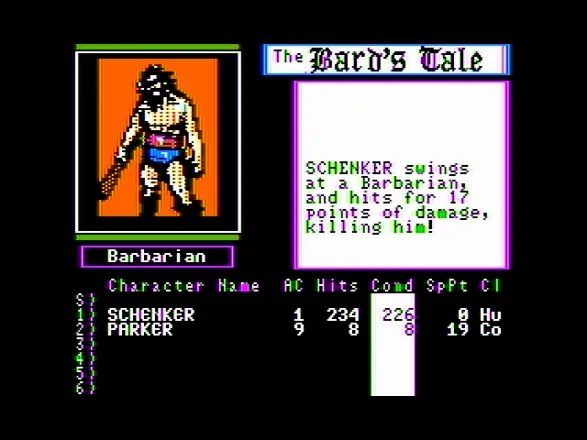
The difficulty curve deserves its reputation. Fresh parties die in the streets to barbarian mobs before they ever see a cellar; the early game is a grind of short expeditions and retreats, hoarding experience and gold until the party hardens. Then, somewhere in the sewers and the catacombs, the machine turns — your conjurers become magicians, your magicians become sorcerers, the spell list opens like a fan, and the game becomes a power fantasy conducted at map-making pace. Few RPGs of any era manage that arc from vermin to demigods as completely, and the sequels — The Destiny Knight and Thief of Fate — would build a trilogy on the foundation, letting parties travel onward, as would the much later fourth game and the modern remastered trilogy, which introduced many players to Skara Brae for the first time.
The template set here ran for a decade. Two sequels followed on the Apple II — The Destiny Knight and Thief of Fate, the latter designed by Cranford himself — and the series’ later Construction Set let players build their own scenarios in this engine, an early vote of confidence in user-made dungeons. Interplay’s fortunes, and eventually a whole genre’s grammar of town, guild, shoppe, dungeon and escalating spell tiers, trace back to the winter Cranford’s Skara Brae spent snowed in. Modern reissues and the 2018 remastered trilogy have carried the Apple II original’s design to new machines intact, which tells you the important thing: the graphics dated, the structure didn’t.
Verdict

On the Apple II, The Bard’s Tale is the moment the computer RPG grew a city, a soundtrack-in-a-character-class and a sense of scale. Its grind is real, its mazes are malicious and its disk drive symphony is period-authentic, but its party-building, its spell system and its sheer generosity of content set the template that the Gold Box games and a hundred others would follow. If Wizardry invented the form, this is the game that made it sing — literally, provided somebody buys the bard a drink.
Score: 9.0/10 — At a glance: Developer Interplay / Electronic Arts · Year 1985 · Genre First-person party RPG · Six adventurers, one bard, zero mercy from the map.