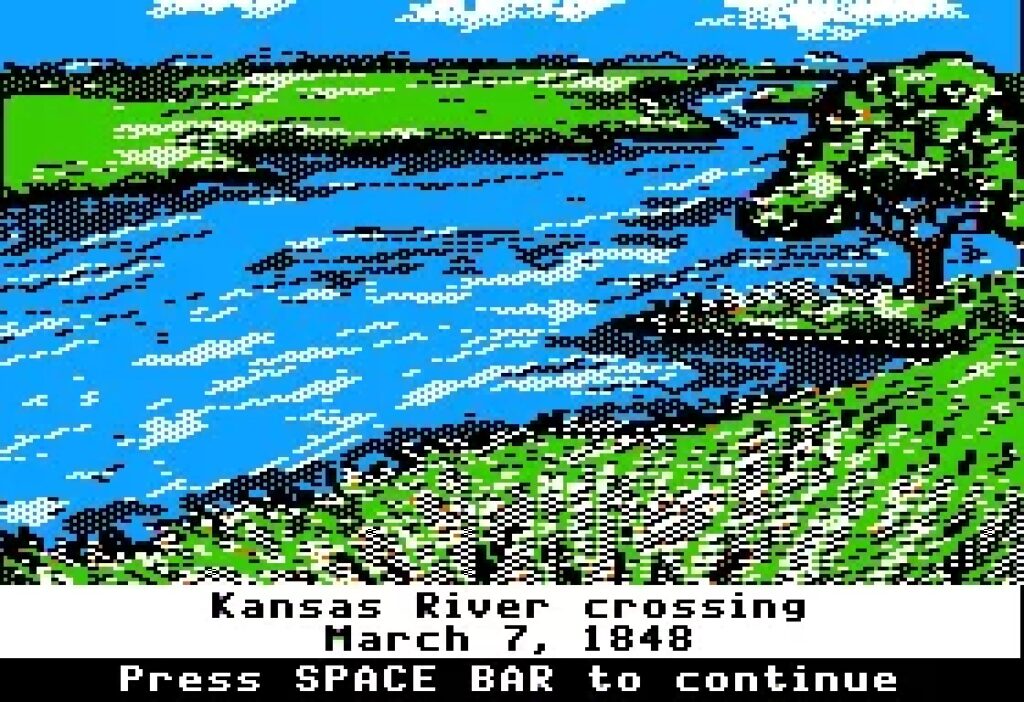
Every generation has a first computer game, and for an enormous slice of America that game began with a simple question: do you want to be a banker, a carpenter, or a farmer? The Oregon Trail, in the graphical Apple II version MECC released in 1985, was waiting in classrooms and school computer labs across the country, and it taught a generation two things at once — how the pioneers crossed a continent, and how quickly a promising expedition can fall apart because somebody packed grandfather clocks instead of food. Revisited today, on the machine it was built for, it remains a remarkably complete little simulation: part resource manager, part hunting game, part travelling obituary generator.
The 1985 game was a ground-up reimagining of a text-only program first written in 1971 by student teachers Don Rawitsch, Bill Heinemann and Paul Dillenberger, and later distributed by MECC, the Minnesota Educational Computing Consortium. Lead designer R. Philip Bouchard and a small team — programmer John Krenz and artist Charolyn Kapplinger among them — spent around ten months rebuilding it for the Apple II as MECC’s flagship push into the home market as well as schools. What they produced is the version everybody remembers: the little ox and wagon trundling across the travel screen, the landmarks ticking past, and the tombstones.
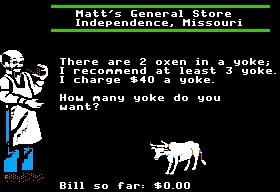
Outfitting at Independence
The game opens in Independence, Missouri, in the spring of 1848, and its first decision is its most quietly brilliant. Your starting profession sets both your money and your final score multiplier: the banker starts rich and scores least, the farmer starts poor and scores triple. It is a difficulty selector disguised as a role-playing choice, and children absorbed it instantly. Then comes Matt’s General Store and the real game — oxen, food, clothing, ammunition and spare parts, weighed against a budget that never quite stretches. Buy too little food and your party starves by Fort Laramie. Skimp on spare wagon wheels and axles and the trail will collect its debt in the middle of nowhere, with nobody passing by to help.
From there the journey settles into its famous rhythm. Each day the wagon rolls, the date advances, the weather turns, and the game reports the state of the expedition in a dry little status block: food remaining, miles travelled, health, pace and rations. Those last two settings are the game’s beating heart. Push a gruelling pace on meagre rations and you will make superb time — right up until the sickness messages begin. Slow to a steady pace with filling meals and you will watch the calendar eat your winter margin. The simulation underneath is simple, but the trade-off it creates is genuine, and it is different on every run because the random events — storms, snakebites, broken limbs, thieves in the night — never quite repeat themselves.
Hunting, Rivers and Hard Choices
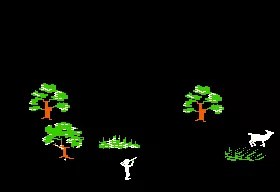
The hunting mini-game is the moment every classroom session came alive. Sent out with your rifle, you steer a hunter around a scrolling landscape and shoot buffalo, bears, deer and rabbits — then discover the game’s neatest moral mechanism: no matter how much you kill, you can only carry a limited weight of meat back to the wagon. The excess rots where it fell. It is a conservation lesson delivered without a single word of preaching, and it made young players into surprisingly disciplined hunters. Ammunition, meanwhile, is a finite resource bought back at Independence, so every hunting trip is also a small budget decision.
The river crossings supply the drama. At the Kansas, the Big Blue, the Snake and others, you choose: ford it, caulk the wagon and float it, hire a ferry where one exists, hire a guide, or wait for conditions to improve while your food drains away. Every option is a gamble priced in days, supplies or drowned oxen, and the Snake River crossing in particular has ended more expeditions than every disease in the game combined. The famous diseases, of course, get the headlines — dysentery above all, which became so synonymous with the game that it survives as a punchline forty years later — but cholera, typhoid, measles and good old-fashioned exhaustion all stalk the party list, and the blunt announcement that a named member of your own party has died still lands. Those names, typed in by the player at the start, are the masterstroke: losing “Mum” or your best friend from third period hurts in a way no anonymous settler ever could.
A Classroom Fixture and a Second Life
It is worth pausing on how thoroughly the Apple II version colonised its environment. MECC’s business was education, and its distribution put The Oregon Trail into American schools at exactly the moment schools were filling their first computer labs — very often with Apple IIs bought for the purpose. The loop was self-reinforcing: the machine schools owned ran the program schools taught with, and a generation’s first computing memory became a covered wagon, a river and a tombstone. Later generations of the game — the graphical remakes of the 1990s, the handheld and phone versions, Gameloft’s well-regarded 2021 reimagining — all redraw the same itinerary this version fixed: Independence, the rivers, the forts, the mountains, the valley. Even the phrase the culture kept, “You have died of dysentery,” is the mainframe game’s line, made immortal by being read aloud in a classroom off an Apple II screen. Plenty of educational software was worthy. This one was also a game — tense, funny, quietly brutal — and that double identity is why it, specifically, is the one people still play.
The Apple II Version Specifically
It matters that this is the Apple II original. The hi-res graphics are spare but characterful — Kapplinger’s landmark illustrations, the animated travel screen, the stark tombstone that marks a death along the trail and stays there for the next traveller in some versions of the lineage. The sound is honest Apple II speaker work: clicks, beeps and the crack of the hunting rifle. Load times between segments remind you this is a floppy-disk production, but the structure — short, snappy scenes between stretches of travel — suits the hardware perfectly. Later ports added colour and polish; none improved the essential loop, and the monochrome-green school-lab memory most players carry is of precisely this version.
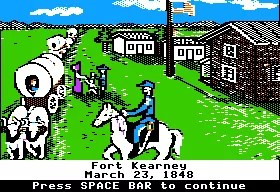
Underneath the charm sits a stricter strategy game than its reputation suggests. Pace and rations are a two-axis risk dial you are constantly re-solving: gruelling pace on meagre rations eats health quietly until the oxen fold; steady pace on filling rations is safe but burns the calendar, and the mountains in November do not forgive a slow September. The hunting mini-game is an economy in miniature — bullets cost money, a bison is more meat than you can carry, and every hour spent shooting is an hour not travelling. The crossings ask for genuine judgment with incomplete information, the game’s signature move: the manual cannot tell you the river’s mood today. Modern players sometimes call the game luck-driven; the veterans know the luck is bounded, and that the bounds are the game. A banker with spare clothes, dry powder and a caulked wagon beats the dice far more often than not.
Verdict
Played cold today, The Oregon Trail is short, luck-heavy and occasionally cruel — a run can be doomed by events no planning could prevent, and veterans will exhaust its surprises within a few journeys. But as a piece of design it is close to perfect for its purpose: every system teaches something, every decision costs something, and the whole brutal arithmetic of the emigrant road is compressed into sessions a child could finish in a class period and an adult can still lose an evening to. It is not merely an educational game that was fun despite itself; it is a genuinely good survival strategy game that happened to live in schools. The banker still takes the ferry. The farmer still prays at the Snake River. And dysentery, inevitably, still gets somebody.
Score: 8.5/10 — At a glance: Developer MECC · Year 1985 · Genre Educational strategy / survival · The classroom classic in its definitive original form.