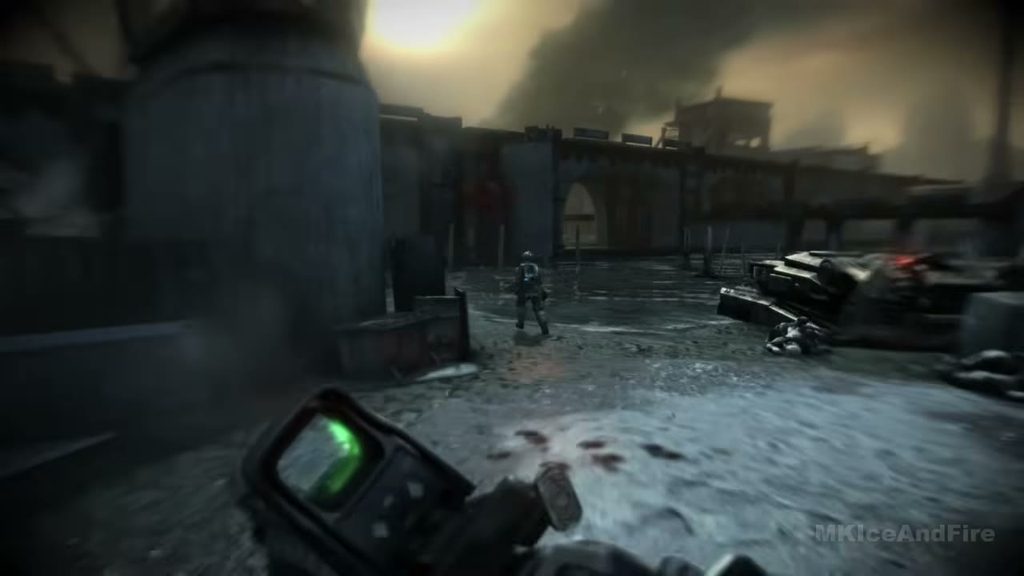
At a glance: Killzone 2 · PlayStation 3 · Guerrilla Games / Sony Computer Entertainment, 2009 · First-person shooter · Score: 9.0/10
No game carried more baggage onto the PlayStation 3 than Killzone 2. The notorious 2005 E3 trailer — a pre-rendered fantasy presented a little too confidently as the future — made Guerrilla’s sequel a referendum on the console itself. Four years later, in February 2009, the game that actually shipped did something nobody expected: it got close enough to the fantasy that the argument changed. Killzone 2 was the PS3’s graphical thunderbolt, a first-person shooter of unprecedented weight, texture and atmosphere. Revisited today, it remains the most physically convincing shooter of its generation — and the purest war film the console ever produced.
Down to Helghan
The setup is a deliberate inversion. Humanity’s ISA, the victims of the first game’s invasion, take the war home to the Helghast homeworld — a poisoned industrial hell of lightning storms, slag deserts and cities built like bunkers. You are Tomas Sevchenko, Alpha Squad, dropped into the capital Pyrrhus in a full-scale planetary assault. The story is military science fiction with the politics left deliberately uncomfortable: the ISA are invaders here, the Helghast are defending their home, and the game’s best writing is in that dissonance — in Colonel Radec’s terrifying professionalism, in Emperor Visari’s broadcasts, in a squad whose bravado curdles as the campaign darkens toward its famous, bitter final objective. It is not a subtle script, but it has a point of view, which most shooters of the era did not.

Weight as a design philosophy
Everything in Killzone 2 has mass. Guns recoil, reload and shoulder with an animation budget that borders on the obsessive. Turning carries momentum; sprinting into cover lands with a thud; the camera is bolted to a body, not a floating gun. Critics at the time called the aiming heavy, even laggy, and Guerrilla tuned it post-launch — but the heaviness is the identity. The Helghast advance through it with the generation’s best enemy animation: they scramble, vault, suppress, react to hits limb by limb, and die with a physical conviction that made every firefight feel like an event. The deferred rendering engine pours light through smoke and dust in a way the PS3 was not supposed to manage, and the colour palette — gunmetal, rust, and the red glow of Helghast eyes in the murk — is a masterclass in restraint. Those eyes, incidentally, remain the most effective enemy design of the era: you read the battlefield by them.
Other shooters made you feel like a camera with a gun. Killzone 2 made you feel like a hundred kilos of armour, ammunition and bad decisions, arriving somewhere hostile at speed.
A campaign of sieges
The single-player campaign runs about eight hours and is structured as a series of sieges rather than levels: the beachhead, the bridge, the desert crossing with its exoskeleton sequence, the train — a full level fought along a speeding armoured train in a lightning storm, still astonishing — the academy, and the palace assault that closes the game in a two-stage finale against Radec that players either revere or resent for its difficulty spike. Set-piece variety is high, turret and vehicle sections are mercifully short, and the whole campaign has a grim momentum that modern military shooters, with their globe-trotting variety packs, rarely match. The cover system — first-person, lean-and-peek, borrowed boldly from the game’s own identity — rewards patience and punishes the sprint-and-spray habits other games taught.

Warzone: the multiplayer that deserved longer
The multiplayer, Warzone, was a generation-defining mode hiding in plain sight: a single continuous match that cycled through objectives — assassination, search and destroy, capture and hold — without ever returning to a lobby, on maps remixed from the campaign, with a class system of badges that let players build hybrid roles. It was superb, and it built a devoted community. Its servers closed in 2018, so the disc today is campaign-only; that is a real loss to record, and it is the main reason the modern Killzone 2 experience, excellent as it is, is a reduced one. The campaign alone, however, was always the headline act.
How it holds up
Remarkably well. The frame rate targets thirty and holds it with a stubbornness rare in PS3 shooters; the image is soft by modern standards but the art direction — all industrial gothic and electrical storms — converts softness into atmosphere. The controls, once controversial, now feel like a stylistic ancestor of every weighty shooter since. What has dated is only the checkpointing in two late fights and a squad-mate who needs reviving at dramatically inconvenient moments. The rest is granite.

The sound of a war being lost slowly
Two things deserve more credit than they usually get. The first is the sound. Killzone 2’s audio is mixed like a war film: weapons have genuine low-end violence, Helghast voices bark through respirators with positional menace, and Joris de Man’s orchestral score — recorded with full orchestra and choir — gives the invasion the weight of a requiem rather than a recruitment advert. Play it loud and the famous bridge defence becomes almost physically exhausting. The second is the game’s relationship with its own hype. That 2005 trailer hung over Guerrilla for four years, and the smartest thing the studio did was refuse to chase it shot for shot. Instead they built an engine around deferred rendering, destruction and animation density — things that made the real game feel like the trailer’s promise translated into physics. The result did not merely review well; it reset what PS3 owners believed their machine could do, in the same month the console finally had the library to back the belief up. Killzone 2, inFamous, Uncharted 2 and Demon’s Souls all landed in 2009: that was the year the PS3 stopped apologising. This was its loudest argument.
The Dutch masters
A closing credit, too, to where it came from: Guerrilla was a mid-sized Amsterdam studio whose first Killzone had been greeted as an overhyped also-ran, and Sony’s decision to hand them the console’s reputation — and a budget to match — was the kind of bet platform holders rarely make twice. The studio’s response was to rebuild everything: engine, animation pipeline, audio, and its own culture, importing film-industry discipline into a game team years before that was standard practice. The same engine and ethos then powered the rest of the PS3’s shooter library through shared technology, and the studio eventually walked away from Helghan to build one of the defining open-world series of the next generation. Killzone 2 is the hinge of that whole story: the moment a studio, and a console, stopped being a punchline about a trailer and became the standard everyone else had to answer. The red eyes in the murk were the point of the exercise. They still glow.
The verdict
Killzone 2 is the PS3’s definitive first-person shooter: the game that answered the console’s most embarrassing hype cycle with a campaign of genuine weight, artistry and menace, and a visual standard the generation chased for years. Its multiplayer is gone and mourned; its campaign is forever. Essential.
Score: 9.0/10 — Heavy, hostile and beautiful. The shooter the PS3 was promised, delivered.