
At a glance: Kirby: Canvas Curse · Nintendo DS · Nintendo, 2005 · Platformer · Score: 8.5/10
Most platform heroes get legs. Kirby, in HAL Laboratory’s 2005 DS experiment Canvas Curse, gets turned into a ball by the witch Drawcia, loses his limbs entirely, and must be escorted through Dream Land by you — armed with the Magical Paintbrush, which is to say your stylus, drawing rainbow lines in the air that a rolling Kirby obeys like roads. It is one of the purest expressions of the DS concept ever shipped: a platform game you do not so much control as conduct, in which the level, the vehicle and the shield are all the same drawn line.
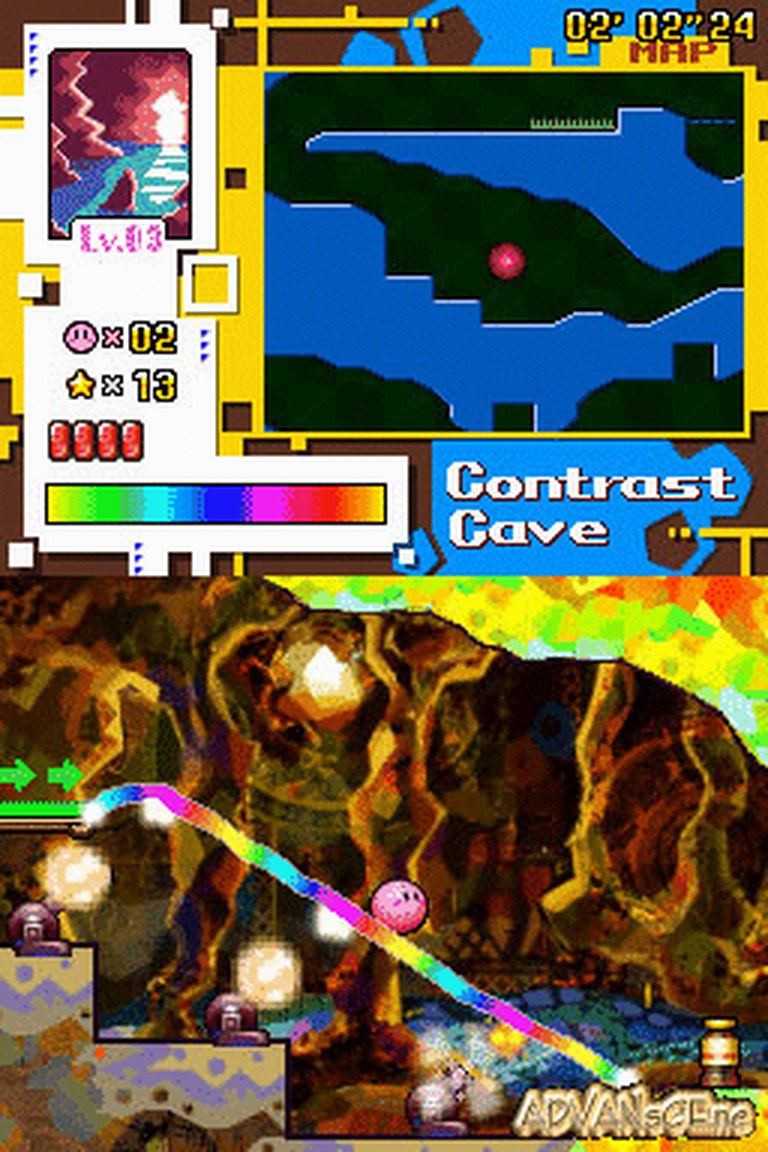
The mechanics take a minute to learn and a game to master. Kirby rolls with momentum; tap him for a dash, tap enemies to stun them, and draw lines to carry him over spikes, up walls and around loops. The rainbow ink is a resource — the gauge refills over time — so greedy drawing strands you mid-gap, while economical, elegant lines feel like calligraphy at speed. Copy abilities survive the transformation: wheel, stone, balloon and tornado forms change Kirby’s physics delightfully, and the game keeps introducing terrain — lava, water currents, wind, darkness lit only by your brush’s glow — that re-teaches the brush new tricks across its eight worlds.
The level is what you draw
Canvas Curse’s levels are less designed courses than designed provocations. A chasm is a question: bridge it straight, or draw a ramp and arrive with speed? A wall of enemies asks whether you will rail over them or dash through with a stunned path. Boss fights extend the idea — including a recurring duel with a paint-roller knight and a final confrontation with Drawcia herself that shifts genre more than once, ending in a sequence that asks everything the game has taught you, at speed, with the screen against you. Few platformers of any era hand the player this much authorship over traversal.
The medal economy gives mastery a ledger. Stages hide medals earned through speed, daring and thoroughness; Rainbow Run mode converts every level into time-trial and line-trial challenges (finish using as little ink as possible — a puzzle of restraint that recontextualises every screen); and unlockables, including playable Meta Knight and King Dedede in ball form, extend the cartridge far past its brisk campaign. It is a small game with the replay architecture of a much larger one.
Painted presentation
Visually, Canvas Curse is a storybook in motion: flat, saturated colour, worlds themed as paintings and palettes, and a Kirby who is quite literally a circle with a face, the character reduced to his purest geometry — and somehow at his most expressive, squashing and stretching as he rolls. The soundtrack remixes series classics with a lightness that matches the brushwork. Performance is flawless, as it must be: a game about drawing physics cannot afford a stutter, and HAL’s engine never delivers one.
You do not play Kirby in Canvas Curse — you draw the world under him, one rainbow at a time, and hope your ink lasts the gap.
The honest caveats: the campaign is short, the difficulty gentle until the final world, and players who want direct control of their hero will chafe at Kirby’s momentum-driven independence — misjudged lines and runaway rolls are the price of the concept. But the concept is the point. This is the rare licensed sequel that reimagines its hero from first principles around new hardware, and lands the idea almost perfectly.
Ink economy and the art of the line
The ink gauge is the design’s quiet genius, and it deserves the spotlight. Because the rainbow refills only when Kirby is grounded or the brush is lifted, every line is a small budgeting decision: a lavish spiral staircase feels wonderful and leaves you defenceless; a single confident stroke across a chasm is both faster and cheaper. Line trials make this economy explicit, but it operates in every second of normal play, giving Canvas Curse a resource tension that traditional platformers — where movement is free — never have. Add the dash’s momentum rules (a tapped Kirby keeps his speed and can smash through blocks and stunned enemies) and the game develops a speedrunner’s grammar of risk: where to spend, where to coast, where to let physics do the drawing for you.
Its place in the Kirby canon is secure and singular. HAL has returned to experiments since — Mass Attack’s ten-Kirby herding, the yarn and clay of the Wii and 3DS outings — but Canvas Curse remains the purest of them, the one where a single input idea reorganises everything the series knew about itself. It also remains, unavoidably, a game that only this hardware could have hosted in this form; its Wii U Virtual Console re-release, stylus and all, underlined the point. Some classics are portable. This one is a native.
It is also worth saying plainly who this game is for: anyone who believes control schemes can be ideas. Canvas Curse is the answer to a question the industry rarely asks — what if the player’s hand, not the character, were the hero? — and its rainbow lines remain one of the most readable, joyful visual signatures in the medium. Short it may be; slight it is not. The cartridge belongs in the first rank of any DS collection, and in the first paragraph of any history of touch gaming.

Playing it today
Copies are easy to find and kinder to the wallet than most first-party DS classics, and the game asks for nothing but a healthy touch screen — its one non-negotiable, since the whole world is drawn. Parents should know it is also among the finest first games ever made for young players: no reading burden, no punishment worth the name, and a creative verb — drawing — that children understand before they understand controllers. That a game can be simultaneously an avant-garde design statement and a perfect first cartridge is the most Kirby thing imaginable. The pink ball contains multitudes.
Technically, the game is a small marvel of restraint: no 3D, no licensed spectacle, just a physics system for a rolling ball, an ink system for a drawn line, and art direction confident enough to let flat colour carry worlds. That restraint is why it has aged so gracefully — there is nothing in it to date except its ideas, and its ideas remain startling. Played today on a big-screened DSi XL, stylus in hand, Canvas Curse feels less like a 2005 experiment and more like a message from a branch of gaming history that deserved more explorers.
Verdict
Canvas Curse is one of the essential early DS games and still one of its most distinctive: a platformer about drawing, built on momentum, ink management and nerve. It is short, sweet and endlessly replayable in its challenge modes — a watercolour sketch of a game that turns out, on inspection, to be a master drawing. If the stylus era produced five classics, this is one of them.