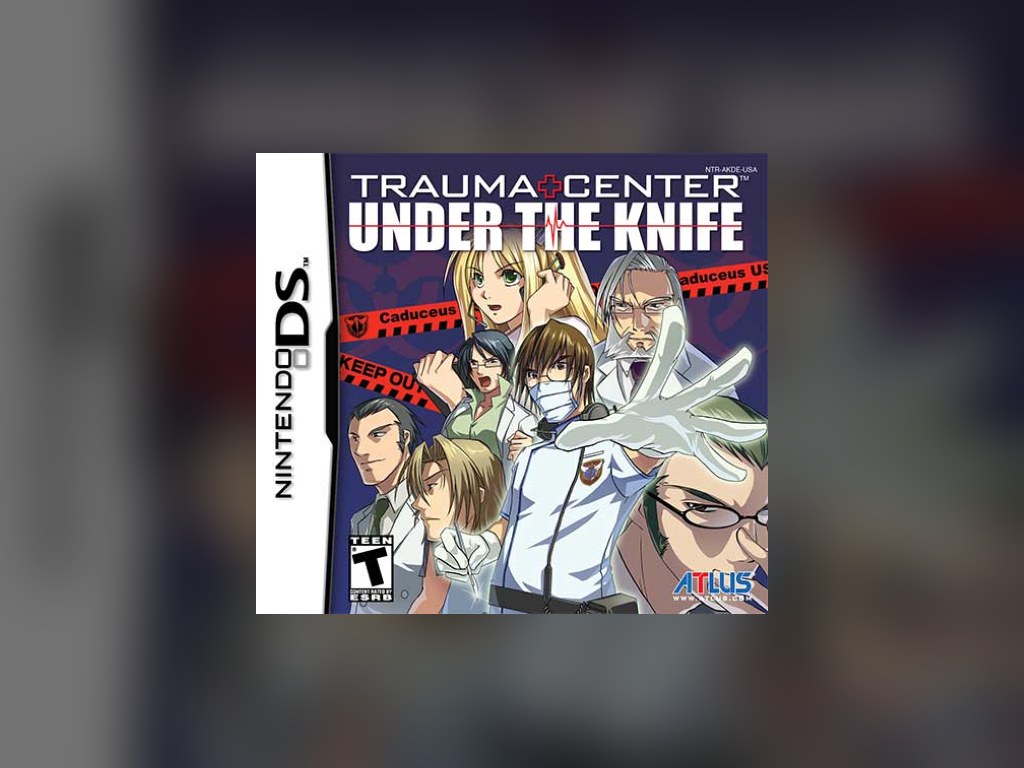
At a glance: Trauma Center: Under the Knife · Nintendo DS · Atlus, 2005 · Medical simulation / visual novel · Score: 8.0/10
Trauma Center: Under the Knife, from Atlus in 2005, might be the most improbable hit of the DS launch era: a game about performing surgery, in real time, with a stylus for a scalpel, interleaved with visual-novel drama about a young doctor with a supernatural gift. You are Derek Stiles, a well-meaning surgeon at Hope Hospital whose carelessness nearly kills a patient in the opening chapter — and whose response to failure is to grow, operation by operation, into the one doctor who can fight GUILT, a engineered plague of parasitic diseases unleashed by a death cult. It is Grey’s Anatomy crossed with an arcade cabinet, and it is riveting.
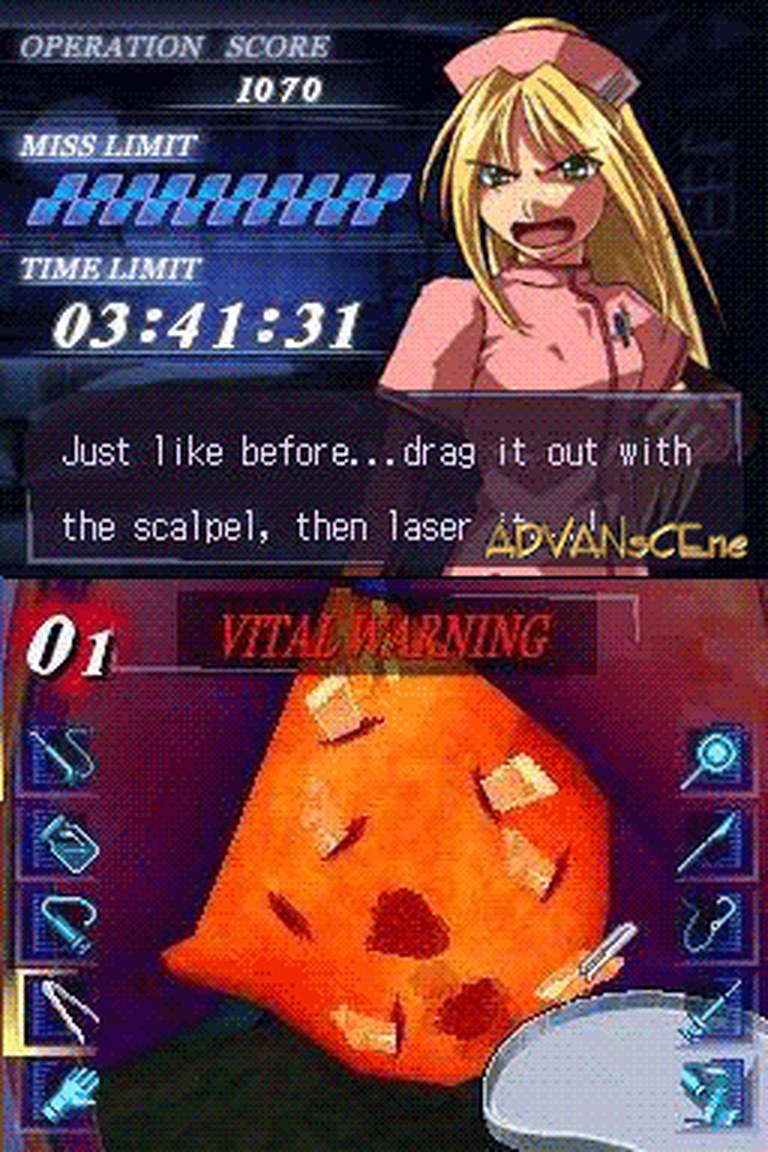
Operations are the game, and they are structured like boss fights with scalpels. Each surgery is a sequence of timed procedures on the touch screen: make the incision, drain the blood, excise the tumour, laser the parasites, suture the wound — drawing, tapping, sliding and circling with tools selected from a radial menu, while the patient’s vitals tick down on the top screen and your nurse’s warnings sharpen. Every tool has a physical grammar the stylus makes intuitive: stitches are zigzags, ultrasound is a sweep, the antibiotic gel is a soothing smear you will apply, in later operations, with the desperation of a man bailing a boat.

The Healing Touch
Derek’s gift — the Healing Touch, a moment of supernatural concentration that slows time — is the game’s mechanical and moral centre. Draw a star on the screen and the operation slows to a crawl, letting you perform the impossible: suturing a rupturing aneurysm, extracting glass from a heart, fighting GUILT strains that regenerate faster than any human could cut. Each GUILT parasite is a puzzle in surgical form — Kyriaki’s darting cuts, Deftera’s paired tumours, Triti’s thorned membranes that must be unpinned in the right order — and the late operations stack them into endurance trials that remain, even for veterans, genuinely palm-sweating.
The ranking system (operations graded up to the coveted S and XS ranks) and unlockable challenge operations give the campaign a score-attack afterlife, and the story between surgeries earns its place: Derek’s arc from careless to committed, his nurse Angie Thompson’s steel, and the game’s earnest argument that medicine is a moral practice, not a technical one, land with surprising force. This is a game that will make you feel guilty about a fictional patient’s vitals alarm. That is not a small achievement.
Where the patient crashes
Under the Knife’s difficulty is its legend and its flaw. The difficulty curve is less a curve than a cliff face in the middle chapters, where multi-stage GUILT operations demand near-perfect execution, memorised sequences and a little luck with vitals — and the DS’s small screen makes precise work on tiny targets fiddly under pressure. The Wii remake, Second Opinion, sanded some of this down; the DS original is the raw, occasionally unfair article. Players should know the game will, at least twice, make them want to put the stylus through the screen it is scratching.
No other game makes you draw a pentagram to slow down time in the middle of open-heart surgery — and then makes you feel the weight of it.
Presentation serves the tension: clean, anime-styled character art, operations rendered in an abstract, blood-light style that keeps the game intense rather than gruesome, and a score of pulsing synths that quickens with the vitals monitor. It is, in every department, a game with a clear idea of itself.
A steady hand is a moral quality
What gives Under the Knife its staying power is the fusion of its systems with its theme. Every mechanic is a statement about care: the vitals meter is not a health bar but a person’s tolerance for your mistakes; the ranking system grades not flair but outcomes; the Healing Touch is literally empathy weaponised — Derek can slow time because he refuses, in the moment, to let someone die on his table. The GUILT arc, written in the shadow of real bioterror anxieties, gives the melodrama stakes beyond the personal, and the game’s insistence that the opposite of a death cult is a hospital — ordinary people doing careful work under pressure — lands harder with every passing year.
For the score-attack minded, the operation select and challenge missions (including operations against multiple GUILT strains under savage time limits) convert the campaign into a discipline of mastery, and the jump from a C rank to an S on the aneurysm operations is one of the DS’s most satisfying skill arcs. It is not a long game, but it is a deep one in the only way that matters here: you finish it a measurably steadier-handed player than you began, which is the game’s whole argument, proven on your own pulse.
Approach it, then, as what it is: an arcade surgeon’s trial by fire, with a heart. The early operations teach generously, the middle ones test severely, and the finale — a gauntlet of GUILT strains stacked like a boss rush with a scalpel — is one of the great difficulty climaxes of the DS library. Players who bounce off its cliffs should know the Wii remake softens them; players who conquer them will carry the peculiar, steady-handed pride forever. Few games leave you with a skill. This one leaves you with two.
Playing it today
The cartridge is inexpensive, plentiful and — one hardware note — demands an accurate touch screen more than any game in this collection, since late operations are examinations in millimetres. Played on a well-kept DS, it remains a singular thrill. Its sequels and remakes refined the formula on Wii and DS alike, but the original’s rawness is its character: the first time surgery became an arcade game, with all the brilliance and bruising that implies. Scrub in, steady your hand, and remember the game’s own first lesson — the patient believes in you. Operate like it.
The game’s afterlife confirms its quality: a Wii remake that expanded its story, a DS sequel that refined its systems, and a permanent place in the ‘games only this hardware could do’ canon that every DS retrospective eventually assembles. Under the Knife also quietly pioneered the visual-novel-plus-simulation hybrid structure that later narrative games would make fashionable. It did all of this while asking the player to hold a pen like a scalpel and mean it. There are more polished games on the DS. There are very few more original ones.
Verdict
Under the Knife is a singular experience: part arcade trial, part medical melodrama, wholly committed to the proposition that a stylus can be a scalpel and a steady hand a superpower. Its difficulty spikes are real, its later operations border on the unreasonable — and its best moments are like nothing else on the system. Scrub in. The patient is waiting, and the clock is already running.