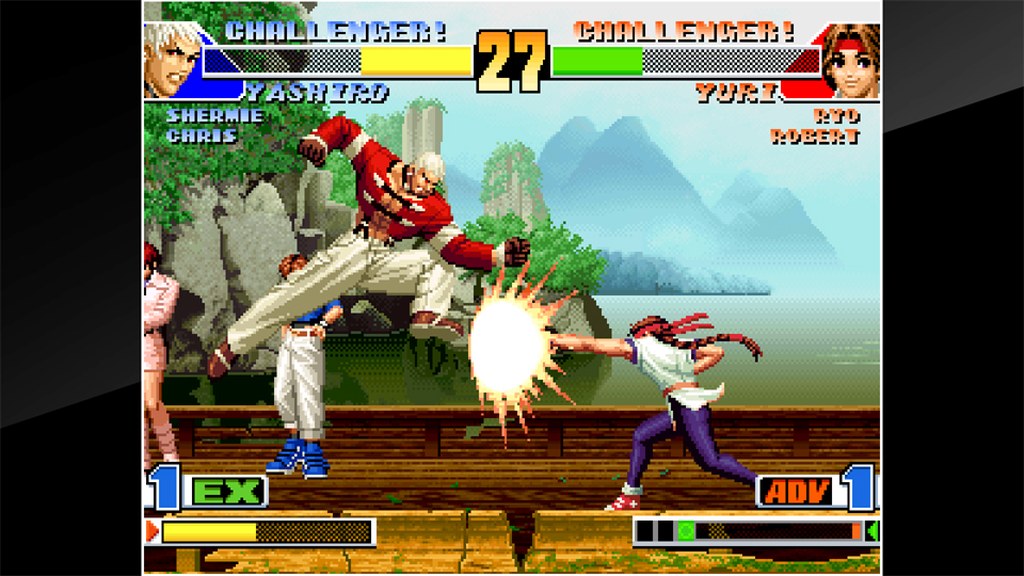
Most fighting games are remembered for what they added. The King of Fighters ’98 is remembered for what it refused to add: a story. After four years of the Orochi saga — ancient gods, possessed teenagers, tournament conspiracies — SNK looked at its flagship series in 1998 and made the boldest possible decision. No plot. No gimmick. Just thirty-eight of the best characters the series had ever produced, the two best fighting systems it had ever built, and a single instruction to the player: fight. The result is the dream match that never ages, a game still headlining tournament brackets decades after its release.
To understand why that restraint mattered, you have to remember what KOF had become by 1997. The series had grown baroque — strikers on the horizon, shifting rosters, and a storyline that required a flowchart. ’98 was a reset in the best sense. SNK billed it as a special edition, a festival, and that is exactly how it plays: like a room full of old friends who have all shown up in their best clothes, ready to settle old arguments.
Thirty-Eight Fighters, Almost No Dead Weight
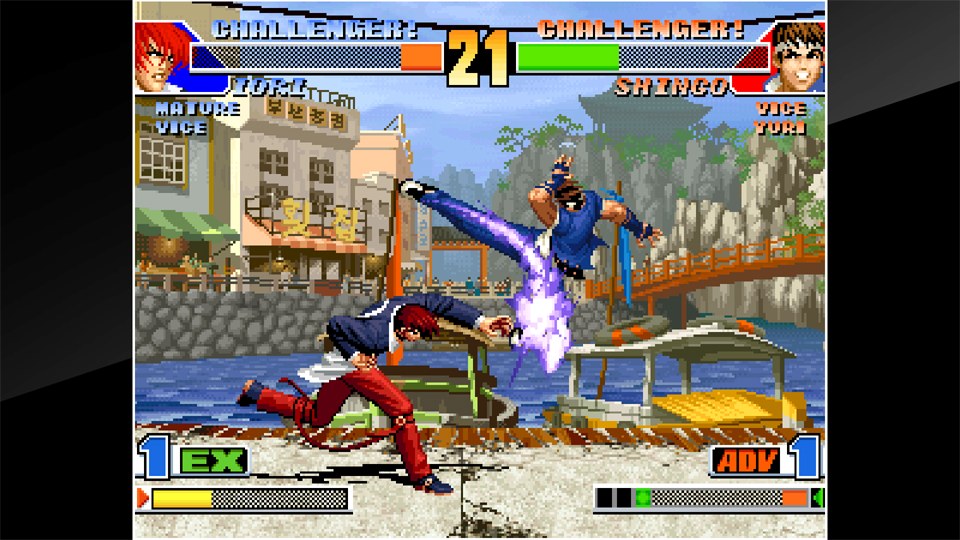
The roster remains staggering. Thirty-eight playable characters, organised into the series’ signature three-on-three teams, spanning KOF ’94 through ’97 plus beloved returns. Rugal Bernstein — the original SNK boss nightmare — is here. The American Sports Team, of all things, is here, Heavy D!, Lucky Glauber and Brian Battler finally getting their second day in the sun. Shingo Yabuki, Kyo’s earnest fanboy, fights with borrowed flames he can only sometimes produce. Even the Orochi versions of Leona and Iori lurk as alternate terrors.
What elevates ’98 above a simple all-star compilation is how seriously it takes the fighting itself. This is a roster where the tier list has been argued about for over twenty-five years precisely because so much of the cast can genuinely win. Iori and Daimon anchor most discussions of the top, but the middle of this roster is a war zone of viable specialists — Chris, Chizuru, Takuma, the other Kyo — and a skilled player with an unfashionable team can still ruin your afternoon. The three-character format does heavy lifting here: a weak matchup is a problem to be solved with team order, not a death sentence, and the mind games begin before the first round, when both players are deciding who leads and who anchors.
Two Systems, Both Right
KOF ’98’s other masterstroke is that it lets you choose your philosophy. Advanced mode, inherited from ’97, is the aggressor’s system: build a stock of power gauge by attacking, spend it on super moves, or pop MAX mode to raise your damage and unlock super desperation moves. Extra mode is the connoisseur’s alternative — charge your gauge manually, gain a super at full charge, and unlock the ability to dodge in place rather than roll, with your supers growing stronger as your health falls. Neither system is a novelty. Both saw serious tournament play, and the choice between them says something real about how you intend to fight.
Around those systems, ’98 tightens everything the series had been building toward. The hop — that short, threatening little jump that makes KOF’s pressure game so distinctive — is at its crispest here. Rolls, guard cancels, throws and command normals all interlock at a speed that feels reckless until you learn its grammar, at which point it feels inevitable. Matches between good players have a rhythm closer to basketball than boxing: constant motion, constant probing, sudden explosive scores.

A Festival in Every Pixel
SNK dressed the dream match like a celebration. Stages tour the world — a Japanese street festival, a Spanish plaza, an American dockyard, a Middle Eastern marketplace — each one dense with background detail and onlookers. Character portraits were redrawn with a confidence the series had never quite shown before, and the soundtrack raids the series’ back catalogue, giving returning teams their classic themes. The presentation secret, though, is the relationship system hiding under the character select: certain teammates like each other, some are indifferent, and some — poor Iori among his many enemies — actively resent their partners, affecting how willing they are to jump in and save a teammate from a beating. It is a tiny system that generates endless playground lore.
The Afterlife of a Dream Match
Here is the statistic that matters most: The King of Fighters ’98 never stopped being played. It anchored arcades in Japan, China, Korea, Mexico and Brazil long after the Neo Geo itself retired. It received a loving remake in Ultimate Match, it anchors online lobbies to this day through modern re-releases with rollback netcode, and it remains a fixture at major tournaments — a game from 1998 sitting comfortably alongside titles a quarter-century younger. That longevity is not nostalgia. It is what happens when a fighting game gets its fundamentals so right that generations of players keep finding new depth in them.
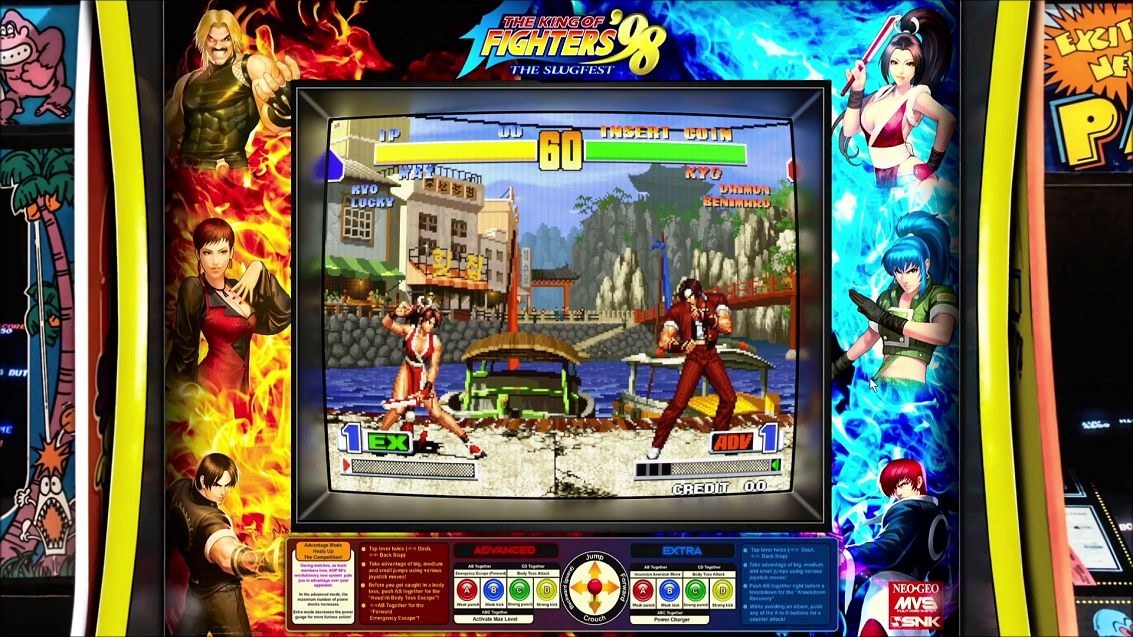
Later KOF games are bigger, flashier and far more complicated. None of them displaced this one. The King of Fighters ’98 is the series distilled — no story, no filler, nothing between you and thirty-eight of the finest fighting-game characters ever drawn. If the Neo Geo is a library of perfect arcade afternoons, this is the volume that falls open at its best page.
New Players Start Here
If you are coming to KOF ’98 fresh — perhaps from a modern entry, perhaps from the essentials lists on this site — the game asks more of you than a modern fighter and rewards you more honestly. Begin with the classic Hero Team of Kyo, Benimaru and Daimon: a fireball-and-pressure leader, a fast, versatile middle, and an anchor whose command throws can end a round in two decisions. Learn the hop until it is reflex, learn to roll through fireballs rather than away from them, and learn one reliable combo per character before you learn three. Then experiment, because ’98’s great pleasure is team-building — the discovery that your favourite awkward trio has a real game plan hiding in it. The training modes in modern re-releases make all of this kinder than it was in a 1998 arcade, where your education cost a coin per lesson and the local champion set the curriculum.
It is also worth saying what ’98 is not. It is not the prettiest KOF — Garou, reviewed elsewhere in this wave, out-draws it comfortably — and its single-player content is a product of its era: a ladder, team endings, and very little else. Everything here serves the versus game. That focus is precisely why the versus game has outlived almost everything built around it.
A closing thought on its famous sibling rivalry: the genre is full of all-star compilations, and almost all of them are footnotes. KOF ’98 avoided that fate by treating its festival as a responsibility rather than a victory lap — rebalancing veterans, honouring both of its fighting systems, and trusting that the characters, properly tuned, were celebration enough. That trust is why players in Osaka, Seoul, Mexico City and São Paulo never really left, and why a newcomer booting it today is not visiting a monument. They are joining a game that simply never ended.
Score: 9.5/10