At a glance: Centipede · ZX81 · dK’Tronics, 1982 · Fixed shooter · Score: 7.5/10
Atari’s Centipede was the connoisseur’s fixed shooter: not ranks of invaders but a single segmented creature winding down through a mushroom forest, splitting when shot, spawning side-threats — a spider bouncing through your territory, fleas, scorpions — in a garden that remembered every shot you fired. dK’Tronics brought it to the ZX81 in 1982 (catalogue model Z004, in the Brentwood house’s early range), and the conversion makes a claim most of the machine’s arcade ports cannot: that the ZX81’s character grid is not a limitation for this game but a translation of its native logic. Centipede thinks in cells. The mushroom forest is a grid. The creature’s famous behaviour — descend a row, reverse, drop again on hitting a mushroom — is a set of rules about squares. On a screen built from squares, dK’Tronics’ version plays its arcade ancestor with an honesty that glossier machines sometimes fumbled.
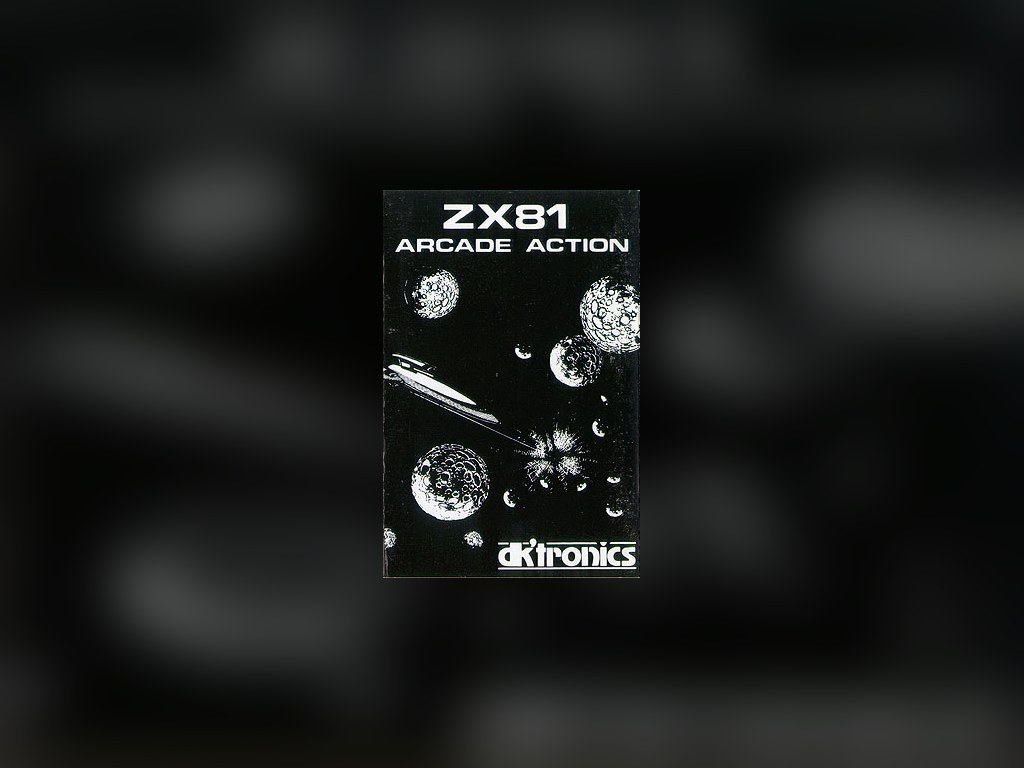
The publisher matters to the story. dK’Tronics — David and Howard’s electronics firm turned software-and-hardware house — was one of the ZX81’s defining companies, as much for its add-ons as its games: its memory expansions and its wedge-shaped RAM packs, shaped to fit the rear of the machine and secured so they stayed put, were the era’s practical answer to the dreaded RAM-pack wobble, and its graphics ROM promised the machine prettier invaders. A company that sold the cure for the ZX81’s most famous flaw also sold it Centipede: hardware people, making software for the machine they kept upright. The game sits in Sinclair User’s first issue among the dK’Tronics adverts — Deflex, the 3D Labyrinth, Centipede, Space Invaders — a whole ecosystem in a single page.

A garden of squares
The mushroom field is Centipede’s soul, and it survives translation best. Every mushroom is a cell state on the grid; shot mushrooms partially break; the creature reads the field as it descends, dropping and turning on contact, so the garden you have damaged becomes the machine the centipede navigates. Shoot the centipede amidships and it becomes two shorter problems. The player’s own territory — the bottom band of the garden, where your shooter roams — hosts the spider, the game’s agent of panic, bouncing through on its diagonal errands to eat mushrooms and players alike. All of this the ZX81 renders in its character vocabulary without embarrassment: the creature segmented, the mushrooms planted, the action legible at speed, which is the whole battle on this hardware.
The period reception, filed in Spectrum Computing’s review archive, places the dK’Tronics conversion kindly: “an exciting version of the arcade game,” “like the original game in almost every way,” with three laser bases to spend, priced at £4.95 — and the later Crash verdict on the same conversion’s qualities called it addictive and good value, even amid reservations about standardness. That is the right register for the judgement. dK’Tronics’ Centipede is not an interpretation or a reinvention; it is a port, executed by a company that understood the host machine at the level of its circuit board, of one of the best-designed shooters ever made. Faithfulness was the assignment, and faithfulness is what the cassette delivers.
The centipede reads the mushroom field like a machine reading a tape. On the ZX81 — a computer that thinks in character cells — Atari’s garden logic came home to the hardware that understood it best.
The hardware house’s shooter
There is a pleasing circularity in playing dK’Tronics software on a dK’Tronics-stabilised machine: the 16K this game needs sits in a pack that does not wobble, while the pack Sinclair sold threatened to end the session if the table was knocked. The company’s dual career — curing the machine’s flaws while feeding its appetite — is a capsule of the ZX81 economy, in which the computer was a platform, an ecosystem and a small industry within a year of its launch. Centipede is the software half of that story at its most playable: a first-rank arcade design, a first-rank hardware house, and a character grid doing what it was born to do.

Modern players will find the conversion brisk and fair, and the mushroom garden as readable as ever. The spider remains a menace, the split-creature problem remains the genre’s neatest puzzle, and the whole thing runs, as it always did, in silence — the garden’s only sound the faint hum of a television and the player’s own muttering.
The Brentwood ecosystem
dK’Tronics’ wider ZX81 story sharpens what the Centipede cassette represents. This was a company advertising, in the first issue of Sinclair User in April 1982, a complete environment for the machine: Deflex and the 3D Labyrinth among the games, Centipede and Space Invaders alongside them, and the 4K Graphics ROM — a hardware upgrade promising the little computer better invaders — elsewhere in the same pages. Hardware, upgrades and software from one house, for one wedge: dK’Tronics was building the ZX81’s first platform business, and its games were demonstrations as much as products. Centipede, catalogue model Z004, demonstrates the thesis best. A mushroom garden is a database of cell states; a segmented creature is a list; a character-mapped computer is, for this one design, not a poor relation of the arcade but a machine thinking in the game’s own units.
The conversion also illustrates the era’s licensing weather. Atari’s garden reached Brentwood in the years when arcade properties travelled by a mixture of licences, tolerance and nerve, and the ZX81’s Centipedes were plural — Llamasoft’s name appears in the catalogues alongside dK’Tronics’, and Kayde reissued the game — a small crowd of centipedes for one small machine, of which the dK’Tronics is the hardware house’s own and the one the review archive treats at length. The ZX81 owner of 1982 choosing between them was participating in a market the industry has since tidied away: multiple honest conversions of the same hit, competing on feel. The feel here — three bases, the splitting creature, the garden that fights back by geometry — is the arcade’s, faithfully carried.
Playing it in 2026
The dK’Tronics conversion is preserved in the standard archives — filed under its several inlay variants, green cover and all — and it remains the fastest way to understand this review’s thesis. Ten minutes in the mushroom garden, watching the creature read your damage and split under your fire, teaches more about the ZX81’s character-cell intelligence than any specification sheet. Play it on a real wedge with a steady RAM pack if you can; play it in emulation without hesitation if you cannot. The garden has not aged. It was always a garden of squares, and squares do not date.
Verdict
dK’Tronics’ Centipede is the ZX81 arcade port at its most faithful: Atari’s segmented, garden-logic masterpiece translated into character cells by the hardware house that knew the machine best. It does not reinvent anything, and it does not have to — the design it carries is one of the great ones, and the ZX81, for once, is the perfect shape to hold it.

Score: 7.5/10 — A grid game on a grid computer: the most natural arcade conversion the ZX81 ever received.