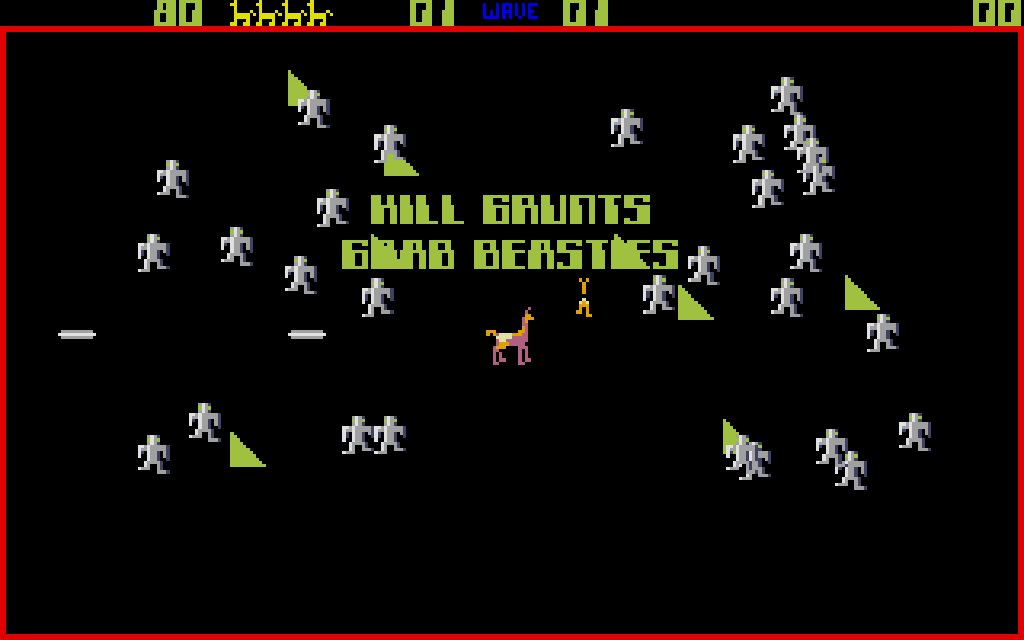
At a glance: Llamatron: 2112 · Atari ST · Jeff Minter / Llamasoft, 1991 · Arena shooter · Score: 8.5/10
Jeff Minter looked at Robotron: 2084, the arcade’s purest panic machine, and asked what it lacked. The answer, obviously, was llamas. Llamatron: 2112 puts you in control of a laser-spitting llama defending sheep, goats and camels — the “dudes” — against waves of the worst things Minter’s bathroom-mirror imagination could supply: rogue Coke cans, toilet seats, space invaders parodied and weaponised, and the dreaded Grunts, whose only desire is to form a conga line of death across the screen. It is a shareware game, sold on an honour system with a suggested price and a famous plea to register, and it is one of the finest arcade games on the Atari ST.
The Robotron inheritance is honoured precisely. Twin-control movement and firing — on the ST, a single joystick with an autofire rhythm you learn like a drum pattern — in a single-screen arena where the enemies pour in geometric escalations and the dudes wander the crossfire waiting to be herded to safety for bonus points. Everything Robotron understood, Llamatron understands: the arena must always be one second from collapse, the player’s attention is the real resource, and a wave cleared with the last dude saved tastes better than a wave merely survived. Minter adds his own systems — floating power-ups, the invulnerable Ozma wars, bonus stages, a screen that periodically inverts into a psychedelic mirror of itself — and tunes the whole to a difficulty curve that starts friendly and ends, around the level 60s, in pure screaming colour.

Yak’s arcade philosophy
What makes Llamatron more than a tribute is the sensibility saturating every pixel. The sprites are tiny, the colours are lurid, the sound effects — sampled bleats, zaps and explosions squeezed through the ST with more life than the hardware usually allowed — turn each wave into barnyard warfare. Minter’s humour is in the mechanics, not pasted on: saving dudes matters because the game loves them, the Grunts are funny until they are terrifying, and the whole production breathes the personality of one programmer with a vision involving ungulates. This was Llamasoft’s first great 16-bit statement after the 8-bit years, and it announced that the Yak had survived the transition with his weirdness fully weaponised.
Llamatron is a love letter to Robotron written by a llama farmer: mechanically reverent, spiritually unhinged, and faster than either has a right to be.
The shareware story is part of the artefact. Llamatron spread by disk-copying, magazine covermounts and word of mouth, with Minter asking a fiver from those who enjoyed it — and famously, enough people paid that the experiment was declared a success and an argument for honest software. On the ST, a machine whose public-domain and shareware scene was a culture in itself, Llamatron was its commercial-grade proof: a game as good as anything in a shop box, arriving by playground post. Playing it now on original hardware, ideally with the volume up and a crowd forming, recovers that whole economy of trust in one disc.

The fine print
The charges are the genre’s own. Single-screen arena shooting is a distilled taste: there are no levels to explore, no story to unfold, and a player unmoved by score attack has a short evening here. The single-joystick control scheme, while expertly tuned, asks your thumb to do twin-stick work and late waves will find any imprecision in it. The psychedelic inversions that delight veterans can genuinely disorient newcomers — that is their purpose — and the ST’s sampled effects, charming as they are, fight a losing battle against the aural chaos Minter clearly heard in his head. Shareware distribution also means versions vary; the 1-megabyte edition is the one to run, with its fuller sound.
None of it has kept Llamatron off the ST’s all-time lists, where it sits permanently among the machine’s best-loved games — ahead, in many polls, of titles that cost six times its asking price and had marketing departments. It is the purest arcade high-score game on the platform, a disc that turns any ST into a cabinet.

Reading the arena
Mastery in Llamatron is a literacy. The expert eye reads a new wave the way a chess player reads a position: where the Grunts will conga, which dudes are exposed, which corner the herd should be shepherded through, when the smart bomb of a power-up is worth dying next to. Minter’s waves are composed, not randomised — patterns with intentions, escalations with jokes in them — and learning the compositions is the campaign the game never has to announce. The dread mechanics reward nerve: a dude saved at the last pixel pays the same as one saved in safety, so the game forever tempts you to leave rescues late and shoot your way out of the consequences. Every great arena shooter lives in that temptation. Llamatron simply dresses it in livestock and Day-Glo.
The ST is an ideal home for it. Minter’s 16-bit code pushes sprites with an abandon the machine’s spec sheet disowns, the samples — bleats, warbles, explosions — arrive with a crunch the YM chip alone could never give, and the whole thing loads fast and plays faster, an arcade cabinet’s manners in a disk. Two-player support turns the arena into a duet of mutual rescue and mutual blame. And there is the matter of the man’s later career: the through-line from Llamatron’s pure, trance-like score attack to Minter’s celebrated modern work is unbroken, which makes this disc a foundation stone as well as a party piece. Play it and you are playing the first great statement of a designer who never stopped. The llama is patient. The Grunts are not.
For the uninitiated, the first evening’s curriculum is short and total: survive by moving in circles, rescue by touching, and never — whatever the bonus promises — let the Grunts complete their line in peace. Within three waves the hands understand; within ten, the eyes do; somewhere around the level where the toilet seats arrive in formation, the room you are playing in goes quiet in the way rooms go quiet around all great arcade games. That silence is Llamatron’s review, written nightly since 1991 by people who came to mock a shareware llama and stayed to defend a high score. The ST has bigger games, dearer games, more famous games. It has very few better machines for manufacturing that silence on demand.
Verdict
Llamatron: 2112 is essential: a master of the arcade form remaking its greatest hit in his own image, and somehow honouring both. It is funny, furious, generous and hard in exactly the proportions a score-attack game should be, and its shareware legend only sweetens the disc. If your ST does one party trick, make it this one — herd the dudes, fear the Grunts, and send the Yak his fiver. He earned it in 1991 and, frankly, he earns it every run.