At a glance: Oids · Atari ST · Dan Hewitt / FTL Games, 1987 · Gravity action · Score: 8.0/10
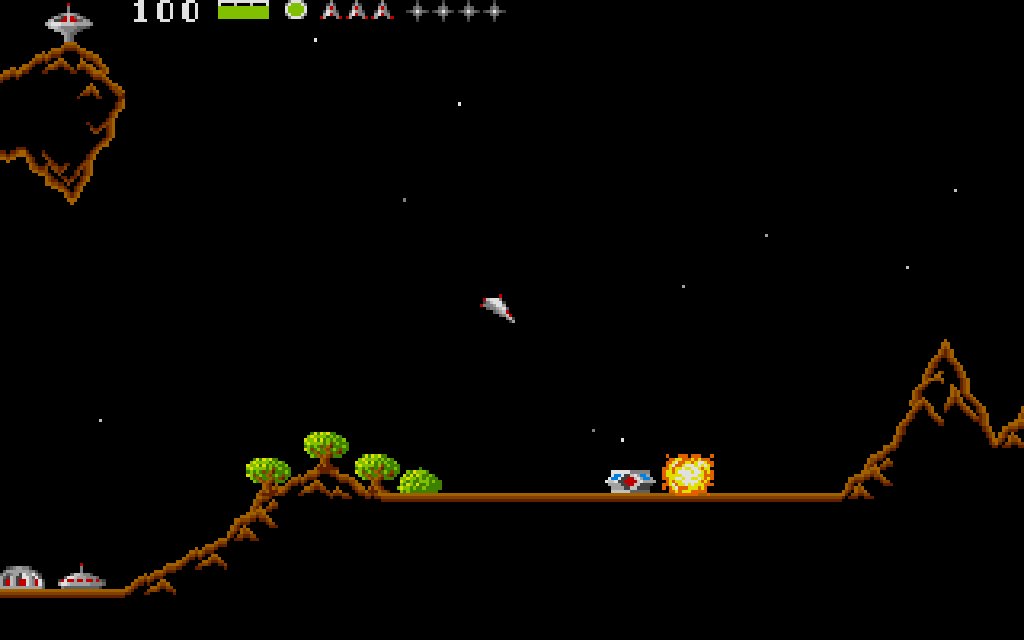
Before Dungeon Master made FTL famous, the same company shipped the ST’s first great gravity game. Oids, designed by Dan Hewitt, is the love child of Asteroids, Thrust and a rescue mission: your little V-wing fighter must liberate the enslaved Oids — small androids working the surface of a series of hostile planets — by blasting their factories’ defences, landing beside the freed workers, scooping them up and lifting them to the mothership, all while gravity pulls you toward the rocks and the planet’s guns pull you toward an early grave. It is a small game with perfect physics, and ST owners of 1987 talked about it the way arcade veterans talk about Gravitar: with respect, and a slight tremor.
The flight model is the whole game, and it is superb. Thrust, rotate, and a shield that doubles as your landing gear and your ramming excuse: the ship handles with a momentum that feels learned in the body rather than the manual. Planets are compact arenas of hills, caverns and installations — bi-nuclear power plants to destroy, missile batteries that track you, enemy fighters that rise to argue. The rescue loop adds the heart: an Oid waving on a ridge is a person, mechanically speaking — land too fast and you crush the very worker you came for; dally under fire with a full hold and the whole mission burns. Risk, tenderness and Newtonian physics in a 1987 arcade game is a cocktail few have mixed since.

A game that ships its own universe
Oids’ second genius is generosity. Beyond its galaxies of ready-made planets, the game includes a full construction kit: design your own planets — terrain, installations, gravity, enemy mix — save them, share them, build whole galaxies for friends to crack. In 1987, on a home micro, a level editor of this completeness was not a bonus feature; it was a statement about who games belonged to. The ST’s disk culture took the invitation exactly as intended, and player-made galaxies circulated through the public-domain scene for years, extending a compact arcade game into a community platform. FTL would change the world with Dungeon Master within the year; Oids shows the same studio’s instincts — systems, tools, player agency — already fully formed.
Oids trusts you with everything: its physics, its rescuees’ lives, and finally its own construction kit. Few arcade games have ever respected a player more.
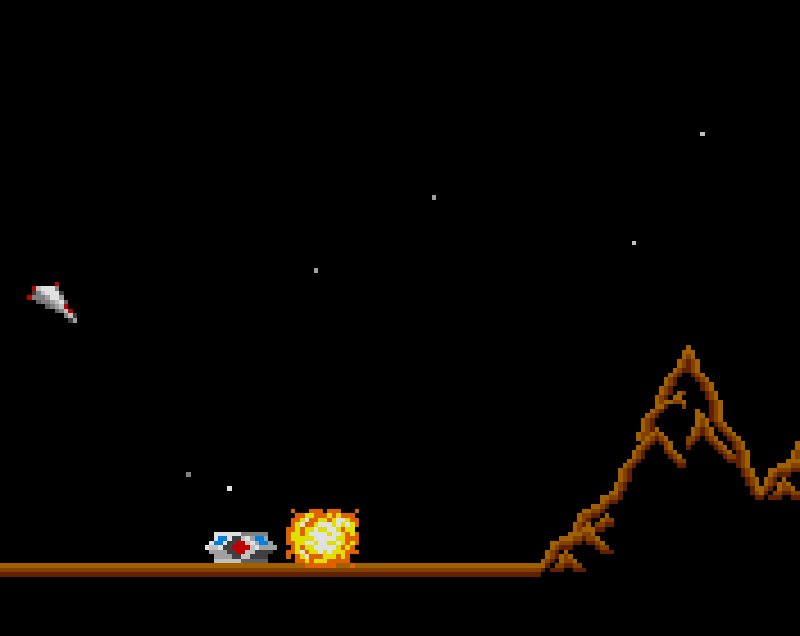
The presentation is early-ST in the best way: clean vector-adjacent sprites over black space and coloured terrain, fast and unfussy, with the screen devoted to the physics rather than decoration. Explosions bloom, the mothership waits at the top of the world like a promise, and the sound — spare YM thrusts and blasts — keeps your ears on the flying. Difficulty is the era’s honest kind: the first galaxy teaches, later galaxies examine, and the Biocrete planets of the advanced sets are examinations some pilots never pass. But the restart is instant, the planets are short, and the one-more-go pull of a perfect rescue run — every Oid aboard, hull intact, time to spare — is undimmed.

The fine print
Age shows in the expected places. The graphics are minimal even by 1987’s standards and primitive next to what the ST would do within two years; there is no music to speak of; and the difficulty of the later galaxies assumes a mastery of thrust-and-rotate flight that some players simply do not enjoy acquiring — gravity games are a temperament as much as a genre. The two-player alternating mode is a score contest rather than true cooperation, and the rescue formula, planet after planet, varies its terrain more than its terms. A modern player reared on gentler physics will bounce off the first cavern a dozen times before the handling clicks — though when it clicks, it tends to click permanently.
Oids’ reputation has travelled the way its galaxies did: hand to hand, enthusiast to enthusiast. It rarely headlines ST retrospectives against the Bitmap Brothers’ chrome or Singleton’s epics, which is precisely why it belongs in a collection like this one — a founding FTL artefact, a physics game of real elegance, and a reminder that the ST’s first year already contained classics.
The FTL pattern
Place Oids beside its famous sibling and the family resemblance is a small history of good design. Both games take a known form — the gravity shooter, the dungeon crawl — and deepen it with systems that respect the player’s intelligence: physics you can master rather than memorise, tools that hand authorship to the player, difficulty that examines rather than ambushes. Both were built by tiny teams with total coherence of vision. And both arrived on a machine young enough that a single excellent game could define its month. Oids’ month was earlier and quieter, but for the ST’s first owners the V-wing’s little rescues were the machine’s first proof that its games would have minds as well as faces.
The construction kit, especially, deserves its legend examining. A 1987 arcade game shipping a full editor — terrain sculpting, installation placement, galaxy assembly — is not a feature, it is a philosophy: that the player’s creativity is content. Commercial games would take decades to normalise the idea, and the ST’s disk-swapping culture made the most of it, with home-made galaxies circulating as a folk literature of hard planets and joke planets, gauntlets thrown between friends. To play Oids completely is to build for it, and a copy with its editor explored is a different, richer artefact than the arcade cabinet experience it first appears to be. Small game, long shadow — the FTL way.
It is worth stating the audience plainly: Oids is for the player who finds beauty in a flight model. If the words “thrust, rotate, and mind the gravity well” read as an invitation rather than a warning, this small disc will give you evenings out of all proportion to its size, and its editor will give you a second game made of your friends’ suffering. If they read as a warning, the game’s honesty about itself is still to its credit — Oids never pretends to be anything but the purest form of its genre, executed by a master, on the machine where he next changed the world. Either way, it is one of the essential documents of the ST’s first age: the moment a young platform proved its games could be both arcade-simple and quietly profound.
Verdict
Oids is a small masterpiece of the gravity-action genre: flight you feel in your fingers, rescues that matter, and a construction kit years ahead of its time, from the studio about to redefine RPGs. It asks for patience with its physics and repays it with runs of pure, weightless flow. For ST collectors it is an essential early disc — the machine learning to fly, and teaching a generation with it. Mind the landing. The little fellows are counting on you.