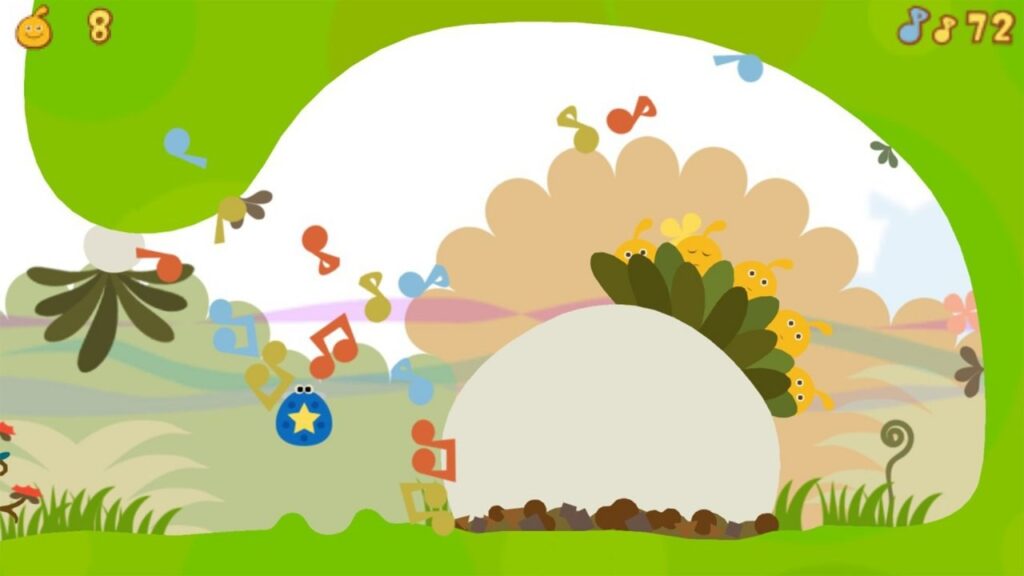
At a glance: LocoRoco · PSP · Japan Studio, 2006 · Platformer · Score: 8.5/10
LocoRoco begins with a decision so simple it looks like a limitation and turns out to be a philosophy: you do not control the character. You control the world. The L and R shoulder buttons tilt the entire landscape left or right, and your LocoRoco — a round, singing blob of pure good cheer — rolls with gravity, up slopes and down dips, bouncing when you tap both buttons together. That is nearly the whole control scheme, and from it designer Tsutomu Kouno and Japan Studio built one of the most beloved platformers on the PSP, a game whose every frame argues that kindness can be a mechanic.
The story is minimal and perfect: the Moja, black spiky troublemakers from deep space, have come to eat the colour out of the LocoRoco’s planet, and the blobs respond the only way they know — by singing at the problem while rolling through it. Across forty stages grouped in five worlds, you gather berries that grow your blob from one voice to twenty, split the whole choir into individual singers with a held button to slip through narrow pipes, and rejoin them in a chorus that is literally scored by how many of them you have kept together.
Physics, but make it cuddly
LocoRoco’s physics are the opposite of simulation. Everything is soft: the blob deforms against corners, stretches over edges, wobbles through landings, and the terrain itself contains springy plants, sticky slopes, rotating wheels and water that carries you like a lullaby. Hazards exist — Moja thorns, spiky pits, the occasional boss-scale Moja — but the game is tuned for flow rather than punishment, with secrets doing the work difficulty does elsewhere: hidden MuiMui friends, house parts for the Loco Editor, and berries tucked behind tilt-puzzles that require thinking in slopes.
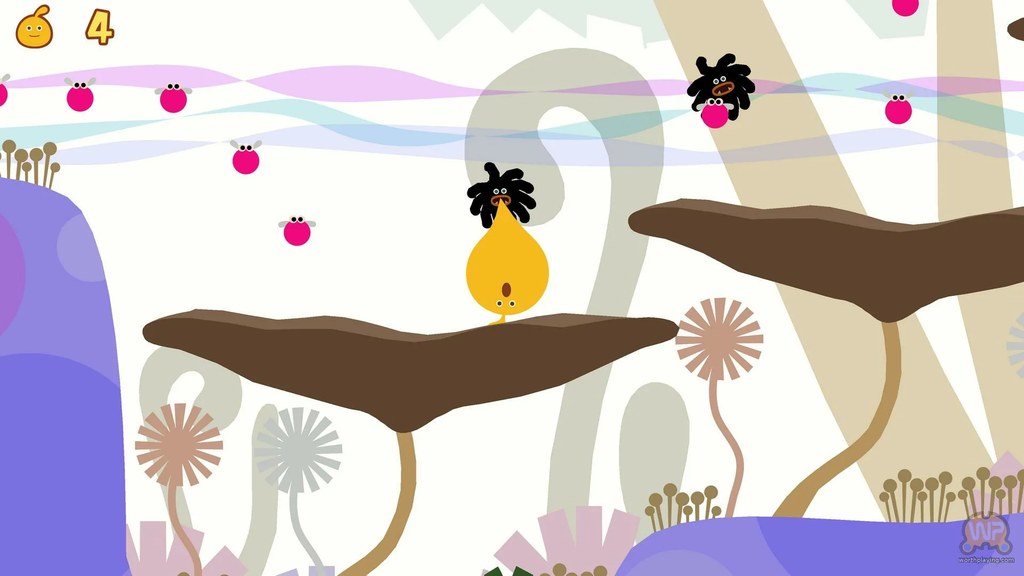
Then there is the music, which is not accompaniment but cast. Each world’s LocoRoco variety sings in its own invented language and musical style — the soundtrack, composed by Nobuyuki Shimizu and Kemmei Adachi, veers from bossa to nursery chant to something like electronic doo-wop — and the blob’s song layers multiply as it grows, so a stage’s music is a direct report on how well you are playing. It is one of the great sound designs on any handheld, best experienced through headphones on a machine held like an instrument.
A PSP game only a PSP could host
The tilt controls were made for the PSP’s shoulder buttons and wide screen, and the game’s origins show it: Kouno designed LocoRoco after sketching on a PDA, imagining a game for people who did not play games. The result was a flagship of Sony’s brief, glorious weird period, when Japan Studio handheld games — Patapon, echochrome, this — treated the PSP as a design laboratory. Its visual language of flat colour and soft geometry, descended from the same poster-art instincts as Patapon, still reads as contemporary graphic design rather than 2006 technology.
Judged strictly as a challenge, LocoRoco is gentle to a fault; an experienced platformer player will roll the credits in a weekend, and the completionist tail — perfect stage scores, the full MuiMui house — asks for replays of stages you may feel you have already sung through. The tilt scheme also, very occasionally, fights you on precise splits. These are the complaints of a reviewer reaching for balance. The truth is the game’s brevity is part of its manners: it is a holiday, not a campaign.

Five worlds, five voices
The game’s structure rewards a second look: each world is fronted by a different LocoRoco colour and voice, with its own musical dialect and palette — jungle greens and choral warmth, icy blues, a sunset world that plays like a lullaby at golden hour. Stages remix their terrain around the resident singer’s personality, so progression feels like meeting new members of a band rather than clearing a checklist. The final world’s Moja stronghold gives the game its only true test, and even that resolves the way the whole game has taught you: by rolling, bouncing and singing louder.
The Loco House and the editor heart
Collecting house parts across the stages unlocks the Loco House, a diorama you furnish and then release LocoRocos into, watching them use your slides and ladders in a tiny physics theatre. It is a toy in the honourable sense — no fail state, no score, just the pleasure of a system playing with itself — and it extends to a mini level editor whose stages can be shared. In 2006, on a handheld, this user-created gentleness was quietly radical, and it captures the game’s values better than any cutscene: given tools, LocoRoco players build playgrounds.
Difficulty is not the point — discovery is
Reviewers of the era occasionally marked LocoRoco down for ease, and time has not been kind to the criticism. The game’s challenge lives in its margins: the berry hidden above a slope you must approach at speed, the MuiMui behind a Moja patrol, the stage time-trials that ask for a perfect, unbroken roll. A game can be gentle at the front door and deep in the garden, and LocoRoco’s garden is full. Completionists will spend longer here than in many sterner platformers — they will simply be smiling for more of it.

A flagship of the gentle era
LocoRoco arrived the same era as Patapon and echochrome in Japan Studio’s handheld laboratory, and together they remain the strongest argument that the PSP years were a golden age of Japanese game design in miniature. Its sequels and remasters spread the love; the original keeps the purest form — one blob, two buttons, a world that leans when you ask it to. Some games you review. This one you prescribe.
The MuiMui and the house that play built
The hidden MuiMui — small blue friends tucked behind the stages’ softest secrets — give LocoRoco its completionist spine, and their house, assembled from parts the stages also hide, is the game’s gentlest meta-joke: a home built out of thoroughness, furnished by curiosity. Watching your collected choir invade the finished house, singing over its slides and swings, is a reward structure with no numbers in it at all. More games should end their treasure hunts at a housewarming.
Colour as difficulty, colour as reward
The game’s palette does mechanical work that sterner platformers assign to spikes: the Moja’s black is the only true darkness in a world of saturated warmth, so danger reads instantly, at a glance, for a player of any age or language — LocoRoco was designed to cross borders without translation, and its visual grammar is the passport. Conversely, a stage’s fullest colour arrives when your choir is complete and the world literally brightens around its song. It is difficulty and reward communicated in light. The PSP’s screen, then a marvel of colour, was the perfect canvas, and everyone involved knew it.
One final, entirely serious recommendation: LocoRoco is the best game on the PSP to hand to someone who insists they do not like games. There is no literacy barrier, no failure spiral, no lore — there is a world that tilts, a blob that sings, and an hour later a new person asking what else the machine can do. Every platform needs an ambassador like that, and the PSP’s is a yellow ball with a song in an invented language. Keep yours fed on berries. Keep the world tilting. Bai, bai — until the next chorus.
Verdict
Pure, engineered joy — a platformer that replaced difficulty with discovery and a hero with a choir. LocoRoco is the game people who never owned a PSP still somehow remember. Roll with it.