At a glance: Patapon · PSP · Pyramid / Japan Studio, 2007 (JP) / 2008 (West) · Rhythm strategy · Score: 9.0/10
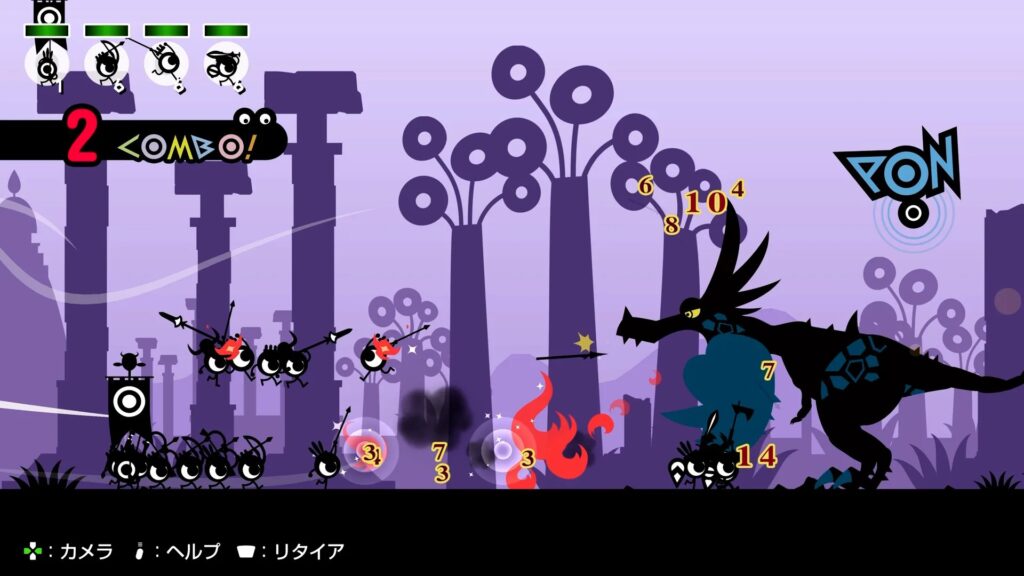
Pata-pata-pata-pon. Four syllables, typed from memory by anyone who owned a PSP, and the surest way to start an argument about the most original game Sony ever published. Patapon, from developer Pyramid and designer Hiroyuki Kotani — with its scratchy, poster-art visuals by French artist Rolito — is a rhythm game where the music is also the command system, a strategy game where you never touch your troops, and a war story about a tribe of eyeballs with spears looking for the edge of the world, where IT awaits. There was nothing like it in 2007. There is barely anything like it now.
You are not a Patapon. You are their god, and your voice is a set of four sacred drums bound to the PSP’s face buttons: Pata, Pon, Don and Chaka. Beat Pata-Pata-Pata-Pon in 4/4 time and your army marches. Pon-Pon-Pata-Pon and they attack. Hold rhythm through combos and the tribe enters Fever, a frenzy state where heroes perform miracles and the music itself swells. Miss the beat and the spell breaks; your warriors stand blinking while a dragon introduces itself. Every order is a performance, and command failure is always, always your fault.
An army you build, equip and feed
Under the chanting sits a proper little strategy economy. Between missions you spend Ka-ching and materials — wood, stone, meat, hides farmed from hunting stages — to spawn new Patapons at the Tree of Life: shield-bearing Tatepons, spear-throwing Yaripons, bow-armed Yumipons, cavalry, horn-blowers, giants. Rarepons bred from better materials change a unit’s stats and look. Equipment drops from bosses and is ground, lovingly, through replays. Your hero unit, customisable with masks, is the army’s heart. The loop of hunt, drum, equip, march deeper is measured in dozens of hours, and it never stops being charming.

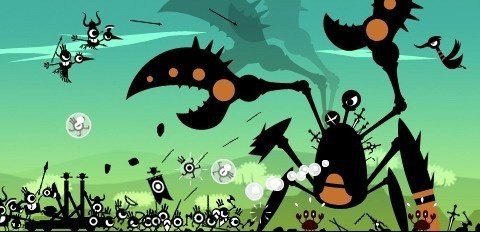
Missions alternate between hunting grounds, story battles against the rival Zigoton empire, and boss encounters — giant crabs, worms, dragons and stone golems — whose attack patterns are themselves rhythms to be read: the cues for the defensive song Chaka-Chaka-Pata-Pon are audio-visual, a boss inhaling, a tail lifting, and learning to watch while drumming is the game’s true skill curve. Weather matters. Rain kills your fever combos’ sound cues; wind decides whose arrows land. It is a war conducted by an orchestra that can see.
Style as substance
Patapon’s silhouette art direction is not a budget decision dressed up — it is the design. Black tribal warriors against saturated, shifting skies read perfectly on the PSP’s screen at any distance, the animation is pure squash and bounce, and the soundtrack builds each stage’s chant from your own inputs until a Fever run sounds like a festival. The PSP had many beautiful games. Patapon is one of the few whose beauty is inseparable from how it plays: remove the rhythm and the art has nothing to conduct.
The frictions are famous and fair to name. Grinding materials for the army you want can stall the campaign’s momentum; the rhythm tolerance, calibrated for the PSP’s buttons and speakers, punishes headphone-less play in noisy rooms; and a failed boss run returns you to the hunting grounds with the tribe’s morale as bruised as yours. Sequels sanded some of this down. None of it changes the original’s status as the system’s most singular artefact.

The hero and the hunt
Two systems keep Patapon’s middle hours alive. The Hero Patapon — resurrected early, customisable with masks that define its class and miracle — gives the army a champion whose Fever-mode ability can turn a boss attempt, while the hunting missions are a game within the game: weather-reading, prey-tracking exercises where the catch feeds the Tree of Life economy. Between them, they give Patapon the RPG spine its rhythm surface conceals, and they explain the sequel’s direction — Patapon 2 leans into heroes and multiplayer, Patapon 3 into customisation — without ever replacing the original’s purity.
Reading a boss like sheet music
Patapon’s boss fights reward a skill games rarely test: listening under pressure. Each great beast telegraphs in sound as much as motion — a breath drawn, a rhythm in its steps — and the correct response is a different song played at the right bar: the retreat chant, the defensive chant, the charge. Playing them on a PSP in a quiet room, the console becomes an instrument you are duetting with the boss. Playing on a bus, missing a cue to traffic noise, is the game’s one hardware-era cruelty, and every veteran has a story about it.
The ending that asks for more
Patapon’s campaign closes on one of the era’s great small cliffhangers: the tribe reaches the end of its world and finds the journey was a beginning. It is perfectly judged — the game is a first movement, honest about it, and the credits roll over a tribe you built from six spear-throwers into a festival with siege weapons. Players in 2008 walked straight into the sequel. Players today should do the same, but start here: no later Patapon has this one’s simplicity, and simplicity, in a game about four drums, is the entire creed.
Why it never left the PSP in spirit
Remasters brought Patapon to bigger screens in later years, and they are welcome — but the original’s bond with its hardware is part of its meaning. The face buttons as drums, the screen held close, the chant leaking from a speaker on a train: Patapon was designed for a machine you carry like a talisman. It remains the clearest proof in the PSP catalogue that a handheld’s limits are a style waiting for a designer brave enough — and rhythmic enough — to use them.
Ka-ching economics and the rare materials wall
The game’s economy deserves a sterner paragraph than its charm usually permits: rare materials — the bones, ores and seeds behind the best Rarepons — drop on schedules that can turn an evening’s campaigning into an evening’s farming, and the boss materials gate the army’s most exciting evolutions behind repetition the rhythm must carry alone. It carries it, mostly, because hunting stages are generous with music and the tribe’s chants make even a grind feel like a festival rehearsing. But the wall is real, and honesty requires the signpost.
The tribe as tamagotchi of war
A quieter pleasure runs under the campaign: husbandry. Naming your units is impossible and unnecessary — the game makes you love them in aggregate, a tribe whose composition is your autobiography as a commander. Losing a veteran Yumipon to a careless beat hurts out of proportion to the materials she cost, which is the surest sign the systems have fused: the economy produced an emotion. Patapon 2 would deepen the customisation; the original already understood that an army you feed is an army you mourn.
Practical advice, from one god to another: play with headphones at least once, learn the defensive song before you think you need it, and hunt more than feels reasonable — the Tree of Life’s best children are expensive, and the war will not wait while you farm, except that it will, because the hunting grounds are half the fun. Patapon asks you to keep time for an army that believes in you absolutely. Twenty years of rhythm games have not produced a purer version of that bargain. Pata-pata-pata-pon. You are already humming it.
Verdict
A masterpiece of invention: part rhythm game, part war drum, part pet army, entirely itself. If the PSP is remembered for one wholly original creation, it is this one. Don-don-don-don-don.