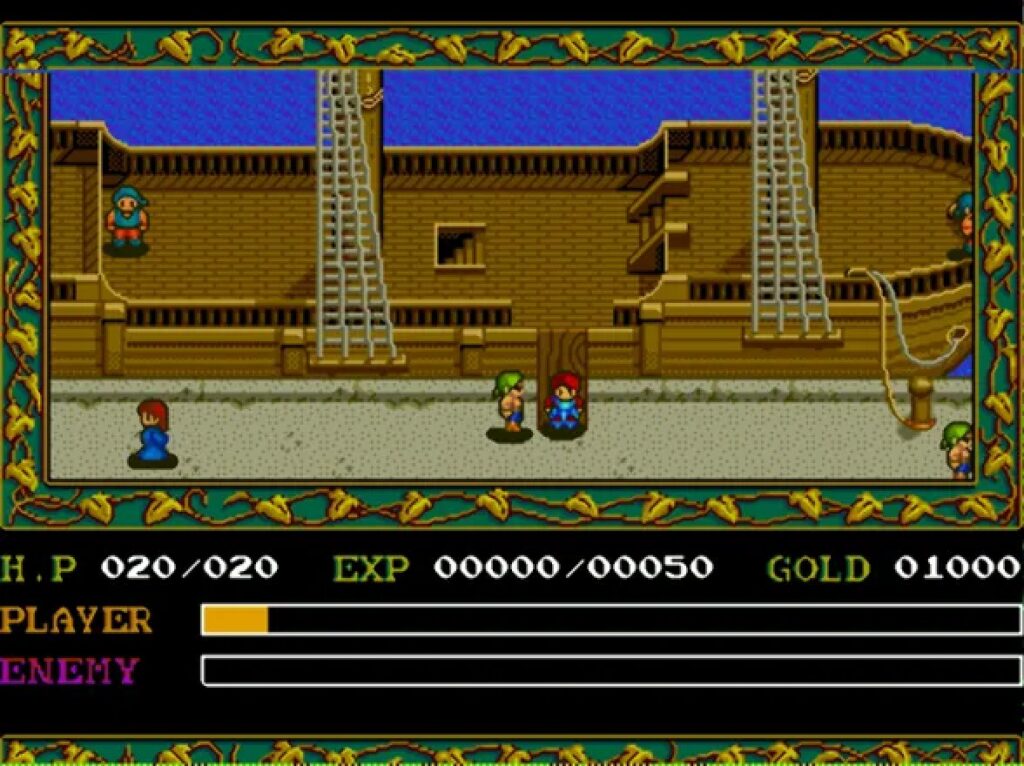
At a glance: Ys Book I & II · TurboGrafx-CD · Hudson Soft / Falcom, 1989 (Japan) / 1990 (North America) · Action RPG · Score: 9.0/10
Every format needs the game that justifies the hardware, and for CD-ROM games that game was Ys Book I & II. Falcom’s first two Ys adventures — the red-haired swordsman Adol Christin’s quest for the six Books of Ys and the floating land that wrote them — had been computer and console staples in Japan. Hudson’s TurboGrafx-CD version, released in Japan in 1989 and North America in 1990, fused both games into one continuous epic and rebuilt everything around the disc: a fully arranged soundtrack, animated cinematics, and voice acting in an era when games were still expected to be read. It became the TurboGrafx-CD’s flagship and, for many owners, the reason the CD unit existed.
The story spans both books without a seam. Book I sends Adol across Esteria — the port town of Minea, the Thief’s Cave, the Shrine of Solomon and the impossible tower of Darm — hunting the first books and the silver equipment of legend. Book II lifts him to the floating land of Ys itself, through the burned village of Lance, the canals and the bell tower, to a confrontation six centuries in the making with the priest Dahm and the Black Pearl’s curse. It is a bigger, stranger, more emotional arc than its era usually attempted, and the CD presentation finally had the tools to tell it.
Bump combat, eternal debate
The Ys system is the famous one: there is no attack button. Adol damages enemies by running into them — off-centre, ideally, so their answering touch doesn’t land. New players bounce off it, sometimes literally, for about twenty minutes. Then it clicks into one of the fastest, most fluid combat systems of its generation: a dance of angles and momentum in which grinding becomes a pleasure because movement itself is the weapon. Bosses break the rules in the traditional way, demanding pattern knowledge and the right equipment tier, and Darm Tower’s bat-winged nightmare remains a rite of passage.

What the CD version adds around that core is the point of the disc. The soundtrack — Falcom’s legendary JDK compositions, arranged for CD audio with Yuzo Koshiro’s original melodies at its heart — is routinely cited among the greatest game scores ever recorded, and in 1990 it was simply from the future: real instruments, real drums, in a console game. Animated cutscenes with voiced dialogue carry the story’s turns, and while the English dub is very much of its time, its earnestness has aged into charm. Load times, the CD era’s tax, are present but modest.
Two games, one arc, no filler
Combined, the books make a substantial quest by 1990 standards — a pair of evenings each, more for explorers — and the fusion improves both. Book I’s brisk treasure hunt gains weight as the first act of a larger tragedy; Book II’s floating-world wonder lands harder when you have walked the land that dreams of it. The difficulty curve is honest, the equipment chase is satisfying, and the save system spares you the password era’s penance.

Caveats for the modern player: the bump system is a genuine filter, and no amount of historical importance will save it for someone who wants a swing button — later remakes exist for them, and this review is not about those. The visuals in-engine are handsome PC Engine work rather than CD spectacle; the disc’s budget went to sound, cinema and scale. Some boss encounters are equipment checks in the blunt old style.
Why it still matters
Ys Book I & II was bundled with the TurboDuo in North America alongside Gate of Thunder — a double statement of what CD gaming meant — and it collected the era’s honours, including game-of-the-year recognition from major magazines. More than the awards, it set the template every CD RPG after it followed: the disc as a storytelling instrument, not just a bigger warehouse.

The books, walked through
Book I is a treasure hunt with a tower at its heart. Esteria is compact and dense — Minea’s port, the plains, the thieves’ hideout, the shrine where the game’s theology starts to bite — and Darm Tower is its masterpiece: twenty-five floors of vertical dungeon that was, in its computer originals, a landmark of the genre, rendered here with the CD’s music turning the climb into an ascent in every sense. The silver equipment set gives the book its RPG spine, each piece a small ceremony of power, and Dark Fact — the wizard waiting at the tower’s top — remains one of the era’s great final examinations, a boss whose speed must be answered with equipment, levels and nerve in equal parts.
Book II changes the register entirely. The floating land of Ys is melancholy and beautiful, a paradise with a curse in its foundations, and the adventure widens: the burned village of Lance and its survivors, the goddess statues, the canal city, the bell that must be rung to wake a god’s road. Magic joins the bump system here — the fire rod’s ranged attacks solve the enemies that positioning cannot — and the story’s revelations about the Books, the Black Pearl and the twin goddesses land with a weight the first book deliberately saved. Taken together the two books are one of the earliest console RPG narratives that feels authored rather than assembled, and the CD cinematics, modest as they are, were the delivery system that let 1990 players feel it.
The soundtrack, given its due
One more pass at the music, because posterity has voted. The arrangements recorded for this version — Falcom’s JDK band ethos translated to CD audio, built on compositions by Yuzo Koshiro and his Falcom colleagues — did something no console soundtrack had done at this scale: they made players buy a game partly to listen to it. Tracks from this disc are still performed, remixed and cited in greatest-ever lists, and the in-game effect is structural, not decorative. The bump system’s speed plus this score produces a flow state that slower, menu-driven contemporaries could not approach. When veterans describe the TurboGrafx-CD with unusual emotion, they are usually, whether they say so or not, describing hearing this disc in 1990 through a television that had never made a sound like it.
New players should know the practical shape: save often, because the era’s boss etiquette applies; grind a level rather than fight a boss under-equipped, because the bump system makes levelling fast and weirdly pleasurable; and play the two books as one game, in one arc, the way this disc fused them. Few releases on any system have ever carried a format’s promise so completely.
New to Ys? Start exactly here
For players arriving from the modern Falcom catalogue — the Trails games, the later Ys action titles — this disc is both a history lesson and a genuinely good first Ys, because the series’ entire grammar is present in embryo: Adol’s silence and kindness, the doomed romanticism of ancient lands, music as a pillar of the experience, and combat built on movement rather than menus. The bump system is the one adjustment, and it is a twenty-minute adjustment. Give it those twenty minutes, on the tower’s lower floors, and the following ten hours are the TurboGrafx-CD’s strongest argument for existing. Some killer apps sell hardware. This one justified a format.
Verdict
A landmark that plays like a pleasure rather than a history lesson: two adventures, one arc, the bump combat in its purest form and a soundtrack that still justifies the format it sold. The TurboGrafx-CD’s essential game.
Score: 9.0/10