
Sequels made late in a console’s life face a cruel arithmetic: the audience has thinned, the budgets are nervous, and the hardware’s tricks are all known. Lunar: Eternal Blue, Game Arts’ follow-up to The Silver Star, solved that arithmetic by ignoring it. Released for the Sega CD in 1994 in Japan and 1995 in North America through Working Designs, it is bigger than its predecessor in every direction that matters — a longer quest, a funnier and more quarrelsome party, a love story with genuine stakes, and an emotional range that pushes at the edges of what a 16-bit RPG attempted. If The Silver Star is the series’ warm handshake, Eternal Blue is the full embrace. It is also, poignantly, the Sega CD’s RPG swansong: the last great statement the format made in the genre it had quietly come to define.
A thousand years on, a new pair of shoulders
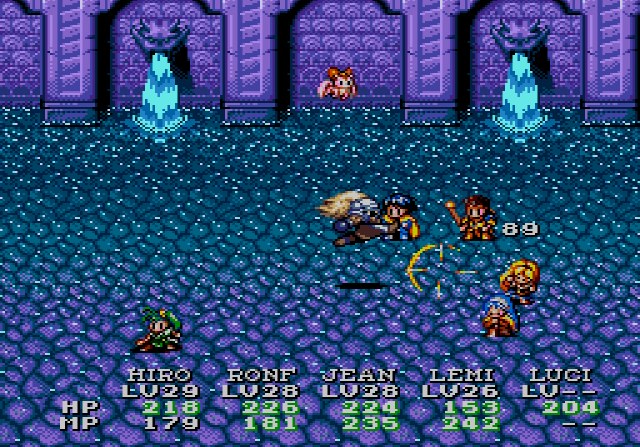
The story begins a millennium after Alex’s adventure, in a Lunar that remembers the Dragonmaster as legend. Hiro, a young ruin-diver raised by his grandfather, finds something in the depths that explorers are not supposed to find: a girl named Lucia, arrived from the Blue Star, speaking of a destroyer coming for the world and of a goddess she must reach. Their journey to the goddess Althena’s city is the spine of the game, and it works because the relationship at its centre is allowed to develop at walking pace. Lucia begins literal-minded, alien and frequently baffled by human custom; the comedy of her education — money, baths, why people lie to be kind — is the game’s comic engine, and it is building, scene by scene, the raw material the ending will spend without mercy.
The party: funnier, harder to like, worth it
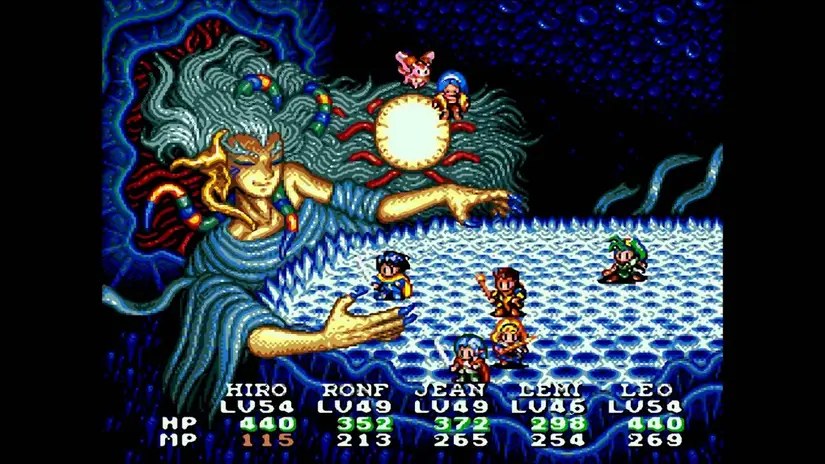
Around Hiro and Lucia gathers the strongest ensemble Working Designs ever translated. Ronfar, a gambling priest whose faith and dice are both loaded questions; Jean, a dancer with a martial artist’s past she is running from; Lemina, a magic-guild heiress whose enthusiastic capitalism makes Popful Mail’s bounty hunting look restrained; and Leo, a white knight so magnificently self-certain that his journey from antagonist-adjacent blowhard to something better is one of the game’s best arcs. They argue. They hold grudges, apologise badly, and grow in directions the first game’s cosier party never had to. The writing gives the villains the same courtesy — the returning threat works through agents with motives you can trace, and late revelations reframe figures you thought you had filed away. It is, structurally, a more ambitious piece of storytelling than The Silver Star, and it knows when to be quiet: a campfire scene here carries more weight than an FMV spectacular elsewhere on the system.
Built bigger — systems, world and challenge
Mechanically, Eternal Blue refines rather than reinvents, and the refinements are the right ones. The positioning-based battle system returns with better enemy variety and bosses that demand actual resource management; magic now draws on a system that lets characters learn and spend more flexibly, and the game’s famous post-game epilogue — a substantial additional chapter after the credits — effectively invented a feature modern RPGs now advertise on the box. The world is larger, the dungeons longer, and the difficulty is tuned a notch sterner than the first game: this is a quest that expects you to use everything it gives you, and Working Designs’ North American balancing kept that edge rather than filing it off.
The sheer amount of game here was the point and the advertisement — multiple discs’ worth of content ambition squeezed onto the format, hours of voiced dialogue, and animated sequences that arrive at the story’s true pressure points. The boat-song equivalent moments are used more boldly this time, scoring entire emotional movements instead of single scenes.

The honest weight of it
A long game on ageing hardware carries costs, and Eternal Blue’s are the family traits: encounter rates that belong to their era, a middle stretch where the journey’s fetch-and-travel structure shows its scaffolding, and the Working Designs localisation style at its most unrestrained — pop references and gags that were contemporary in 1995 and are archaeology now, sitting beside emotional scenes the same team translated beautifully. Both things are true, and the game’s admirers have always known it. Ruby, Hiro’s baby red dragon companion and Nall’s counterpart, divides players precisely because the comedy is turned up — some find her the game’s heart, others its loudest voice. What no one disputes is the ending’s force: the final movement, and the epilogue’s coda, earned this game a permanent place in “endings that made you stare at the screen” conversations.
The presentation peak of the format
It is worth pausing on how far the production values travel from the first game. The animated sequences are more frequent, more confidently directed and better integrated — used for character moments as readily as for spectacle, which is the sign of a team that had learned the grammar of the form. Voice performances in the North American version run to hours, and the leads carry it: Hiro’s earnestness could curdle into blandness in lesser hands, and Lucia’s gradual thaw — from visitor reciting observations to someone choosing this world at cost to herself — is played in the voice work as much as written in the script. The soundtrack, given a CD’s whole canvas, ranges from village themes with genuine folk warmth to final-dungeon music that understands it is scoring the end of an era; in a sense it was, because the Sega CD’s story as a living platform closes shortly after this game, and Eternal Blue’s North American release arrived when the Saturn was already on shelves redefining what came next. That timing hurt it commercially and burnished it historically: the last big game on a dying format tends to be remembered as a monument, and few monuments are this alive inside.
Should you play it before the remakes of either game?
Newcomers face a genuinely pleasant dilemma, because Eternal Blue, like its predecessor, was later remade in expanded form, and the remakes are the easier on-ramps today. Our advice stands from the first review, doubled: the Sega CD version is a distinct telling, leaner in places, stranger in others, with its own balance, its own script and the epilogue structure that later editions inherited. Play it as you would read a first edition after knowing the revised one — not out of duty, but because the differences are the biography of a classic being born. And play it on the hardware family’s own terms if you can: load times, memory-card saves and all, because this is what the machine was for at its best.
One small mercy deserves recording: the game is generous with save opportunities by the standards of its predecessor, and its epilogue respects your time by being a true second campaign rather than a victory lap. Even its kindnesses are substantial.
Verdict
Lunar: Eternal Blue is the sequel that outgrew its console — a bigger, funnier, more emotional RPG that closed the Sega CD’s contribution to the genre at its peak. Play The Silver Star first for the foundation, then play this for the cathedral built on it. The Sega CD never got a finer farewell.
Score: 9.0/10