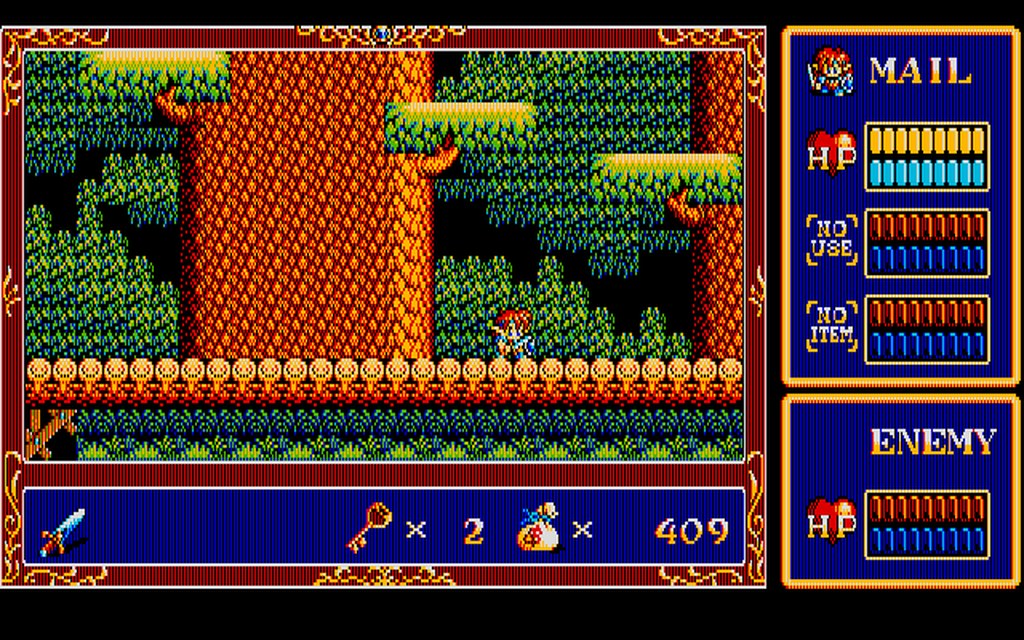
Popful Mail has the best elevator pitch on the Sega CD. You are Mail, a bounty-hunting elf with a sword, a one-track mind and a price on everyone’s head; the world owes you money and you intend to collect. Falcom’s action-RPG — part platformer, part hack-and-slash, part comedy — arrived in North America through Working Designs, who treated its script the way they treated Lunar’s: as raw material for the funniest, chattiest localisation the hardware would hold. The result is one of the most purely enjoyable discs on the system, a game whose grin is visible from the title screen.
A bounty hunter’s tour of a storybook world
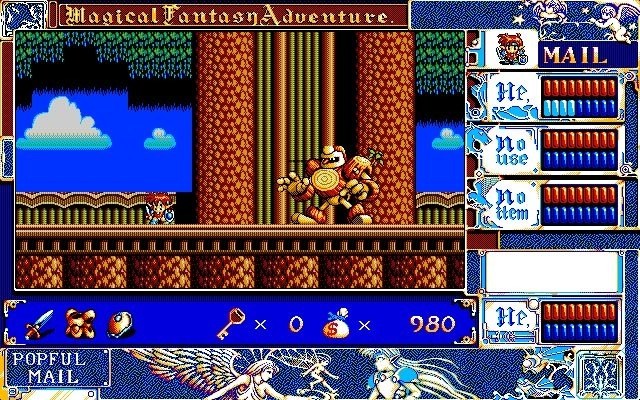
The plot is cheerfully mercenary. Mail takes a bounty on the wizard Muttonhead, the job goes sideways in the way these jobs do, and the chase pulls her across a bright fantasy world of forests, mines, ice fields and fortresses, gathering companions as the stakes quietly escalate from “one wizard, one payday” to the usual business of ancient evils. What distinguishes it is tone. Popful Mail is a comedy that never stops being an adventure: the villains bicker like middle management, the heroes argue about reward money in the middle of rescues, and Mail herself — greedy, brave, completely unbothered by anyone’s grandeur — is one of the great protagonists of the 16-bit era. She is not collecting crystals to save the world. The world keeps happening in the vicinity of her invoice.
Three hunters, one button-press apart
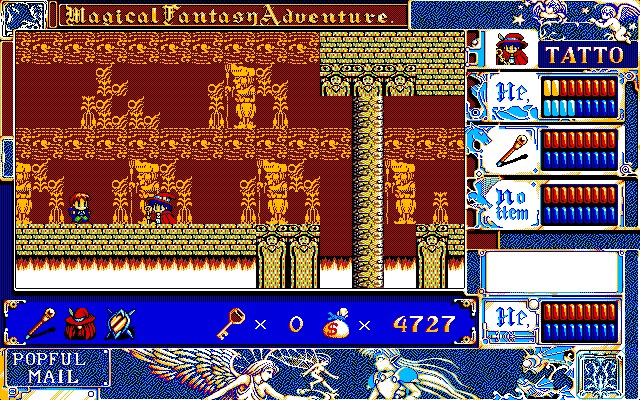
Mail does not travel alone for long. She is joined by Tatt, a young magician whose ranged spells trade power for reach, and Gaw, a small round creature — Mail’s species description of him is unprintable in a family review — who can squeeze through low passages and eventually soar over gaps entirely. You switch between the three with a button press, mid-stage, and the level design is built around the swapping: a corridor too tight for Mail is Gaw’s doorway; a boss whose weak point sits above sword range is Tatt’s problem; a screen of armoured brutes is Mail’s natural habitat. Character-swapping systems often feel like key-and-lock busywork. Here it feels like tag-team improvisation, partly because all three are fun to control in their own right and partly because the game keeps the pace up — stages are brisk, secrets are tucked into the alternate routes each character opens, and backtracking is a choice rather than a sentence.
Action first, RPG second — correctly
Popful Mail’s combat is side-on and immediate: you run, jump and hit things with a weapon whose arc and range you learn by feel, in the tradition of Falcom’s own action lines and the Wonder Boy adventures it clearly admires. Between stages, towns and shops provide the RPG layer — better swords and armour, healing items, and a great deal of talking to people. Equipment genuinely matters, because the difficulty is honest: enemies hit hard, bosses hit harder, and wandering into a new area under-geared is a mistake you make exactly once per area. Saving is handled at inns and save points in the manner of the time, and the game expects a certain amount of grinding in its later stretches — not egregious, but present, and worth flagging for modern players arriving from slicker action-RPGs.
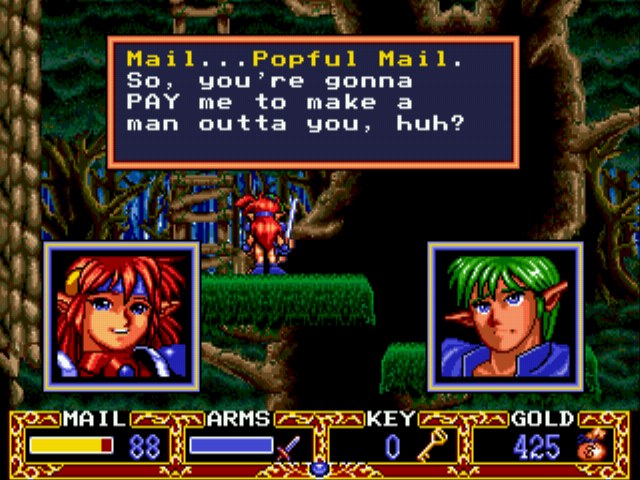
The animated cutscenes and voiced dialogue use the CD the Lunar way: sparingly, for character. Working Designs’ cast plays the comedy properly — this is a script that needs timing more than gravitas — and the localisation gives the script a jolt of early-90s pop energy. Yes, some references are period pieces now. The characters underneath them are not: Mail’s mercenary warmth and Tatt’s earnestness survive every joke that dates.
Looks, sounds, and the Sega CD difference
Falcom’s game existed on other Japanese systems, but the Sega CD version is the fullest realisation English players got: rich, saturated pixel art with big expressive sprites, parallax stages that keep the storybook look moving, and a CD soundtrack that gives each region its own flavour. Mail and company are animated with real squash-and-stretch charm — watch Mail’s idle animation nurse her impatience — and enemy design leans cute-but-deadly, which matches the difficulty better than first impressions suggest. Load times are gentle, presentation is generous, and the whole package feels like a game that knew exactly what it wanted to be.
The details that sell the comedy
What keeps Popful Mail funny across a full-length quest, rather than a strong first hour, is commitment to the bit at every level of the production. Enemy design is a running gag reel — armoured knights with improbable helmets, wizards whose menace is entirely administrative, a villain entourage who treat world domination like a failing small business. The townsfolk have the good grace to be in on it: shopkeepers comment on your reputation, innkeepers know exactly what a bounty hunter’s custom is worth, and the script gives even walk-on characters a punchline or a personality, frequently both. Mail’s own animations do silent comedy — her triumph pose, her fury at being short-changed, the way she treats a treasure chest as a personal appointment. Falcom’s sound team matches the energy with a score that bounces between heroic and vaudeville without ever tipping into parody of itself. It adds up to the rarest thing in games, then or now: a comedy whose jokes are integrated into its systems, art and music rather than pasted onto its dialogue, which is why it still raises smiles in players who have never heard of the disc it came on.
One more honest note on difficulty
New players deserve the warning plainly: the final third does not care about your feelings. Bosses stack patterns, late-game enemies treat your upgraded armour as a suggestion, and the distance between save opportunities lengthens exactly when the stakes peak — the classic Falcom crescendo. The correct response is the game’s own: buy the best gear the moment it appears, keep healing items like a professional, and learn that switching characters mid-fight is a defensive tool as much as an offensive one — a fresh health bar is standing right there in your party, wearing a funny hat. Players who adapt will find the challenge fair in the old-school sense: it kills you for specific, correctable reasons. Players who do not will meet the game-over screen often enough to memorise its jingle. Both groups tend to remember the game fondly. Only one group finishes it.
Why it stayed a gem instead of a classic
The melancholy footnote is availability: Popful Mail’s North American print run was modest, the series never continued in English, and the character became a beloved footnote rather than a mascot — which is precisely why the disc is chased today. Play it, though, and the footnote treatment feels unjust within an hour. Games this confident about their own tone do not date; they wait.
Verdict
Popful Mail is the Sega CD’s charm offensive, and it works: a funny, fleet, genuinely challenging action-RPG with three heroes worth swapping between and a protagonist worth the disc price alone. If the system’s library has a personality problem — too many grainy films, too few games with a pulse — this is the corrective. Mail would want her fee up front. Pay it.
Score: 8.5/10