Most CD-ROM games of the early 1990s used all that storage for grainy video of actors in front of green screens. Lunar: The Silver Star, developed by Game Arts and brought to North America by Working Designs, used it for something far more radical: warmth. Here was a role-playing game with sung songs, voiced characters and hand-drawn animated scenes that existed to make you care about a boy, a girl who sang, and a flying creature who was definitely not a cat. It was not the biggest RPG of its generation. It may have been the most loved, and playing the Sega CD original today shows you exactly why.
A familiar quest, told with unusual sincerity
Alex, a boy from the village of Burg, idolises the Dragonmaster Dyne and sets out — as boys in these games do — to become a Dragonmaster himself. He travels with his childhood friend Luna, whose singing voice turns out to matter a great deal more than either of them knows, and Nall, a small white flying companion whose sarcasm does a lot of the game’s comic heavy lifting. The outline is deliberately traditional: visit the dragons, gather the party, confront the rising dark power. Lunar never pretended the outline was new. What it understood is that an old story told by characters you genuinely like beats a clever story told by mannequins.
The party fills out beautifully — a gambler, a priestess, a thief with a heart, a magician with an ego — and crucially, they talk. Not just in cutscenes: the game is full of optional conversations, and your companions comment on towns, events and each other with a frequency that was unheard of in a 1992 Japanese release and a 1993 North American one. This is the secret of Lunar’s reputation. The plot is fine. The company is wonderful.
Voices and songs that justified the disc
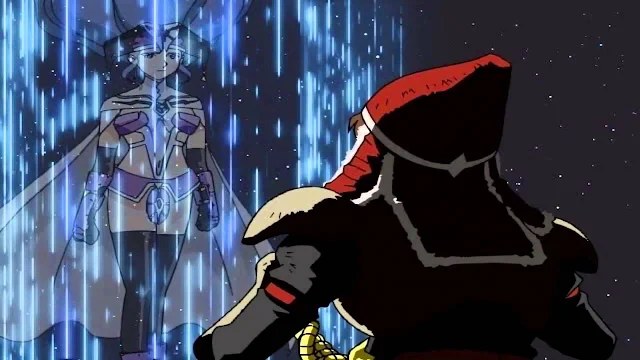
The Sega CD’s storage bought Lunar its soul. Key scenes are fully voiced — genuinely acted, by the standards of the day, and still charming now precisely because the performances are earnest rather than polished. Luna’s boat song, performed as the party crosses to the mainland, is the moment everyone who played this game in 1993 remembers unprompted: a sung vocal track, on a game console, used not as a gimmick but as the emotional hinge of the story. The animated cutscenes, drawn in a clean anime style, are short and used sparingly, which is why they land. Where FMV games sprayed footage everywhere, Lunar treats animation like punctuation — a gasp, a reveal, a goodbye.
Working Designs and the translation question
No discussion of this version is complete without its North American localisation, and honesty requires describing it accurately rather than reverently. Working Designs rewrote dialogue freely, adding humour, contemporary references and a chattiness that the plainer Japanese script did not have. Some of those jokes have dated; a few were dated by 1995. But the philosophy underneath the jokes — that a translation should read like people talking, not like a spreadsheet wearing a costume — gave Lunar its voice in English, and the characters’ personalities in the North American version are the ones a generation of players bonded with. Working Designs also adjusted game balance for the North American release, generally making the journey brisker. Purists can argue the details forever; what is not arguable is that this localisation made an imported niche RPG feel like it had been written for the person holding the controller.
How it actually plays
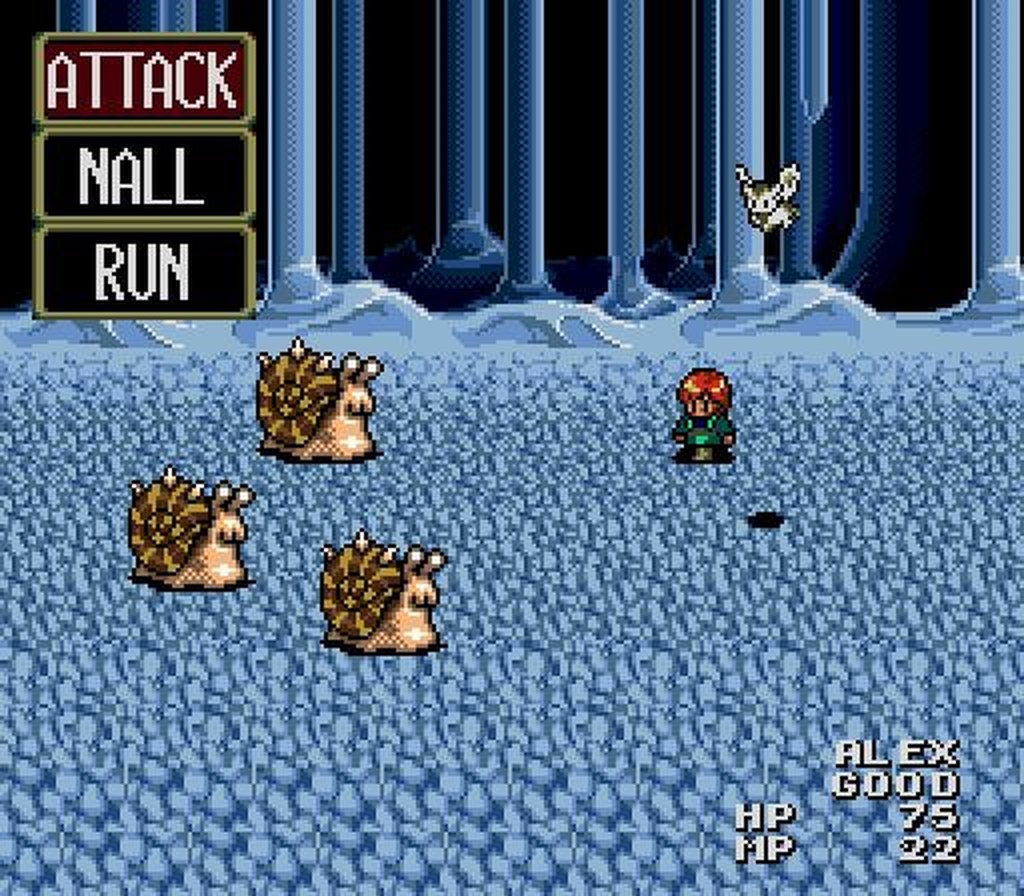
Underneath the presentation is a solid, conventional turn-based RPG, and it is better for knowing its job. Battles use a simple but satisfying wrinkle: positioning matters. Characters and enemies move on a small field, melee fighters must spend movement to reach their targets, and area spells reward reading the formation rather than mashing attack. It is not deep by modern tactics standards, but it keeps random encounters from becoming pure autopilot — mostly. The encounter rate is of its era, which is a polite way of saying you will fight a great many things on the way to anywhere, and the difficulty has a few honest spikes, particularly around bosses who expect you to have stocked up and levelled sensibly.
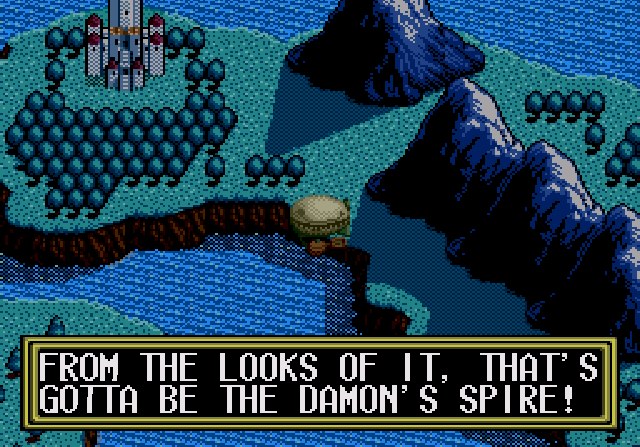
The structure is linear and proudly so, broken up by towns that are worth poking around in for the conversations alone, and dungeons that stay on the right side of maze-like. The whole journey runs to a satisfying length for its hardware generation — a full quest, not a demo reel for the CD format, which a surprising number of its contemporaries were.
Against its own remakes
Lunar has been remade and re-released repeatedly, and those later versions are prettier, fuller and in many mechanical ways better. So why play the Sega CD original? Because it is a different telling, not just an older one. The story was substantially reworked in the remakes; scenes, character beats and the entire shape of some arcs exist here in their first form. The original’s rougher edges — its simpler dungeons, its of-the-moment jokes, its voices — are the record of what made people fall for this world in the first place. Think of it the way you would a first edition: the later printings may be tidier, but this is the one that started it.
The dungeons, the dragons and the long middle
A word for the quest’s architecture, because it is easy to let the characters carry the whole review. The journey is built around the four dragons — white, red, blue and black — whose trials structure the middle of the game into satisfying expeditions, each with its own dungeon flavour and a payoff that is part power-up, part rite of passage for Alex. The dungeons themselves are honest 16-bit work: multi-floor, puzzle-light, treasure-heavy, with enemy sprites visible in some contexts and ambushes in others, and a length that makes returning to a town feel like coming home. Towns are the game’s real dungeons, in a sense — the challenge is remembering to talk to everyone twice, because the script keeps moving: villagers react to events, party members wander off to corners with things on their minds, and the world’s sense of being inhabited comes from these small, optional, easily missed exchanges more than from any cutscene. Add the bromides — collectible character cards hidden away for the devoted — and you have a game that rewards the unhurried everywhere. Modern players raised on quest markers should be warned about exactly one thing: Lunar expects you to listen. The reward for listening is the whole game.
It also, not incidentally, makes the strongest possible case for its own sequel, reviewed alongside this one: everything Eternal Blue does at greater scale is present here in embryo, and playing them in order is one of the great two-disc journeys of the 16-bit era.
Verdict
Lunar: The Silver Star is the little RPG with the big heart, and the heart is not nostalgia talking — it is in the writing, the voices, the song on the boat. As a piece of game design it is a well-built traditional RPG; as an experience it is something rarer, a game that likes its characters and trusts you to like them too. On a system famous for FMV novelty acts, Lunar is the disc that proved CD-ROM could mean emotional range, not just footage.
Score: 9.0/10