
At a glance: Mario Kart DS · Nintendo DS · Nintendo, 2005 · Kart racing · Score: 9.0/10
Mario Kart DS arrived in November 2005 with a burden no previous entry carried: it was the flagship for Nintendo Wi-Fi Connection, the company’s first serious step into online play, and it had to prove that a handheld could deliver the full Mario Kart experience without compromise. It did both, and more. This is not a cut-down port but arguably the most complete Mario Kart of its era — thirty-two tracks, a mission mode the series has never repeated, proper battle modes and online racing that worked on a machine you carried in your coat pocket.
The track list remains astonishing. Sixteen brand-new courses — including the pinball chaos of Waluigi Pinball, the airborne loops of Airship Fortress and the figure-eight simplicity of the course literally named Figure-8 Circuit — are joined by sixteen retro tracks drawn from every previous game in the series, SNES to GameCube. The retro cup idea, now a series institution, starts here, and the selections are generous rather than tokenistic. Twelve racers, unlockable karts with genuinely different handling, and the return of proper drifting physics round out a package that never feels like a handheld compromise.

Snaking, missions and the bottom screen
Mechanically this is the last of the old-school Mario Karts, and purists still argue it is the finest. Powersliding builds mini-turbo boosts, and the technique known as snaking — chaining boosts down straights — turned expert play into a writhing, high-skill spectacle that split the community and has never been allowed back in this form. The bottom screen earns its keep with a live course map showing every racer’s position, incoming items and hazards: glancing down to see a blue shell hunting you is a small revolution in information design that later entries kept.
Mission mode is the great lost treasure: dozens of bite-size challenges — drive through numbered gates, collect coins against the clock, fight bosses including a returning Eyerok and King Boo — graded from one to three stars. It converts Mario Kart into a puzzle-racer for an entire extra game’s worth of hours, and its absence from every sequel remains baffling. Battle mode offers balloon battle and shine runners for up to eight players from a single cartridge via download play, which in 2005 felt like sorcery in a schoolyard.

The Wi-Fi pioneer
Online, Mario Kart DS was a revelation with caveats history has kindly sanded down. Four-player races over Nintendo Wi-Fi Connection worked, matchmaking was quick, and the friends-and-rivals system made repeated matchups likely. The caveats: only twenty of the thirty-two tracks were playable online, battle mode stayed local, and the service itself was retired in 2014, so today the online chapter is a memory preserved by fan servers. None of that dents what it proved — that Nintendo’s audience wanted online play, on handheld, immediately.
Thirty-two tracks, a mission mode the series never repeated, and online racing in your pocket: Mario Kart DS was not a port, it was the main event.
Presentation is superb for the hardware. The 3D models are chunkier than the GameCube game’s, but the frame rate is rock-steady, the courses are colour-saturated and readable at speed, and the soundtrack remixes retro themes with real affection. Single-player Grand Prix difficulty scales fairly, the rubber-banding is present but less spiteful than in some successors, and the unlock structure — mirror mode, extra characters including R.O.B., extra karts — rewards the long haul properly.
Karts, characters and the art of the drift
Beneath the track count sits a kart system with real depth. Each character has multiple karts — a standard frame, a signature machine and unlockable extras — and the stats genuinely matter: drift, weight and item ratings reshape how a combination races, so the time-trial scene developed its own meta of character-and-kart pairings per course. The item set is the series’ most combative vintage: the Blooper inks your screen (and, cruelly, the bottom screen’s map with it), the Bullet Bill makes its handheld debut, and triple shells orbit as both shield and threat. Item balance in DS leans aggressive, which keeps Grand Prix fields compressed and dramatic to the final lap.
The single-player ladder is structured for the long term: four engine classes including the unlockable Mirror mode, staff ghosts to chase in Time Trial with your own best runs saved alongside, and a star-rating system on every cup that completionists still chase. The emblem editor — drawing your own kart decal pixel by pixel on the touch screen — was a small creative joy, and a reminder that the DS’s stylus turned even menus into play. Rubber-banding exists, as it must in Mario Kart, but the DS tuning is remembered fondly: firm enough to keep races honest, loose enough that skill tells over a cup.
Historically, this is the Mario Kart that globalised the series. Its online success — over half its early owners tried Wi-Fi races within weeks — proved the audience, its retro-cup structure became permanent series architecture, and its handheld-first design (short cups, quick menus, download play) defined what a portable kart racer should be for the two decades since. Mario Kart 7 and 8 are grander productions. Neither is more important.
One more consideration for modern players: the local multiplayer is fully intact and remains the best way to experience the game. Eight systems, one cartridge, download play — the arenas and grand prix run exactly as they did in 2005, and a room of DS Lites needs nothing from the internet at all. Retro evenings built around this cartridge are a going concern for a reason. Snaking, incidentally, is optional: house rules settle what the community never could, and the game is generous enough to be superb with or without its most contentious technique.
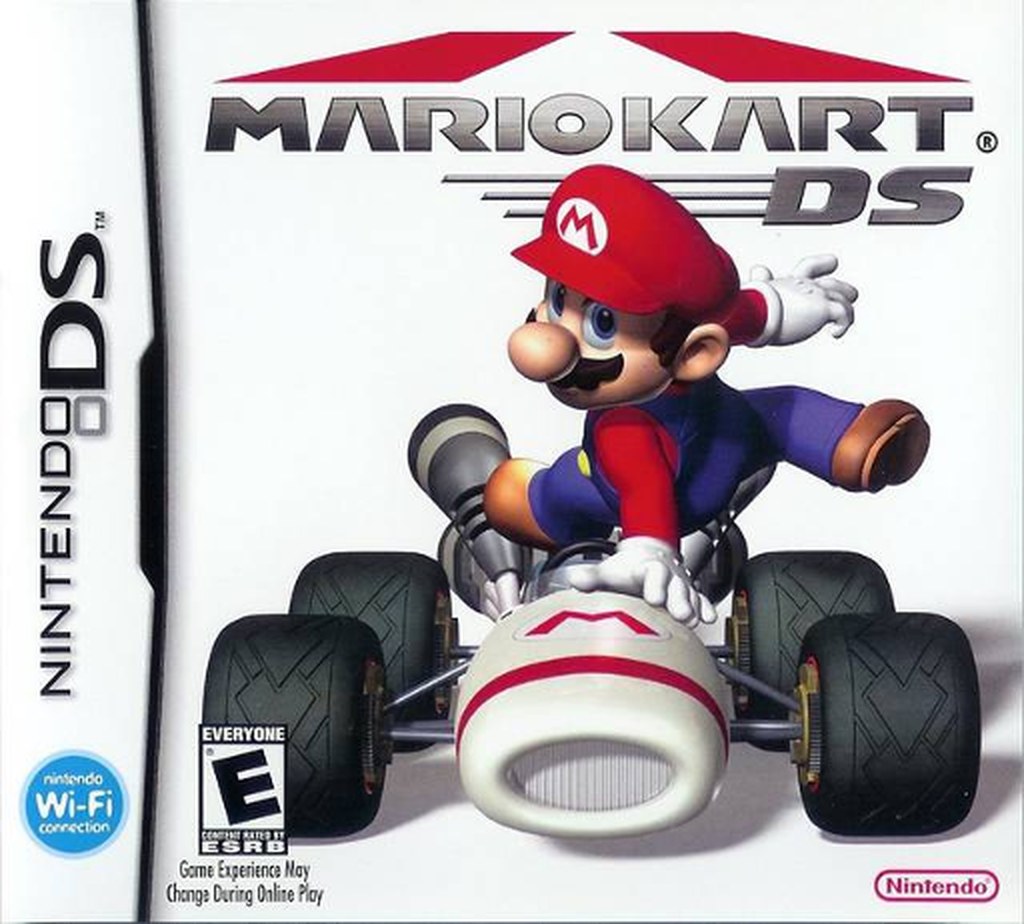
Playing it today
Modern ownership is painless: the cartridge is common worldwide, works on every DS and 3DS-family machine, and its single-player and local content — the great majority of its value — is entirely self-contained. What the closed servers took (online matchmaking) the fan community has partially restored through unofficial services for those willing to configure them, but the honest truth is that Mario Kart DS never needed the internet to justify itself. It justified the internet. The thirty-two tracks, the missions and the download-play parties are all still in the box, waiting for a room with two handhelds in it.
Verdict
Mario Kart DS is the handheld racer against which all others on the system are measured, and most lose. Its content mountain, its superb drifting model, its generous multiplayer — local download play remains a joy with a room of DS owners — and its historical role as Nintendo’s online pioneer make it essential. The snaking divide and the now-defunct official online service are footnotes. For pure karting on the DS, nothing else comes close, and it stands comfortably among the very best games in the entire Mario Kart series.