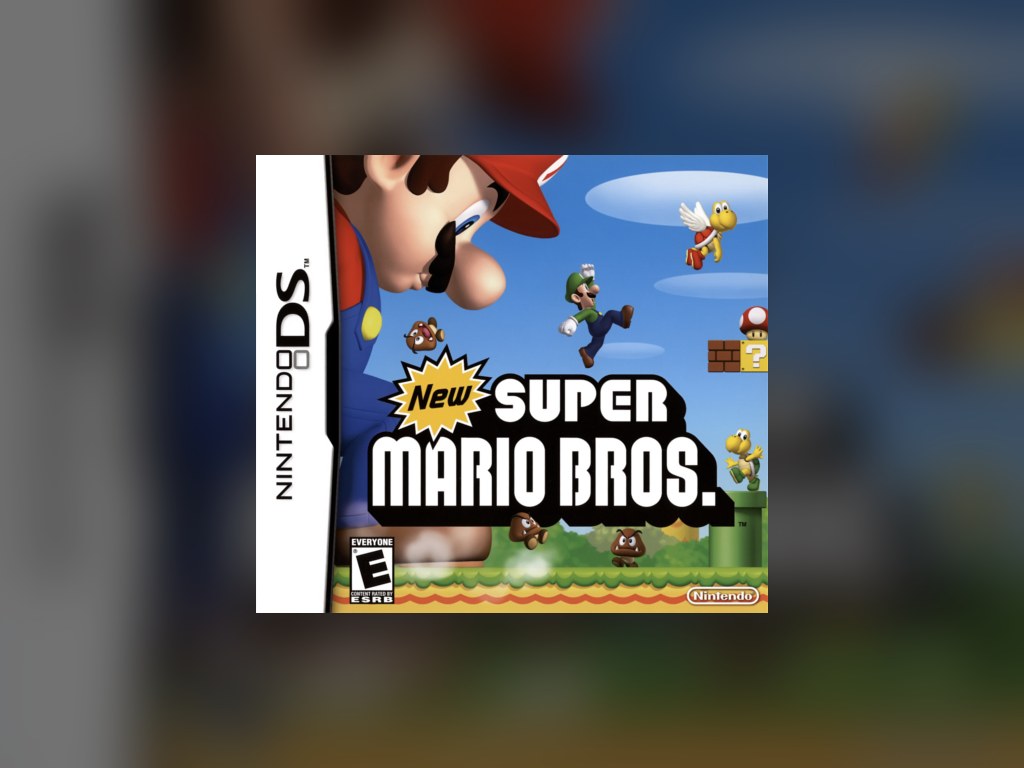
At a glance: New Super Mario Bros. · Nintendo DS · Nintendo, 2006 · 2D platformer · Score: 9.0/10
By 2006, the 2D Mario platformer was supposed to be history. The last wholly new side-scrolling entry, Super Mario Land 2, dated from 1992; Mario himself had gone 3D, gone karting, gone to parties. New Super Mario Bros. on the Nintendo DS was therefore both a revival and a wager: that the run, jump and stomp grammar of 1985, rebuilt with modern craft, could still command an audience. It won the wager so completely — becoming the best-selling DS game ever made — that it effectively restarted an entire sub-series and re-taught the industry that 2D was not a nostalgia act but a living form.
The setup is deliberately, almost defiantly, traditional. Princess Peach is kidnapped — by Bowser Jr. this time, scampering off with her between worlds — and Mario gives chase across eight themed worlds of grass, desert, snow, pipes and lava. There are no hub-world errands, no collectathon stars gating progress, no apology for the linearity. What there is, in abundance, is level design of a confidence that borders on arrogance: every stage introduces an idea, develops it, twists it and discards it before it can bore you.

Old moves, new toys
Mario’s moveset is the Super Mario 64 kit translated gracefully into two dimensions: the triple jump, the wall jump and the ground pound all survive, and they change the feel of 2D Mario profoundly, adding vertical escape routes and a sense of athletic improvisation the NES games never allowed. The headline power-ups are new. The Mega Mushroom turns Mario into a screen-filling giant who smashes through bricks, pipes and enemies alike while a destruction meter fills for bonus lives — pure, giddy spectacle. The Mini Mushroom shrinks him to a sprite who can sprint across water, slip through tiny pipes and reach the game’s most sadistically hidden secrets, at the cost of dying to a single touch.
The Blue Shell, borrowed from the karting games, lets Mario withdraw and slide as a spinning projectile — awkward to master, devastating once learned. Underneath the novelties, though, the fundamentals are immaculate. Mario’s acceleration, jump arc and skid feel exactly right, tuned by a team that understood the difference between faithful and fossilised. Star Coins — three large coins hidden in every stage — give explorers a reason to master each level, unlocking paths on the world map and, eventually, bragging rights that take real skill to earn.

Two screens, used with restraint
For a flagship DS title, New Super Mario Bros. uses the hardware with notable restraint, and is better for it. The top screen is the game; the bottom is a progress display and reserve-item window you tap to drop a stored power-up — a small, sensible use of touch that never interrupts play. In reserve, a second entire game hides: a suite of touch-driven mini-games, several expanded from Super Mario 64 DS, plus a frantic two-player Mario vs. Luigi mode over local wireless in which both brothers race to collect stars while shelling each other into pits. It is generous, polished filler of a kind modern releases would sell separately.
New Super Mario Bros. did not just revive a genre — it outsold everything else on the system and made 2D platforming modern again.
The presentation holds up beautifully. The characters are smooth 3D models moving through richly coloured 2D worlds, an approach that has aged far better than the flat sprites of many contemporaries, and Koji Kondo’s themes are remixed with a bounce that matches the game’s spring-heeled step — including the famous touch of enemies hopping in time to the music, a detail that still makes players grin. Difficulty is the one honest criticism: the main quest is gentle, clearly pitched at the lapsed players Nintendo wanted back, and veterans will finish it in a weekend. The Star Coins, secret exits and unlockable challenge of simply perfecting every stage supply the spine for anyone who wants it.
Secrets, shortcuts and the long tail
The world map hides more than it shows. Warp cannons return from the original Super Mario Bros., flinging Mario to later worlds; two entire worlds — 4 and 7 — are optional, reachable only by finishing earlier bosses while Mini, a piece of design mischief that forces mastery of the game’s most fragile form to even see a third of its map. Secret exits fly red flags on the map and open branching routes, and the Toad Houses scattered between worlds dispense lives, items and gambling mini-games with a generosity that keeps the difficulty curve friendly without making it toothless. Completionists face a sterner game than casual players ever meet: every Star Coin, every exit, every cannon is a small examination.
Multiplayer deserves its own paragraph in the game’s legend. Beyond the Mario vs. Luigi star chase, the mini-game suite supported up to four players from a single cartridge, with touch-driven tables — card games, picture poker with Luigi as dealer, snowball fights, trampoline target games — that were engineered for train carriages and schoolyards. In 2006, before phones ate that social space, a DS with New Super Mario Bros. in it was a party in a pocket, and the cartridge’s second life as a mini-game hub is a real part of why it never left the charts.
Its legacy is difficult to overstate. New Super Mario Bros. sold over thirty million copies, became the best-selling DS game of all time, and spawned three sequels across Wii, 3DS and Wii U that iterated on its template for a decade. More importantly, it reset Nintendo’s own design compass: the 2D platformer was re-established as a flagship genre, the ‘New’ visual language became house style, and a generation of children met Mario first in two dimensions, exactly as their parents had. The critical consensus at the time — superb, if safe — has aged into something warmer: this is simply one of the most perfectly made platformers on any handheld.
A final word on craft: the game’s physics are a deliberate bridge between eras. Mario carries the weight and skid of his NES incarnation but lands with the forgiveness of his 3D self — coyote time, generous ledges, a camera that leads his runs — which is why the game feels simultaneously classic and modern in the hands. The level design speaks the same bilingual language: set-pieces like the collapsing bridges, the tide-locked beach stages and the famous final castle, with its rotating, gravity-playing corridor and a boss fight that ends with the series’ most theatrical bridge-drop since 1985, are built from old bricks in new shapes. It is a history lesson you play at a sprint.

Availability today is the game’s final gift to new players: it sold so enormously that loose copies remain among the most affordable classics in the entire DS library, boxed copies are common, and no downloadable version has ever replaced the cartridge as the standard way to own it. There is no barrier between a curious player and this game except the price of a modest lunch — which is exactly the barrier a game of this importance should have. Every DS collection begins somewhere. Statistically, historically and sensibly, it begins here.
Verdict
New Super Mario Bros. is a masterclass in revival done properly: it respects the source material without embalming it, adds exactly enough novelty to feel new, and controls so well that playing it remains a pleasure two decades on. Its easiness in the main run is a real caveat, and later entries in the New series would iterate rather than revolutionise. But as the game that brought 2D Mario back from the museum and proved a handheld audience in the tens of millions still wanted it, its place in the DS library is untouchable. If you own the system, you own this — probably twice.