
SNES · NEWS · HARDWARE · FRESH CARTRIDGE
Most retro hardware announcements ask you to admire a spec sheet. Hyperkin’s latest asks you to open a drawer. On October 28, the company launched the refreshed SupaBoy — its handheld that plays real Super Nintendo and Super Famicom cartridges — in two new colourways, Crimson and Prime, at $129.99, with a 4.3-inch IPS screen and a battery Hyperkin rates at around ten hours. A week on, with the launch dust settled, it’s worth asking the question this odd little machine has always posed, now in sharper focus: in a world of FPGA handhelds that play everything, is there still a sane case for a handheld that plays exactly one system’s cartridges — the ones you already own?

What actually launched
First, the facts of the refresh, because the SupaBoy name has been recycled for over a decade and the generations blur together. The SupaBoy line began in 2011 as a chunky, cheerful proposition: a wide handheld with a cartridge slot on top, into which you plug an actual SNES game, the way nature intended. Successive versions (the SupaBoy S and SFC among them) refined the screen and the compatibility. This 2026 refresh keeps the concept untouched and modernises the presentation: two colourways — Crimson, a deep red, and Prime, a translucent clear-grey with Super Famicom-coloured buttons — the 4.3-inch IPS display, and that ~10-hour battery figure, at a $129.99 asking price that lands squarely in impulse-upgrade territory rather than serious-hardware territory. No emulation menus, no storefront, no account. The cartridge is the interface. That stubborn simplicity is either the whole appeal or the whole problem, depending on the size of your SNES shelf.

The machine it feeds

Context matters. The SNES library is the most cartridge-collected in retro gaming — the big first-party titles have held their value for a decade, and most serious retro shelves have a row of grey carts (and a guilty row of pricier ones) that get played less than they deserve because playing them means the full TV-console ritual. Every device in this category — the SupaBoy, the Analogue Pocket with its adapters, the various clone consoles — is really selling the same thing: lowering the activation energy between owning those cartridges and actually playing them. The SupaBoy’s pitch is the most literal of the lot. It doesn’t ask you to dump, scan, or configure anything. You take the cart off the shelf, you put it in the top, you play it on the sofa. For collectors, that physical continuity matters more than spec sheets ever admit: the label art, the save battery you replaced in 2019, the initials in marker from a previous owner. It’s your copy, running in your hands.
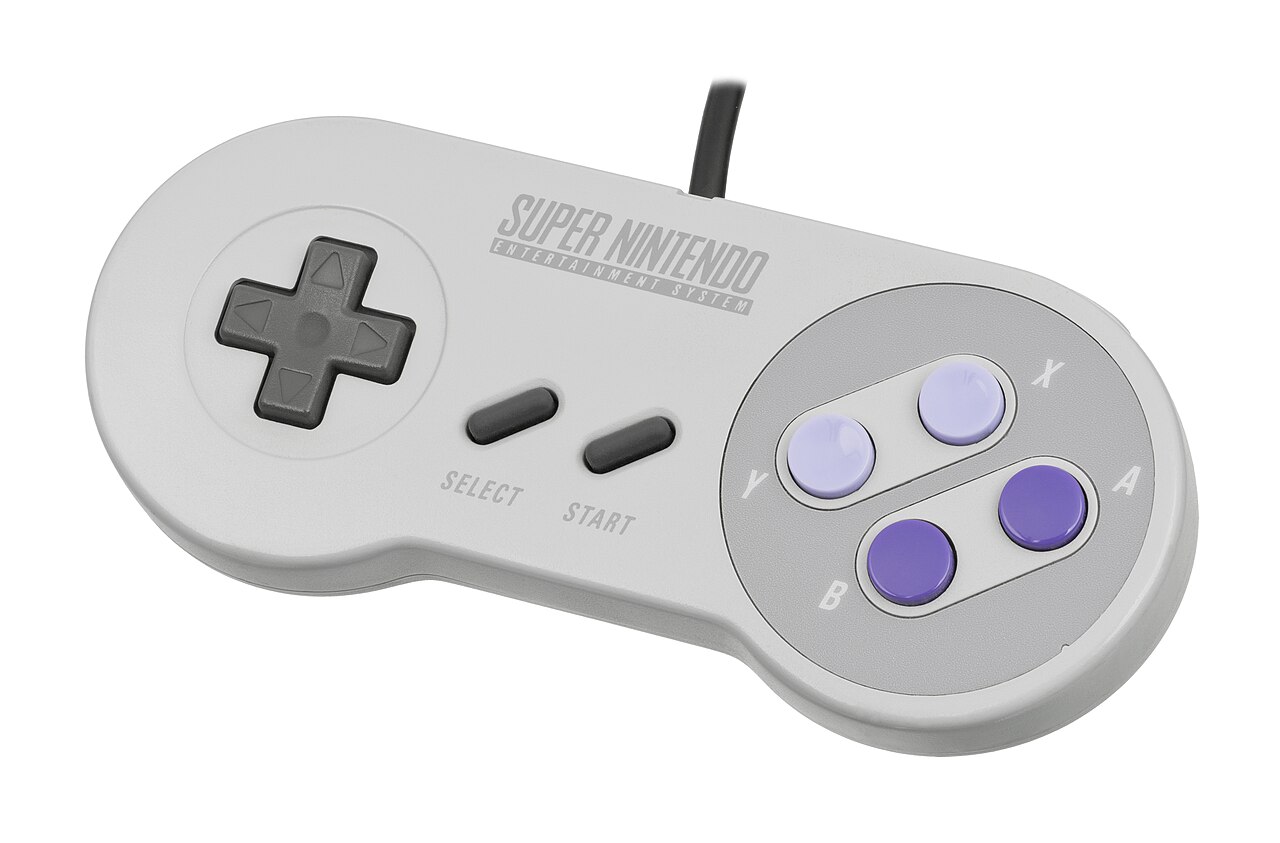
The controls tell the same story. The SNES pad is the most imitated controller layout in history for a reason — diamond face buttons, proper shoulders, a D-pad people still benchmark against — and the SupaBoy folds that layout around its screen rather than reinventing it. That’s the right call: the games were designed for exactly these inputs, and a handheld that honours them disappears in your hands the way a good controller should. The trade is size. A machine built to swallow a full SNES cartridge will never be pocketable in the Game Boy sense; this is a bag handheld, a sofa handheld, a train-table handheld. It has always been so, and the refresh doesn’t pretend otherwise.
Two regions, one slot

The detail that quietly matters most to collectors: the slot takes Super Famicom cartridges as happily as North American SNES ones. That has been a SupaBoy family trait and it remains the strongest practical argument for the device, because the economics of SNES collecting have pushed more and more buyers toward Japanese carts — same game, often a fraction of the US price, and for platformers and racers the language barrier barely exists. A handheld that treats both cartridge families as first-class citizens doubles its useful library without a single adapter, region mod, or converter cart wobbling on top. European PAL owners should check the fine print on any specific unit before buying — PAL’s 50Hz legacy has complicated every device in this class — but for the NTSC world and Japan, the two-regions-one-slot story is complete, and it’s the feature owners consistently say they actually use.
What you will actually play on it
Super Mario World

The pack-in that never was is still the benchmark. Mario World is the cartridge most SupaBoy owners will slot first, partly from muscle memory and partly because it’s the ideal handheld game hiding in a console library: short levels, constant saves via the world map, and colour work that shows off a modern IPS screen beautifully. On a 4.3-inch display the pixel art reads crisp rather than crunchy, and the game’s pick-up-and-put-down rhythm suits a battery-powered machine in a way the TV original never got to demonstrate.
Donkey Kong Country
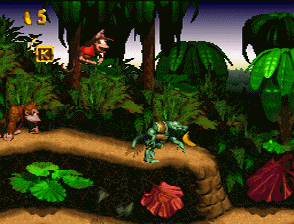
If Mario World is the screen’s friendly exam, Donkey Kong Country is the viva. Rare’s pre-rendered graphics were designed for the forgiving blur of a CRT; on modern panels they can look muddy or magnificent depending on the display’s brightness and contrast, which makes DKC the cartridge that will tell you the truth about this refresh’s IPS panel within one jungle level. It is also, not coincidentally, a game whose mine-cart stages have ended more handheld sessions in rage than any battery ever has.
The Legend of Zelda: A Link to the Past
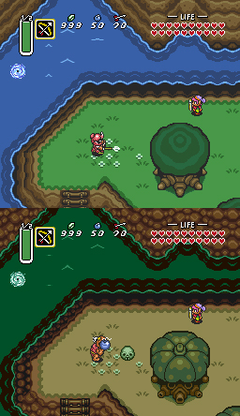
And then there’s the long game. A Link to the Past is where a ~10-hour battery stops being a spec and becomes a playstyle: a full Hyrule campaign carried around the house, dipped into for a dungeon at a time, the cartridge save doing the rest. RPGs and adventures are the SupaBoy’s stealth use case — Chrono Trigger, Final Fantasy III, EarthBound for the brave and the wealthy — because they reward exactly what a handheld offers: frequency over session length. The refresh’s battery claim, if it holds anywhere near its rating in real use, is aimed at precisely these games.
The FPGA question
Now the awkward part, because no 2026 retro handheld gets reviewed in a vacuum. For roughly twice the money, FPGA devices — the Analogue Pocket above all — offer cycle-faithful hardware simulation, cartridge adapters across whole families of systems, save states, sleep, and screens that have become the class benchmark. Clone-based cartridge handhelds like the SupaBoy play the original cart through modern reinterpretations of the hardware, and purists will always find the seams: the odd edge-case game, the accessory that doesn’t fit the slot, the special-chip titles that separate “compatible” from “flawless.” That hierarchy is real and this article isn’t going to pretend otherwise.
But hierarchies have prices, and the SupaBoy’s counter-argument has survived a decade of predictions of its death. It costs $129.99, it is actually in stock, it asks nothing of you — no firmware, no cores, no adapters to buy in a second transaction — and it does the one job on the tin with the least friction of any cartridge handheld ever sold. The retro market keeps rediscovering that “good, available, and simple” beats “perfect, waitlisted, and complex” for a very large number of humans. The refresh’s job was never to beat FPGA. It was to keep the simple option modern — better screen, better battery, colours people want — and on paper, that’s exactly the job it does.
Should you buy one?
The verdict splits cleanly on your shelf. If you own SNES and Super Famicom cartridges — really own them, a row or more — and they spend their lives waiting for TV time, the refreshed SupaBoy at $129.99 is an easy week-one recommendation: Crimson if you want it to look like an event, Prime if you want it to match the original hardware’s family photo. If your SNES life is already FPGA-shaped, or your collection is digital, there’s nothing here to convert you, and Hyperkin knows it. And if you are cartridge-curious but cart-less, do the honest maths first — the handheld is the cheap part of this hobby, and it always has been. The SupaBoy grew up the way its owners did: same games, better screen, longer evenings. Sometimes that’s the whole review.