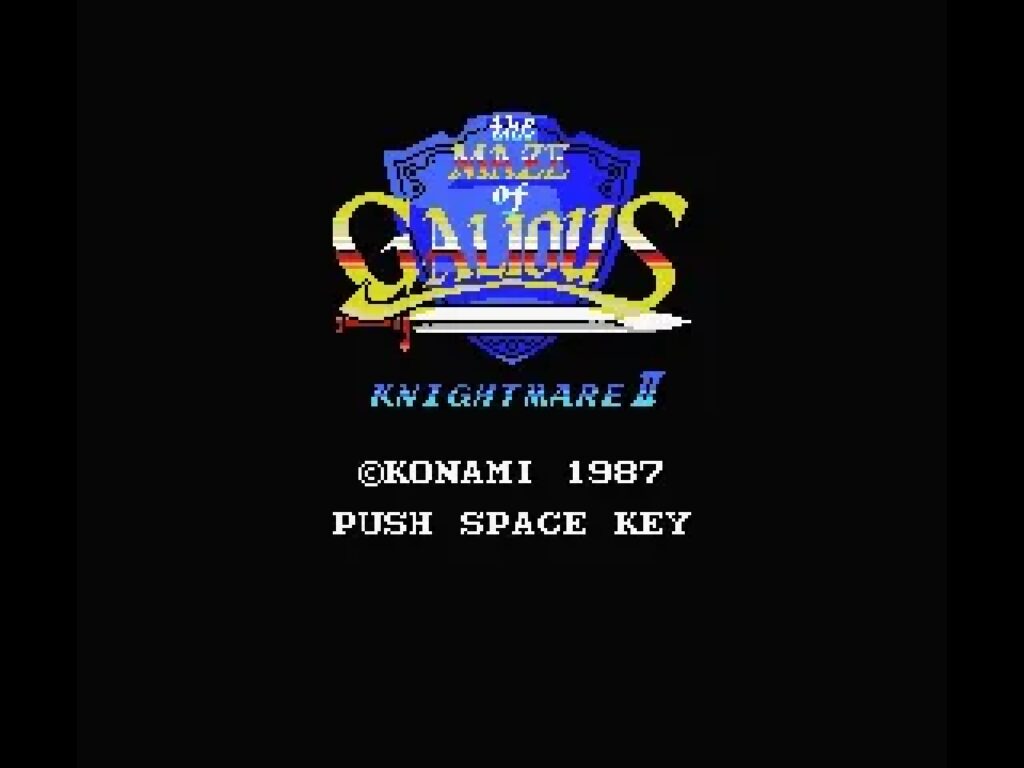
Some games are finished; The Maze of Galious is inherited. Konami’s 1987 MSX sequel to Knightmare — officially Knightmare II — cast players as Popolon and Aphrodite, knight and goddess, storming a castle of ten sealed worlds to rescue their unborn child from the priest Galious. It became the defining adventure of the MSX’s European and Japanese playgrounds: a game so full of secrets that a generation traded its passwords and rumors like scripture. Revisit it now and the legend resolves into something better than nostalgia — one of the finest action-adventures of the 8-bit era.
At a glance: Konami, 1987 · MSX · Action-adventure · Knightmare II
A Castle of Ten Worlds
The structure was audacious for 1987. The castle is a hub of interconnected chambers, shrines and elevators; within it, ten “worlds” — self-contained labyrinths, each ruled by a demon boss — wait behind doors that open to the right preparation. You explore, gather keys, coins, arrows and holy upgrades, learn which goddess-statue blesses which endeavor, and die, repeatedly, in the service of the map forming in your head. It is the Metroidvania formula assembled six months after Metroid itself, with a two-character system layered on top: Popolon and Aphrodite have different strengths, different fates in certain rooms, and the freedom to swap between them turns the castle’s navigation into a genuine partnership.
Secrets All the Way Down
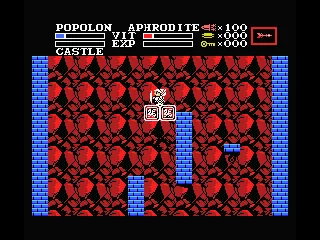
What made Galious immortal is its density of hidden things. Walls conceal shops and shrines; certain rooms respond to specific actions learned from gravestones, fairies and sheer playground folklore; the password system — those famous long strings — let a schoolyard share progress like samizdat. Modern players have the internet; 1987 players had each other, and the game was designed with a cruelty and generosity that assumed exactly that social layer. Knowledge was the real power-up. Few games since have trusted their players this much, or been rewarded with this much devotion.
The Konami Standard
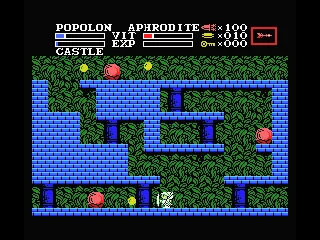
Presentation is pure late-decade Konami: a rich, varied castle of distinct palettes per world, characterful monsters, those indefatigable musical themes, and — for many European copies — the SCC-enhanced experience that marked the company’s premium MSX releases. The difficulty is the era’s honest article: bosses are walls until they are patterns, and the castle’s backtracking demands the mapping patience of its generation. But the game is fair in the way that matters — every death teaches the room that killed you.
Its Long Shadow
The Maze of Galious went on to be cited by the creators of La-Mulana as a foundational influence — the whole modern lineage of archaeological, secret-saturated action-adventures runs back through this castle. Play it and the genealogy is obvious: the inscrutable shrines, the lore in fragments, the bosses as examinations. Indie games with million-dollar budgets have spent twenty years trying to feel like this cartridge feels.
The Two-Hero System, Examined
The Popolon-and-Aphrodite partnership deserves slower attention, because it solves problems most 1987 adventures never raised. The two heroes differ in jump, in strength, in how the castle’s dangers tax them — and certain passages are effectively gated by those differences, teaching you to read a room twice: once for the knight, once for the goddess. It creates a rhythm of rescue and reciprocity rare in the era — each character covers the other’s limits — and it gives the castle a domestic stake no solitary hero could carry: this is a family fighting for its future child, decades before games routinely dared that kind of motivation. The mechanic also multiplies the game’s secrets, since a discovery made by one hero changes the other’s map, and the playground folklore of the era is full of rooms that only made sense once somebody’s sibling tried the other character.
Passwords, Shrines and Schoolyards
Every era of gaming has a technology of community, and Galious’s was the password: those long, precious strings that encoded your progress and could be traded, dictated over telephones, and copied into exercise books with liturgical care. Konami built the game’s social life directly into its systems — the shrine prayers, the fairy messages, the hints that point at actions in rooms three worlds away — a design that assumes players will talk to each other, because no single child in 1987 was going to hold this castle’s entire truth alone. To play it today with a guide open is legitimate; to play it as intended is to recreate that commons in miniature, trading discoveries with a friend as you go. Either way, the castle keeps its essential quality: it feels discovered rather than completed, a place with weather in it.
And one line for the collectors: Galious is among the most beloved MSX cartridges in Europe and Japan alike, and complete Konami-boxed copies have the prices to prove it. The game has also been reissued in Konami’s modern retro collections for the standard, which is the sane way in. However you enter, budget evenings, plural — the castle does not do visits. It does residencies.
Playing It Today
Modern visitors should know the terms of entry. Galious rewards the player it was built for: one who maps, who interrogates every shrine twice, who understands that a locked door is a question the castle will answer three worlds from now. A guide will smooth the sharpest edges — the most cryptic secrets assume a playground’s worth of distributed knowledge — and using one is no confession of weakness; the game’s own community was the first guide. What no guide can supply is the sensation the game was engineered for, the slow conversion of a hostile castle into a known and loved geography, until the final ascent feels like walking a house you grew up in. Give the game its evenings. Few adventures of any era repay residency like this one, and none of its decade does it with more heart per kilobyte.
Verdict
A cathedral of an adventure — vast, secretive, and decades ahead of the genre it helped invent. The MSX’s essential quest.
Nine out of ten, and the missing point is only the era’s customary stinginess with mercy. If you play one MSX adventure, make it this one; Popolon and Aphrodite are still waiting at the castle gates, and the castle is still keeping its secrets the honest way — one discovery at a time.
The Bosses of the Ten Worlds
A word for the castle’s examiners, because Galious’s bosses are where its design philosophy bares its teeth. Each world ends with a demon whose defeat is a thesis: the room, the weapon, the hero — every element you have gathered is questioned at once, and brute persistence without understanding gets the same answer every time. These are not reflex tests so much as oral examinations on the world you just crossed, and failing one sends you back into the castle not punished but enrolled — there is always something else to find, some preparation the castle has been quietly offering. When the tenth demon finally falls, the victory feels earned in the oldest sense: you did not overpower the castle. You learned it. Modern soulslike design built an empire on that sensation; Galious was renting it out in 1987, by the password.