At a glance: Metal Head · 32X · Sega, 1995 · Mech action / mission shooter · Score: 7.5/10
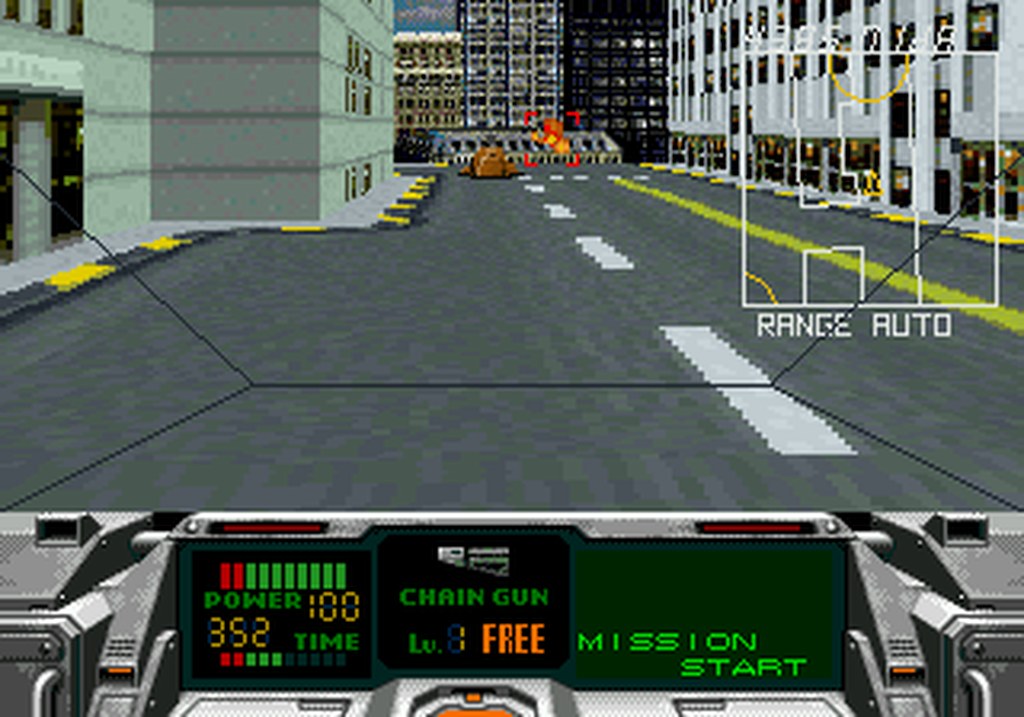
If one game shows what Sega itself believed the 32X was for, it is Metal Head. Not a port, not a licence — an original, built in-house, designed to do the one thing the Mega Drive could never do: texture-mapped 3D, in a city, at street level, with a story told by talking heads between missions. You are a pilot in the Metal Head unit, a police-mech force in a near-future city sliding towards civil war, and across a campaign of patrols, escorts, ambushes and sieges you stomp the streets in a two-legged machine that can, in the game’s best trick, change its legs for wheels and race.
The missions are the substance. This is not an arena shooter with objectives pasted on; each sortie has a brief, a map, a set of friendlies to keep alive or hostiles to prioritise, and a debrief that moves the story. The city is drawn from textured polygons — buildings with actual surfaces, signs, windows — which at the time read as sorcery on a cartridge, and the draw distance fog that keeps the frame rate alive is dressed as atmosphere. Enemies are rival mechs, tanks, gun emplacements and aircraft, and the combat model rewards positioning: strafe around a corner, manage your weapon heat and ammunition, use buildings as the cover they plainly are.
The heads that talk
Between missions, Metal Head does something no Mega Drive game could: it talks. Digitised portraits with animated mouths deliver the plot in full voice, in English or Japanese, with a cheerful B-movie earnestness that has aged into pure charm. The story — a coup, a conspiracy, a city holding its breath — is no masterpiece, but the presentation ambition is the point. Sega was demonstrating a kind of game the 16-bit generation simply could not stage, and the talking-head briefings remain the single most ‘next generation’ feeling on the whole 32X.
The mech itself is the other star. Weapons are bought and fitted between missions with earned credits — a small economy of cannons, missiles and armour that gives the campaign a spine of progression. And the leg-swap transformation, walker to wheeled racer at the press of a combination, is more than a gimmick: wheeled mode trades firepower for speed, and missions quietly teach you to arrive fast and fight heavy. Control is unavoidably complex on the pad, with the six-button controller close to mandatory, and the learning curve of the first missions is the game’s steepest hill.
Full voice, talking heads, a transforming mech in a texture-mapped city: Metal Head is the most ‘next generation’ feeling on the whole 32X.

The frame rate is the price of all this ambition. Metal Head’s textured city costs frames the flat-shaded racers never missed, and in heavy crossfire the game slows to a determined trudge. It stays playable — the pace of mech combat forgives what a racer could not — but players raised on Virtua Racing Deluxe’s silk will feel the grain. Mission length compounds it: long sorties with no mid-mission save make failure expensive, a very 1995 kind of toughness.
The 32X version, specifically
There is no other version — Metal Head is a 32X exclusive, Sega’s own proof of concept for its own add-on, and it has never been re-released. That exclusivity is now its burden and its glory: the only way to play one of the most technically distinctive games of 1995 is on the mushroom itself. For collectors it has become, alongside Chaotix and the arcade ports, one of the system’s defining cartridges.

Verdict: ambitious, characterful and imperfect — a mech campaign with a presentation suite a generation ahead of its hardware’s reputation. The frame rate argues; everything else persuades. One of the essential 32X exclusives.
Time has sorted the 32X library into the famous, the infamous and the forgotten, and Metal Head rewards being met on its own terms rather than through any of those reputations. Played today — on a serviced stack, through a clean video path, with the six-button pad the era intended — it is a reminder that the mushroom’s forty games were never its problem. The problem was the calendar they were born into, and calendars cannot be replayed. Games can.
There is also the matter of what Metal Head says about its machine. The 32X was sold as a bridge to the 32-bit future and remembered as a dead end, but its best cartridges argue a subtler case: that for eighteen months it was simply a good games platform with a small, strange, high-quality library, judged at the speed of a market panic rather than at the pace games deserve. Revisiting it now, without the panic, is the closest thing the platform will ever get to a fair trial — and on the evidence of this cartridge, the defence rests well.
For collectors, Metal Head sits in the honest middle of the 32X market: neither the loose-change common nor the four-figure grail, but a cartridge that rewards the hunt and justifies its shelf space every time the stack is powered up. In a library this small, every game is a significant fraction of the whole. This one earns its fraction.
What lingers after the credits is how completely Metal Head belongs to its moment — and how well that moment has kept. The early polygon years are often treated as an embarrassing adolescence for the medium, all jagged edges and experimentation. The best 32X games suggest otherwise: the experiments were the point, the edges were the aesthetic, and a generation of designers was learning 3D in public, at full speed, on hardware like this. Metal Head is one of their better lessons.
Time has sorted the 32X library into the famous, the infamous and the forgotten, and Metal Head rewards being met on its own terms rather than through any of those reputations. Played today — on a serviced stack, through a clean video path, with the six-button pad the era intended — it is a reminder that the mushroom’s forty games were never its problem. The problem was the calendar they were born into, and calendars cannot be replayed. Games can.