
At a glance: Doom · 32X · id Software / Sega, 1994 · First-person shooter · Score: 6.5/10
Every early 32X owner owned this, and every one of them has an opinion. Doom was the biggest game on Earth in 1994, and Sega needed it on the add-on for launch — needed it so urgently that the port was built at sprint speed, reportedly from an early, unfinished codebase, by a small team against a deadline that could not move. The result is gaming’s most famous letterbox: a play window bordered on all sides, roughly three-quarters of the screen, inside which id’s masterpiece runs at a reduced resolution. And yet. Inside that window is Doom — recognisably, playably, enjoyably Doom — on a Mega Drive, in 1994, and the miracle and the mess have to be judged together.
The content is a curated seventeen levels drawn from Knee-Deep in the Dead and The Shores of Hell — the Inferno episode is absent, along with the BFG, the Cyberdemon and the Spider Mastermind, which trims the campaign’s climax into an anticlimax for PC veterans. What remains is chosen well: the hangar, the nuclear plant, the refinery, the command control rooms — the levels that taught a generation what a first-person shooter was. Weapons run from fist to rocket launcher, monsters from zombie to Baron of Hell, and the level geometry, secrets included, is faithfully reproduced.
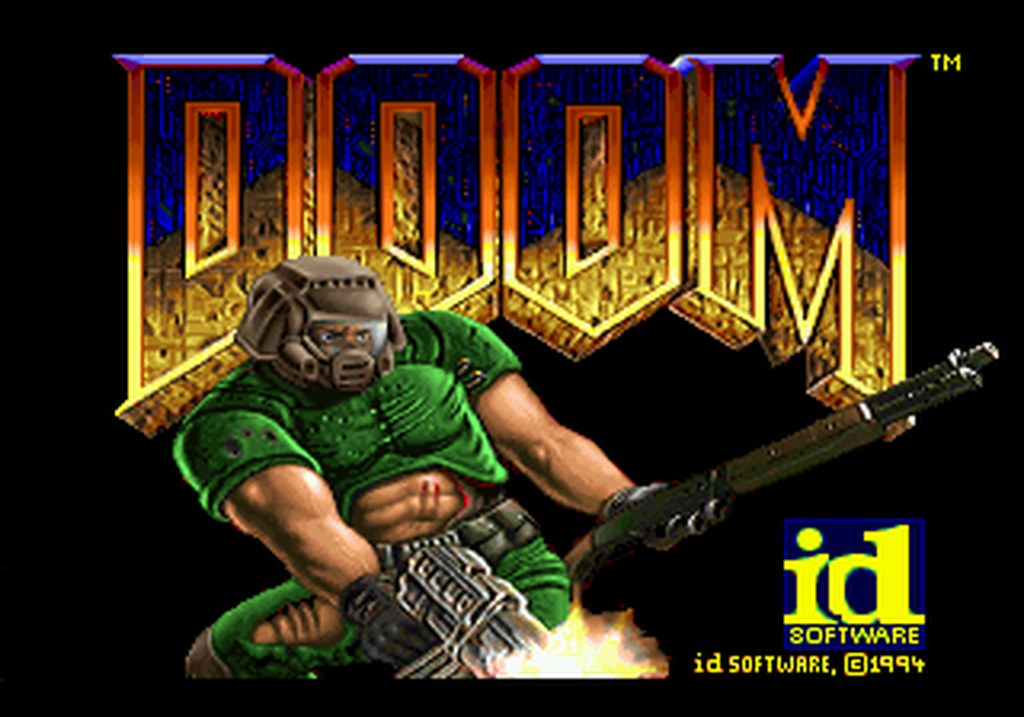
The window, the music, the argument
Let us settle the two eternal arguments. The window: yes, it is small, and yes, the resolution inside it is coarse enough that distant enemies dissolve into suggestion. But the frame rate inside that window is the port’s redemption — it moves. Where the SNES version (a year later, on a Super FX2) chugs through full-screen mazes, the 32X game flows, and Doom that flows is Doom. The music: the Mega Drive’s FM chip renders Bobby Prince’s score in a rendition so abrasive that fans christened it with nicknames unfit to print. Judged fairly, a few tracks survive as crunchy curiosities; as a whole it is the port’s weakest element, and the sound effects — sampled, punchy, correct — only sharpen the contrast.
Controls are the third compromise. The standard three-button pad maps weapon cycling and strafing onto combinations that demand rehearsal; the six-button pad, which the game quietly expects, restores sanity with dedicated strafe buttons. With the right controller, Doom 32X handles like a proper console shooter of its era — turn speed is brisk, the auto-aim is generous, and the difficulty, capped at ‘Hurt Me Plenty’ equivalents in spirit though named otherwise, is tuned for the pad rather than the mouse.
Inside that famous letterbox is Doom — recognisably, playably Doom — on a Mega Drive, in 1994. The miracle and the mess must be judged together.

History has been oddly kind to this port, partly because of what fans later proved: the homebrew ‘Doom Resurrection’ project rebuilt the game for the same hardware with the full screen, the missing episode content and a repaired soundtrack, demonstrating that the 32X could have done far better with more time. That knowledge cuts both ways. It convicts the original schedule, but it also confirms what playing the 1994 cartridge suggests — the bones here were sound. The levels are right, the speed is right; the finish was rushed, not the conception.
The 32X version, specifically
Against its contemporaries this was, for a window of about a year, the best Doom on any console — faster than the SNES, more faithful than the 3DO’s notorious slideshow, and beaten only when the Jaguar’s excellent port and later the PlayStation’s arrived in force. Its historical role is larger still: it was the add-on’s best-selling argument, the game that put 32X hardware into the most homes, and the port every subsequent console Doom was measured against.

Verdict: a compromised classic — trimmed content, a small window, a soundtrack to survive rather than enjoy — wrapped around a fast, faithful, genuinely fun core. Not the Doom to choose in a world of perfect ports, but the Doom that mattered most in November 1994, and far better than the jokes about it suggest.
Time has sorted the 32X library into the famous, the infamous and the forgotten, and Doom rewards being met on its own terms rather than through any of those reputations. Played today — on a serviced stack, through a clean video path, with the six-button pad the era intended — it is a reminder that the mushroom’s forty games were never its problem. The problem was the calendar they were born into, and calendars cannot be replayed. Games can.
There is also the matter of what Doom says about its machine. The 32X was sold as a bridge to the 32-bit future and remembered as a dead end, but its best cartridges argue a subtler case: that for eighteen months it was simply a good games platform with a small, strange, high-quality library, judged at the speed of a market panic rather than at the pace games deserve. Revisiting it now, without the panic, is the closest thing the platform will ever get to a fair trial — and on the evidence of this cartridge, the defence rests well.
For collectors, Doom sits in the honest middle of the 32X market: neither the loose-change common nor the four-figure grail, but a cartridge that rewards the hunt and justifies its shelf space every time the stack is powered up. In a library this small, every game is a significant fraction of the whole. This one earns its fraction.
What lingers after the credits is how completely Doom belongs to its moment — and how well that moment has kept. The early polygon years are often treated as an embarrassing adolescence for the medium, all jagged edges and experimentation. The best 32X games suggest otherwise: the experiments were the point, the edges were the aesthetic, and a generation of designers was learning 3D in public, at full speed, on hardware like this. Doom is one of their better lessons.