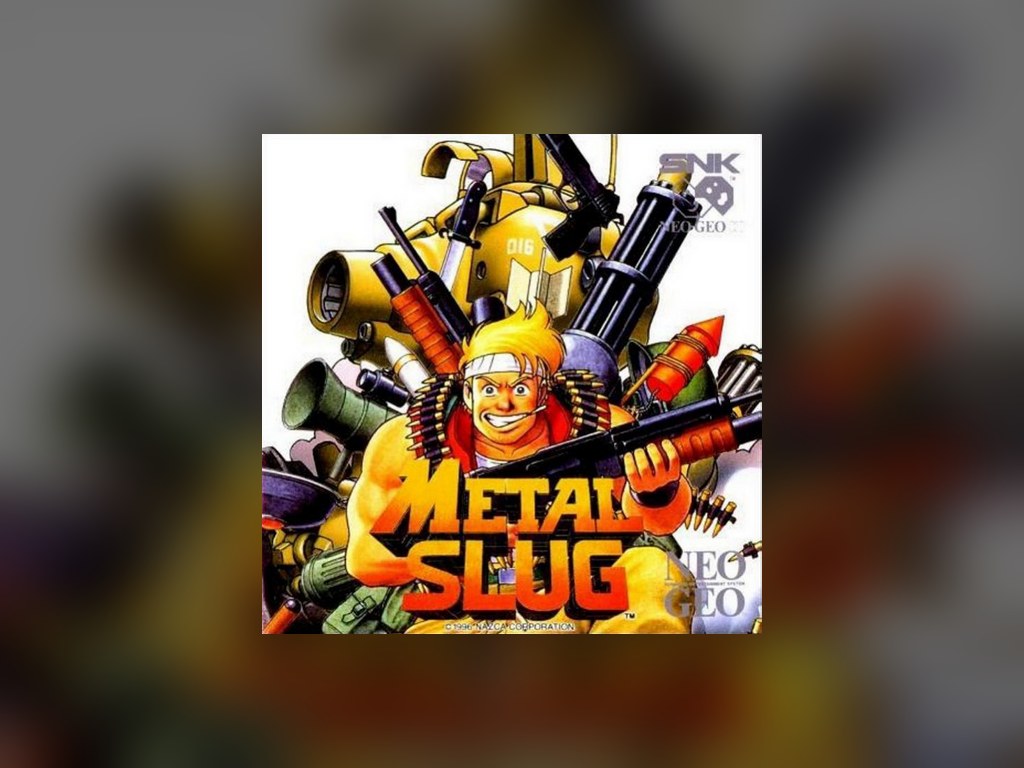
At a glance: Metal Slug · Neo Geo CD · Nazca / SNK, 1996 · Run-and-gun · Score: 9.0/10
There is a reason Metal Slug became the Neo Geo’s calling card, and it is visible in the first ten seconds: a soldier who fidgets, yawns and adjusts his bandana when you leave the stick alone, enemies who sunbathe, panic, and flee, and a world drawn with the obsessive density of a great newspaper cartoon. Nazca, a young team formed from Irem alumni, built the 1996 original as a deliberate antidote to the po-faced military shooters around it. You are Marco Rossi (or Tarma Roving in player two’s seat), running rightwards through six missions against General Morden’s army, freeing bearded prisoners who repay you with weapons, points and the occasional roast chicken.
The run-and-gun grammar is classic — eight-way-ish shooting on the flat, a jump, a grenade button, and the crouch that turns survival into geometry — but the execution is anything but generic. The Heavy Machine Gun chatters, the Rocket Launcher arcs, the Shotgun deletes crowds, and the Flame Shot turns screen-filling set-pieces into barbecues. Then there is the Slug itself: the SV-001 tank, armoured, jump-capable, with a vulcan cannon and a main gun that can be aimed while the hull soaks up hits meant for you. Vehicles were not new to the genre; a vehicle with this much personality, that visibly dents, smokes and finally dies under you, was.
Six missions of escalating invention
What keeps Metal Slug at the top of the format’s library is that it never repeats a trick without raising it. Mission one is a beachhead stroll; mission two introduces the train and the first taste of vertical pressure; by mission four you are fighting up a mountainside and across a collapsing bridge, and the finale strings together a harbour assault, a boss rush of accumulated grudges and Morden’s last stand. Every mission hides branching paths, POWs tucked behind scenery, and score routes that reward the brave. The bosses are the showpieces the animation budget was saved for: the giant Tani Oh cannon, the Hairbuster Riberts biplane duel, the Hi-Do helicopter fought across a broken bridge — each one a small mechanical theatre with tells, phases and a deeply satisfying explosion.
Difficulty is honest arcade difficulty. One hit kills Marco, continues are a button press away on the home formats, and mastery means learning the game as a score attack: weapon management, grenade economy, when to abandon a dying Slug and when to ride it into the fire. Two-player co-op doubles the chaos and halves the life expectancy of everything on screen, and it remains one of the finest shared afternoons the system offers.
The CD question: loading, audio and what survives
Judged specifically as a Neo Geo CD conversion — which is the only honest way to judge it here — Metal Slug is one of the format’s success stories, with one famous caveat. The caveat is loading: the CD’s single-speed drive, streaming at roughly 150KB/s into 7MB of RAM, needs a noticeable pause before each mission — long enough to watch the juggling monkey do its act — and shorter top-ups at mid-mission boundaries on the larger stages. It is not the worst offender on the system, because the game was designed in self-contained missions rather than as one continuous world, but nobody will mistake it for the cartridge’s instant start.
Against that, everything that matters survives. The animation — the entire point of Metal Slug — is present in full: no frames were sacrificed to fit the RAM budget, because the per-mission structure let Nazca stream each stage’s art as a complete set. And the audio is a genuine upgrade. The CD version carries an arranged, CD-quality soundtrack that takes the original’s military-band swagger and gives it real brass, real drums and room to breathe; the title and mission themes here are the versions many fans consider definitive. Sound effects and voices stream cleanly, and the whole presentation feels like the arcade record remastered rather than reduced.

Metal Slug on CD is the moment the Neo Geo stopped being a rumour most players had only seen in magazines and became a machine you could actually own.
CD versus AES
The comparison that decided real purchases in 1996 still frames the game today. The AES cartridge was — and remains — one of the most valuable objects in retro gaming, a three-figure (now four-figure) rarity that most Neo Geo owners never owned. The CD version launched at ordinary new-game money. Content-wise the disc is complete: same six missions, same endings, same two-player mode, with the arranged soundtrack as a CD-only bonus. What you trade is flow: the cartridge never interrupts you, the disc pauses between missions, and purists note the CD’s occasional mid-stage top-up loads on the biggest set-pieces. In every other respect — sprites, animation, difficulty, secrets — this is the same game, which is precisely why the CD pressing became the way most of the world actually played Metal Slug at home.
The set-pieces that built a legend
Reputation in Metal Slug is earned scene by scene, and the CD version’s completeness matters precisely because the scenes are the game. The mission-three train, fought car by car as the landscape scrolls beneath; the mission-five harbour, where the Hi-Do duel plays out across a collapsing bridge while the arranged score does its best war-film work; the POW hidden behind the waterfall, the one every veteran routes for without thinking — all of it is here, frame for frame. Later ports and compilations have occasionally trimmed, re-timed or re-balanced these moments; the CD, being a contemporary conversion by the format’s own engineers, presents them as 1996 intended, at the original difficulty, with the original slowdown-free pacing the game was tuned around.
That fidelity extends to the small print collectors care about: the CD pressing carries the full attract and options suite of the home conversion, the two-player mode without restriction, and the Japanese and export presentations selectable by machine region — the disc itself is region-free, so a Japanese pressing on a Western machine plays the Western game. For a title whose cartridge is a four-figure artefact, the CD is not a footnote in its history; it is the edition through which the game was a living-room fixture rather than a magazine photograph, and it plays like one.
The CD version in 2026
Playing Metal Slug on the format today is a choice among honest goods. Original hardware gives the arranged soundtrack its full voice and the disc its period rhythm — mission loads and all — with the CDZ halving the pauses and an SD loader erasing them for players who have served their time with the monkey. Emulation preserves the game faithfully for sampling, and the disc itself, region-free and plentiful beside its cartridge’s four-figure shadow, remains the ownership sweet spot of the whole series on home hardware. However you arrive, arrive with a second pad: this is a co-op game to its bones, and its best moments were always scored for two players and a room that can hear the soundtrack properly.
The verdict
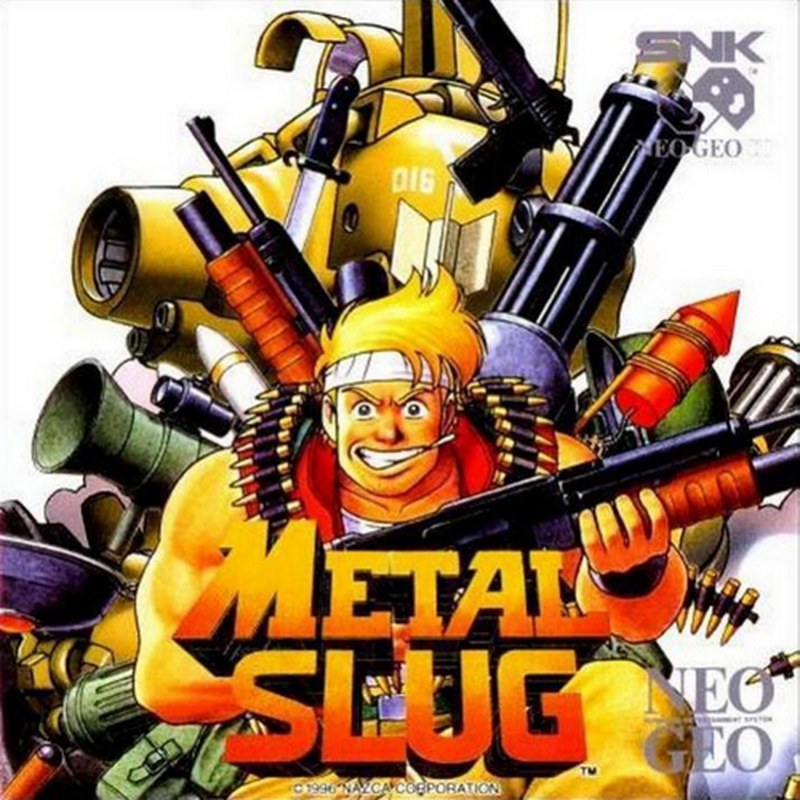
Metal Slug did not need the Neo Geo CD, but the Neo Geo CD badly needed Metal Slug: proof that the disc format could carry the system’s most celebrated artistry without amputating it. The loading is real, the monkey is patient, and neither matters much once the first mission’s arranged brass kicks in and the screen fills with Nazca’s beautiful, ridiculous war. As a game it is a masterpiece of its genre; as a CD conversion it is one of the format’s defining bargains — the masterpiece, whole, at a fraction of the cartridge’s price.
Score: 9.0/10 — The masterpiece, whole, with the best soundtrack — the disc that justified the machine.