At a glance: Demon Attack · Intellivision · Imagic, 1982 · Fixed shooter · Designed by Rob Fulop (Atari 2600 original) · Score: 8.5/10
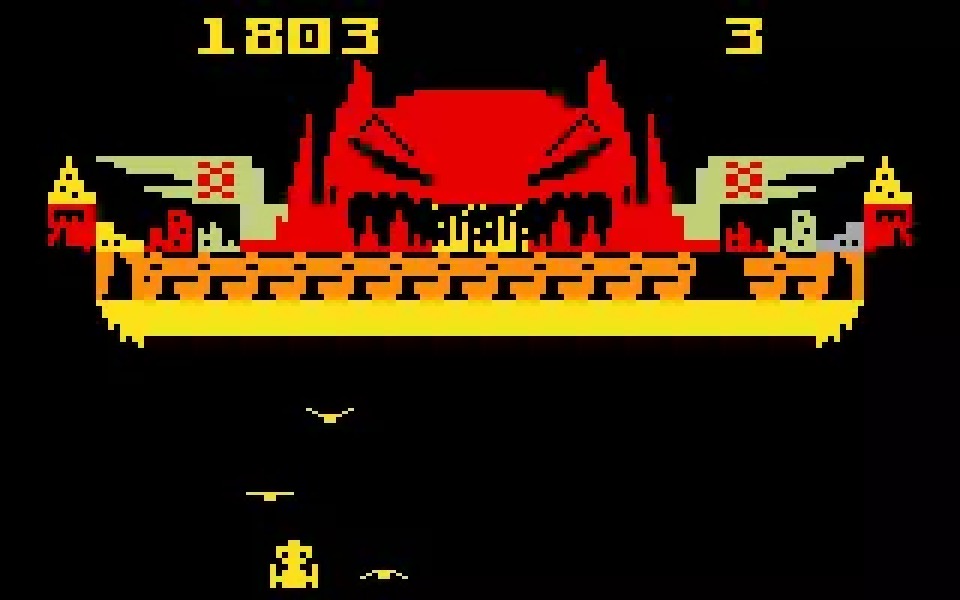
Everybody knows the Atari 2600 version of Demon Attack, and they should — Rob Fulop’s 1982 Imagic shooter, waves of gorgeous, fluttering demons diving at your lone cannon on a moon’s surface, was one of the 2600’s defining games. But the Intellivision version is the connoisseur’s secret. Built for hardware with finer graphics and a bigger palette, it keeps everything that made the original great — the demon designs, the escalating waves, the split-and-multiply chaos of the later birds — and then adds something the 2600 could not: an ending of sorts, a final assault on the demons’ own fortress, a great red Pandemonium mothership that turns an endless score-attack into a campaign with a destination. If you have only played the famous version, you have played the demo. This is the album.
The demons themselves
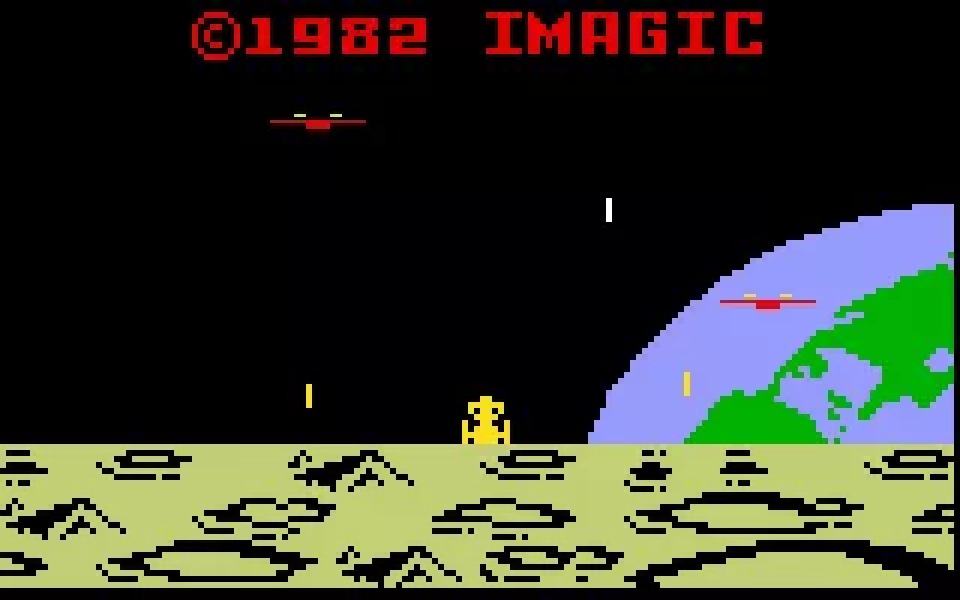
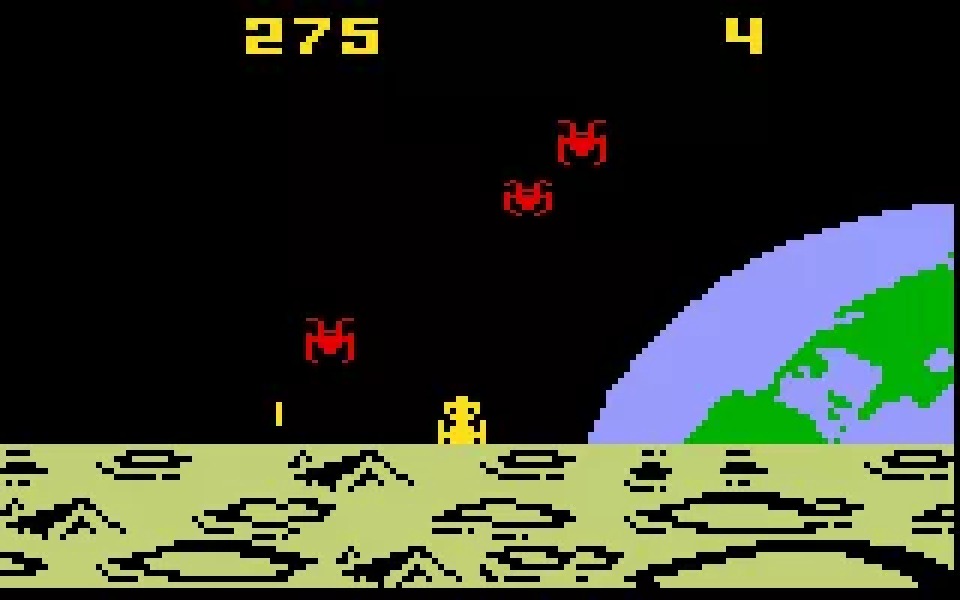
Start with what made Demon Attack Demon Attack. The enemy design, in an era of squares and blobs, was a revelation: demons with flapping wings, rendered in multicolour sprites that genuinely perform — hovering, darting, splitting into smaller demons when shot in the later waves, raining fire in patterns that feel choreographed rather than random. The Intellivision hardware, with its finer sprite handling and richer colour, lets those designs breathe: the demons are larger, the animation smoother, the planet looming behind the battlefield a saturated blue-green marble that gives the whole game the look of a pulp paperback cover. Your cannon sits on a cratered moonscape, rendered in the same detailed style, and the entire scene has a visual richness that the 2600 — for all its programming heroics — could only suggest.
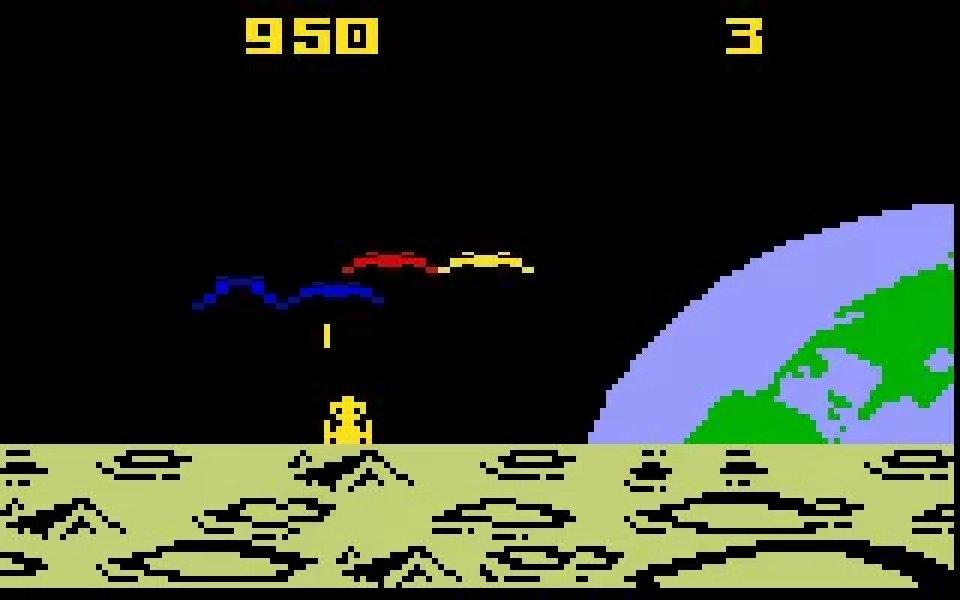
The shooting model is the genre’s classic purity: move, fire, survive. But Fulop’s wave design gives Demon Attack its grip. Early waves teach the demons’ flight in forgiving numbers; later waves layer the types — the splitting demons, the ones that drop like stones, the ones that weave — until the screen is a genuine ballet of threats and the correct position is a place that exists for half a second. The game’s sound supports the menace with eerie, pulsing effects that build as waves progress, a rising dread quite unlike the cheerful bleeps of most fixed shooters.
The Pandemonium difference
The Intellivision edition’s signature addition waits at the top of the climb: survive the waves and you face Pandemonium, the demons’ fortress — a huge red bastion filling the top of the screen, bristling with guns, which you must dismantle under fire. In structural terms this transforms the game. The 2600 original is an infinite escalator: play until you die, score what you score. The Intellivision version gives the escalator a top floor — a boss fight, in modern vocabulary, years before boss fights were standard grammar on home consoles — and then, gloriously, loops you back to do it all again faster. Reaching Pandemonium the first time feels like an event; beating it feels like a campaign medal. Version-comparison pieces often treat ports as footnotes to originals. Here the port is the more complete work, and collectors who know both versions tend to keep this one plugged in.
The two-player support and difficulty options round out a generous cartridge, and the whole package carries Imagic’s trademark polish — the same house style that made Atlantis and Microsurgeon (both covered in this wave) look like dispatches from a more colourful universe than the one Mattel and Atari painted in.
Where it sits
Measured against the Intellivision’s own fixed shooters, Demon Attack is Astrosmash’s great rival for the crown: less systemic than Sohl’s game — no deduction scoring, no colour-band difficulty intelligence — but more theatrical, more beautiful, and possessed of the better finale. The honest summary is that the system is lucky enough to have both arguments. Measured against the wider fixed-shooter field of 1982, the Intellivision Demon Attack stands with Phoenix and the best arcade conversions as the genre’s high-water mark on home hardware.
One caution for shoppers: the versions differ enough that the box matters. This review covers the Intellivision cartridge by Imagic; the 2600, Odyssey² and other editions are their own games with their own merits, but Pandemonium lives here.
The Fulop factor, and Imagic’s house style
Rob Fulop’s name on a 1982 shooter meant something specific, and it is worth spelling out for readers meeting him here first. Fulop had been at Atari, where his ports and originals were noted for polish beyond the hardware’s apparent limits; at Imagic he became part of a small group of designers who treated the fixed shooter as a form worth perfecting rather than a formula worth repeating. Demon Attack was his signature: a game whose every decision serves the moment-to-moment duel — the demons’ wingbeats have a rhythm you learn in your hands, the cannon’s fire rate sits exactly at the boundary between generous and desperate, and the waves breathe, tightening and loosening like something alive. The Intellivision conversion team inherited all of that and, to their credit, changed nothing that worked. What they added — visual richness, the fortress — is additive rather than revisionary, which is precisely how a great port should behave.
There is also a historical point hiding in the box art’s shadow. Imagic was the Intellivision’s defining third-party voice: where Activision made its name on the 2600, Imagic’s most ambitious work kept landing on Mattel’s machine — Atlantis, Beauty & the Beast, White Water!, Microsurgeon, and this. The company understood the hardware’s palette and its audience’s appetite for presentation, and its Intellivision catalogue is the strongest argument that the system’s third-party ecosystem, though smaller than Atari’s, punched at a higher average weight. Demon Attack is where that argument starts.
The verdict
Demon Attack on Intellivision takes one of the era’s finest shooters and makes it finer: richer demons, a more beautiful battlefield, and a fortress finale that turns survival into victory. It is Imagic’s showpiece on the system and one of the essential third-party cartridges in the library. The 2600 version made the legend. This version completes it.
Playing it today, what lingers is the game’s confidence. Demon Attack never hurries you toward its best material and never apologises for its simplicity: one cannon, one moon, wave after wave of beautifully animated malice, and a red fortress somewhere up the road with your name on it. In a library — and an era — full of shooters auditioning for your attention, this is the one that behaves as if it already has it. Four decades on, it still does. New players raised on modern twin-stick shooters will find the grammar familiar and the discipline stricter: no bombs, no upgrades, no mercy mechanics, just position and timing and the demons’ terrible choreography. That purity is not a limitation of its age. It is the reason the game has outlived nearly everything that tried to complicate it.
File it, finally, where it belongs: beside Astrosmash at the top of the system’s shooter shelf, the beauty to Sohl’s brains, and the cartridge that proves the Intellivision’s third-party scene could beat the first-party at its own game when Imagic was in form.
Score: 8.5/10