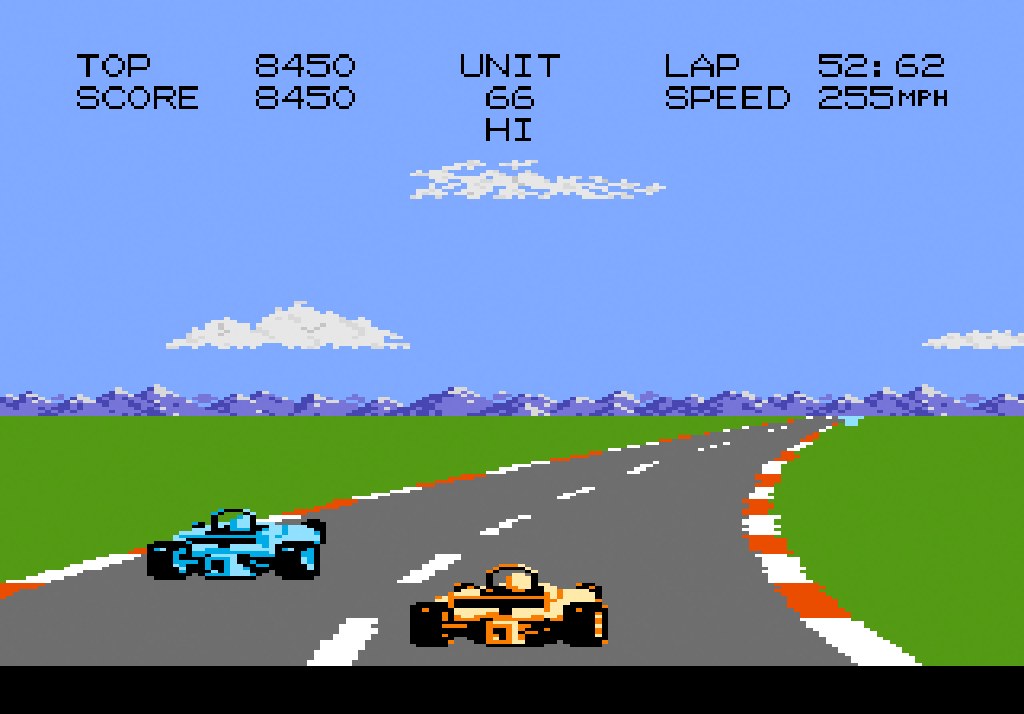
At a glance: Pole Position II · Atari 7800 · Namco / Atari, 1984 (released 1986) · Racing · Score: 8.0/10
Every 7800 ever sold in North America began its life with this game inside the box. Pole Position II was the pack-in — the cartridge Atari chose as the console’s first impression, in the 1984 test launch and again in the 1986 relaunch — and the choice tells you what Atari thought the 7800 was: an arcade machine for the living room, leading with Namco’s flagship racer. The home version of the sequel to the biggest driving game on Earth was a statement of intent. Judged today, the statement mostly holds up: this is a handsome, fast, four-track arcade racer that flatters the hardware, even if its shallowness shows sooner than the pure score-attack games of the launch line.
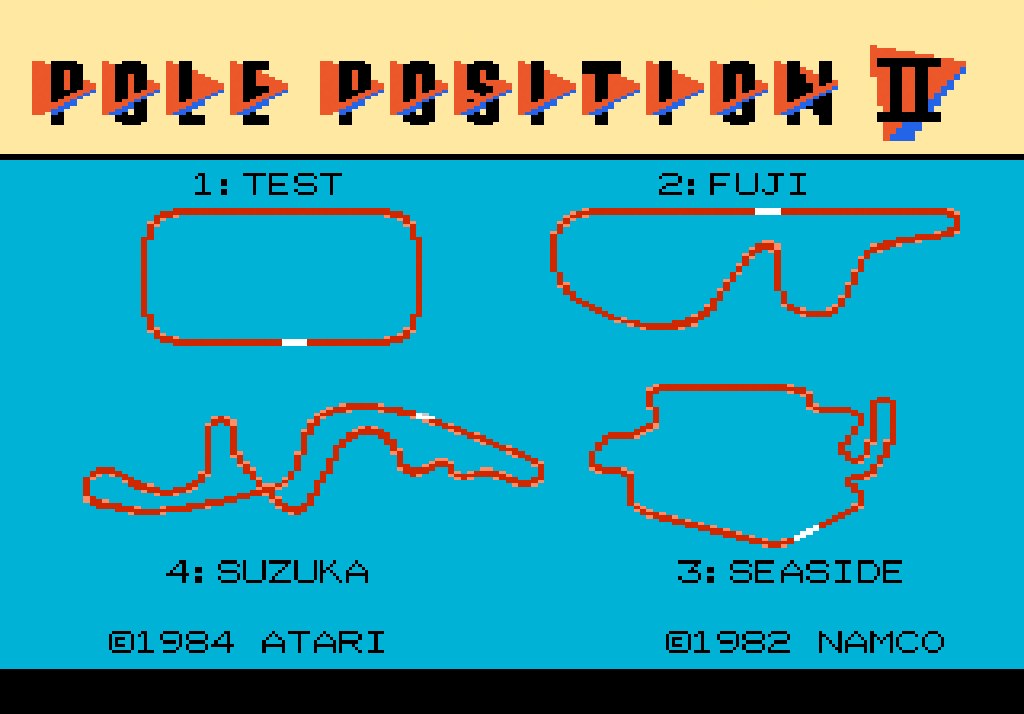
The sequel’s headline is choice. Where the original Pole Position offered one circuit — Fuji — the sequel offers four: the Test track, an oval for finding your feet; Fuji itself, with Mount Fuji presiding; Suzuka, tight and technical; and Seaside, a coastal run with the era’s idea of scenery, amusement parks and shoreline rolling past. Each is selectable from a track menu that shows their silhouettes, and each changes the racing meaningfully — corner sequences, traffic patterns, the rhythm of qualifying. For a pack-in in 1986, four circuits was generosity.
Qualifying matters
The structure is the arcade’s two-act play. First, qualify: one flying lap against the clock to earn your grid position, with the readout showing where your time slots you among the eight places. Then the race itself — a multi-lap Grand Prix against the full field, with points accumulating across the run. The qualifying lap is Pole Position’s quiet genius as a home game, because it makes every session begin with a pure time trial: no traffic, no excuses, just you and the car’s two gears. High and low. That is the whole transmission — this is 1982’s design, after all — and the 7800’s two-button Pro-Line stick maps naturally onto it, one button effectively becoming your shifter’s home.
On the road, the game is a pleasure of its period kind. The car is big and assertive, the roadside signs whip past with the proper sense of speed, rival cars wear their period liveries, and the explosion that follows a high-speed misunderstanding is satisfyingly total — followed, generously, by a fresh car and a ticking clock rather than a game over. The draw distance and road curvature are arcade-plausible, and the 7800 keeps the frame rate civilised even with the field bunched ahead of you. Steering is digital, of course, and the car’s response has that slightly binary, lane-to-lane decisiveness of the era’s home racers; within a lap your hands learn the increments.
The pack-in’s burden
A pack-in has a second job: to make the console look good to a first-time owner in the first five minutes. Pole Position II was well cast. It is bright where the launch shooters are dark, fast where they are tense, and instantly readable to anyone who had ever seen the arcade game — which, in 1986, was everyone. It also showed off MARIA’s roadside-object handling: signs, grandstands, mountains and shoreline furniture streaming past without a flicker. If it lacks the Asteroids/Centipede style of bottomless score-chase depth, that was arguably the point. This was the demo, and as a demo it sold the machine’s arcade credentials in one lap.
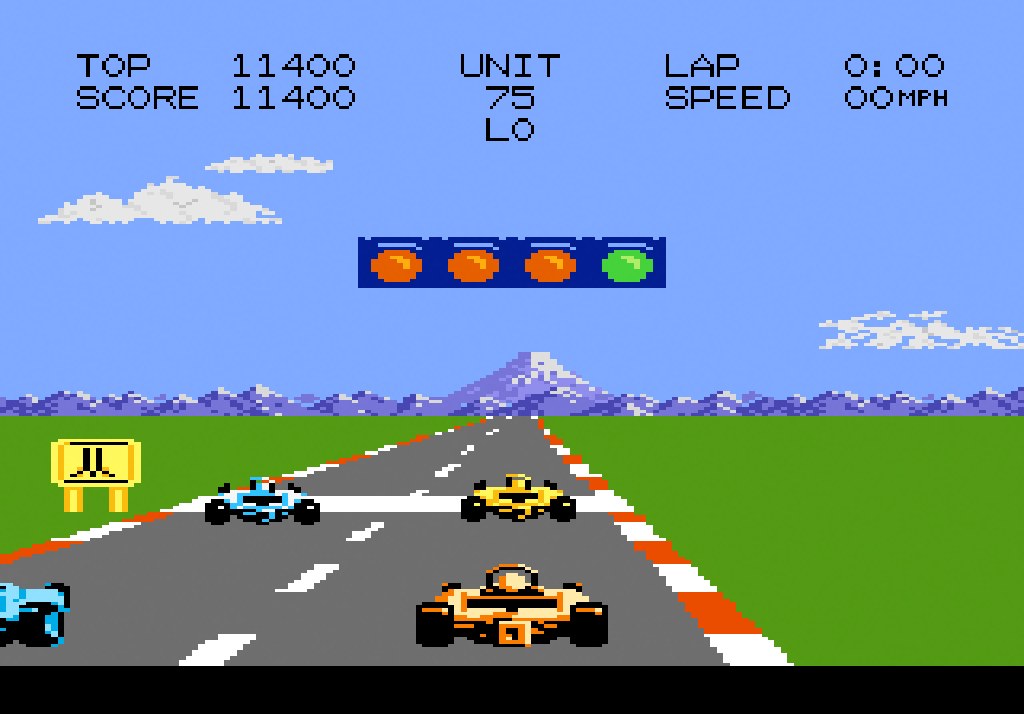
Four tracks, two gears, one job: be the arcade. As the 7800’s front door, Pole Position II opened the house well.
The debits accumulate on longer acquaintance. The engine note is TIA-thin, a wasp in a jar where the arcade had a proper snarl; the collision model is unforgiving, with rival cars effectively armoured and every touch a fireball; and once you have learned the four tracks, the game’s ceiling arrives — there is no championship structure, no weather, no tuning, just faster traffic and your own consistency. Rival home versions of the era do not embarrass it, but the design itself was ageing even in 1986, in a world where Out Run was about to redefine the arcade racer entirely.

Four circuits, four tempers
The tracks repay individual attention, because the sequel’s real content lives in their differences. The Test oval is a laboratory: long straights, gentle banking, the place to learn the two-gear discipline and the exact moment a rival car becomes an obstacle instead of a landmark. Fuji is the classic — the mountain watching, the long curves punishing greed, the circuit from the original game expanded into company. Suzuka is the technician’s track, its sequences arriving quickly and demanding the low gear more honestly than any other. And Seaside is the showpiece, the one that trades lap-time purity for spectacle, with the coast and the fairground rolling by — the track a 1986 buyer would show a friend to justify the console. Traffic behaviour varies subtly between them, and the qualifying cut-offs tighten, so a grid slot earned at Suzuka feels different from one earned on the oval. For a game with two gears and no brakes worth the name, that is a respectable amount of texture.
There is skill in the racing, too, of the era’s particular kind: memorising each circuit’s corner order, learning which bends can be taken flat in high gear with a rival in the way, and managing the clock — because the Grand Prix format is ultimately a time trial with traffic, and the points table rewards the finisher who treats every lap like qualifying with consequences.
Historical footnote, and a pleasing one: because Pole Position II was the pack-in on both sides of the warehouse years, it may be the most-owned 7800 cartridge in existence — which makes it, for many owners, not just a game but the smell of the console’s first morning. Nostalgia is not a review criterion. But a pack-in that still earns its slot forty years later is doing something right, and this one is.
And spare a thought for what the game had to survive. Pole Position II was manufactured for a 1984 launch, warehoused through a change of ownership, and reissued in 1986 as the ambassador of a console the market had already begun to write off — against a Nintendo phenomenon gathering force by the month. It was asked to be a system-seller in two different decades of the same industry, effectively, and it carried the role with more dignity than the strategy around it managed. Played today, stripped of that burden, it is simply what it always was underneath: a bright, brisk, four-track arcade racer that still knows how to make a qualifying lap matter.
It also remains the friendliest first cartridge a new collector can buy: ubiquitous, inexpensive, and immediately fun in the way only a two-gear arcade racer can be. Some pack-ins are filler. This one was a flag planted.
Start your engine, then. The grid is waiting, and it has been waiting — twice — since 1984.
The verdict
As a pack-in and a period piece, Pole Position II is a success: four real circuits, honest qualifying, genuine speed, and historical importance as the cartridge that introduced a console. As a long-term racer it is outlasted by the system’s score-attack greats. Every 7800 collection should have it — most already do, which is rather the point — and every owner should run a Fuji qualifying lap now and then, for the old religion.
Score: 8.0/10 — Four tracks, one pack-in pedigree. The 7800’s front door, still swinging.