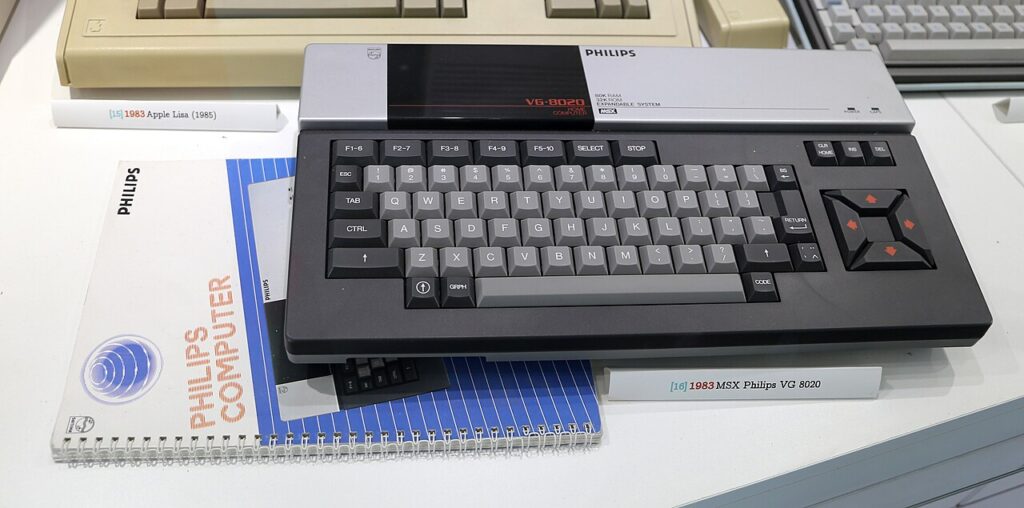
Every other machine on this site is a product. The MSX is an idea: a single, published specification that any manufacturer could build to, so that a cartridge written in Osaka would run on a machine in Amsterdam, São Paulo or Seoul. Between 1983 and the early 1990s that idea united dozens of rival companies — Sony, Philips, Yamaha, Toshiba, Panasonic, Canon, GoldStar and more — behind one logo, sold millions of computers across Japan, Europe, Brazil, Korea and the Middle East, and quietly incubated the careers and companies that defined Japanese gaming: Konami’s golden age, Hideo Kojima’s Metal Gear, Compile, Micro Cabin and a homebrew culture so durable that new MSX games still launch on cartridge today. America mostly missed it. This is the complete story of the standard that conquered everywhere except the United States.
Kazuhiko Nishi and the Idea of a Standard
MSX begins with one of computing’s great might-have-beens. Kazuhiko Nishi founded ASCII Corporation in Japan in 1977 and became Microsoft’s man in Tokyo — ASCII was Microsoft’s agent for the Far East, and Nishi worked closely with Bill Gates at the moment the personal computer industry was fracturing into dozens of incompatible machines. Every manufacturer had its own BASIC dialect, its own cartridge slot, its own everything; software written for one computer was landfill on another. Nishi’s conviction was that the home computer needed what the video industry was getting from VHS: one open standard, licensed to everyone, where manufacturers competed on hardware and price while the software library stayed universal.
Microsoft supplied the soul of the standard — MSX BASIC, written by Microsoft itself, with Gates’s company taking a royalty on every machine — and ASCII published and policed the specification. On 27 June 1983, at a Tokyo press conference, the MSX standard was unveiled with a coalition behind it that no single computer launch could match: Japanese giants including Sony, Matsushita (Panasonic), Mitsubishi, Pioneer, Sanyo, Sharp, Toshiba, Yamaha, Canon, Casio, Fujitsu and Hitachi, plus Korea’s GoldStar and Daewoo and Europe’s Philips waiting in the wings. The name itself was deliberately ambiguous — Nishi later offered several expansions, among them “Machines with Software eXchangeability” — but the promise was precise: buy any MSX, run all MSX software. It remains the closest the 8-bit era ever came to a universal platform.
The Spec: Z80, Yamaha Video and a Cartridge Slot
The MSX1 specification of 1983 reads today like a greatest-hits compilation of proven parts. At its heart sat a Zilog Z80A processor running at 3.58 MHz — the same CPU family that powered the ZX Spectrum and a thousand arcade boards. Video came from Texas Instruments’ TMS9918/9928/9929 family of display processors, the chips behind the TI-99/4A and ColecoVision, delivering a 256×192 screen, 16 colours and hardware sprites. Sound was the General Instrument AY-3-8910, the three-channel chip familiar from the Intellivision and, later, the Atari ST. Memory started at a modest 8KB on the cheapest machines and ran to 64KB and beyond; every MSX carried at least one cartridge slot on top, a keyboard in the case, and Microsoft’s MSX BASIC in ROM, so the machine woke up ready to program.
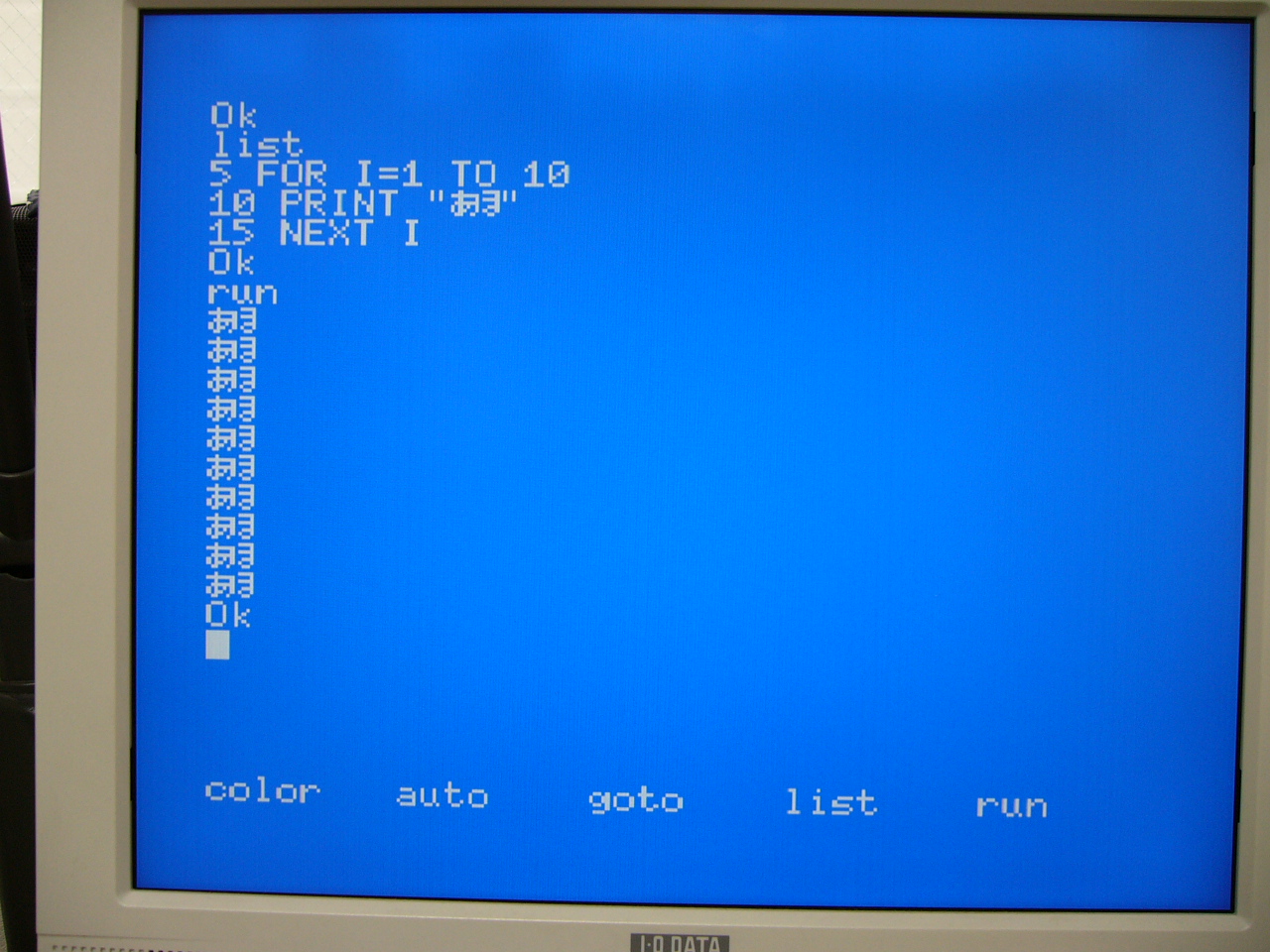
None of it was exotic, and that was the point. Because the silicon was standard, so was everything else: the cartridge format, the joystick ports (the MSX defined the nine-pin standard countless joysticks followed), the cassette interface, the printer port, even the expansion bus. A peripheral built for a Yamaha would work on a Sony. Games arrived on cartridge first — expensive but instant — and on cassette for the budget end, with floppy drives following through a standardised disk system, MSX-DOS, that was deliberately compatible with Microsoft’s MS-DOS file formats. The standard even specified the small things other platforms left to chance, which is why, forty years on, MSX collecting is mercifully free of the will-it-work anxiety that haunts other shelves.
Japan Takes the Standard Home
In Japan the MSX landed in a market already crowded with domestic computers from NEC, Fujitsu and Sharp, each incompatible with the next. MSX’s pitch — cheaper machines, shared software, the backing of the entire electronics industry — cut through. The first wave arrived in late 1983: Mitsubishi’s ML-8000, Canon’s V-8 and V-10, Sony’s HB-55 and HB-75 HitBit machines, Yamaha’s CX5 family and Toshiba’s HX-10 Pasopia IQ among them, with prices starting under ¥60,000 and falling fast. By Christmas 1984 an MSX was the default first computer for a generation of Japanese schoolchildren, and the software industry reorganised around it.
The machine’s Japanese heartland mattered because of who wrote for it. ASCII’s own MSX Magazine documented the scene monthly. T&E Soft turned the MSX into an RPG and golf powerhouse. Micro Cabin built the Xak and Fray adventures. Compile — founded in 1982 — made the MSX its home turf, cutting its teeth on shooters like Zanac and Aleste that are still revered. And above all there was Konami, whose MSX division, freed from arcade deadlines and Nintendo’s licensing regime, produced a run of cartridges so inventive that the platform’s library is still introduced through them. Japan’s arcades had the spectacle, but the MSX had the laboratory.
Konami’s Cartridge Kingdom
Konami’s MSX catalogue deserves its own shelf in any history of games. Knightmare (1986) vertical-scrolled a lone knight through Greek myth. The Maze of Galious (1987) sprawled a demon-haunted castle into a proto-Metroidvania of genuine scale. Nemesis — Gradius by its arcade name — arrived with a twist that made the MSX versions legends: hide a second Konami cartridge in the spare slot and the games talked to each other, unlocking weapons and bonuses, an Easter egg economy years ahead of its time. Penguin Adventure, designed with a young Hideo Kojima assisting, sent Penta the penguin across continents. Vampire Killer took Castlevania’s first steps in a non-linear form the NES version abandoned. F-1 Spirit pushed racing hardware with a dedicated enhancement chip in the cartridge.
Then, in July 1987, came Metal Gear. Assigned to the junior planner Hideo Kojima and built for the MSX2’s memory, it inverted the action genre’s logic — the hardware couldn’t fill the screen with bullets and soldiers, so Kojima made avoiding them the game. Stealth was born from a cartridge’s constraints. A year later Snatcher, Kojima’s cyberpunk adventure, used the MSX2’s floppies and the SCC sound cartridge to deliver atmosphere home computers weren’t supposed to manage. When people ask why the MSX matters to games rather than just to computing, the honest answer fits in two words: Konami, mostly — and the standard’s open door is what let Konami’s strangest ideas ship.
MSX2: The Standard Grows Up
The MSX2 specification of 1985 was the standard’s masterstroke: a generational leap that kept total compatibility. Yamaha’s V9938 video chip replaced the TI part with screens up to 512×212, 256 colours on screen from a palette of 512, smooth hardware scrolling registers and proper bitmap modes; RAM climbed to 64KB minimum and typically 128KB or more; a real-time clock, a built-in floppy drive on most models and MSX-DOS in the box made the machines credible tools as well as toys. Every MSX1 cartridge still ran. Sony’s HB-F1 series, Philips’ NMS 8245 and 8250, Panasonic’s FS-A1 line and Yamaha’s YIS machines fronted a second wave that carried the platform through the late eighties.
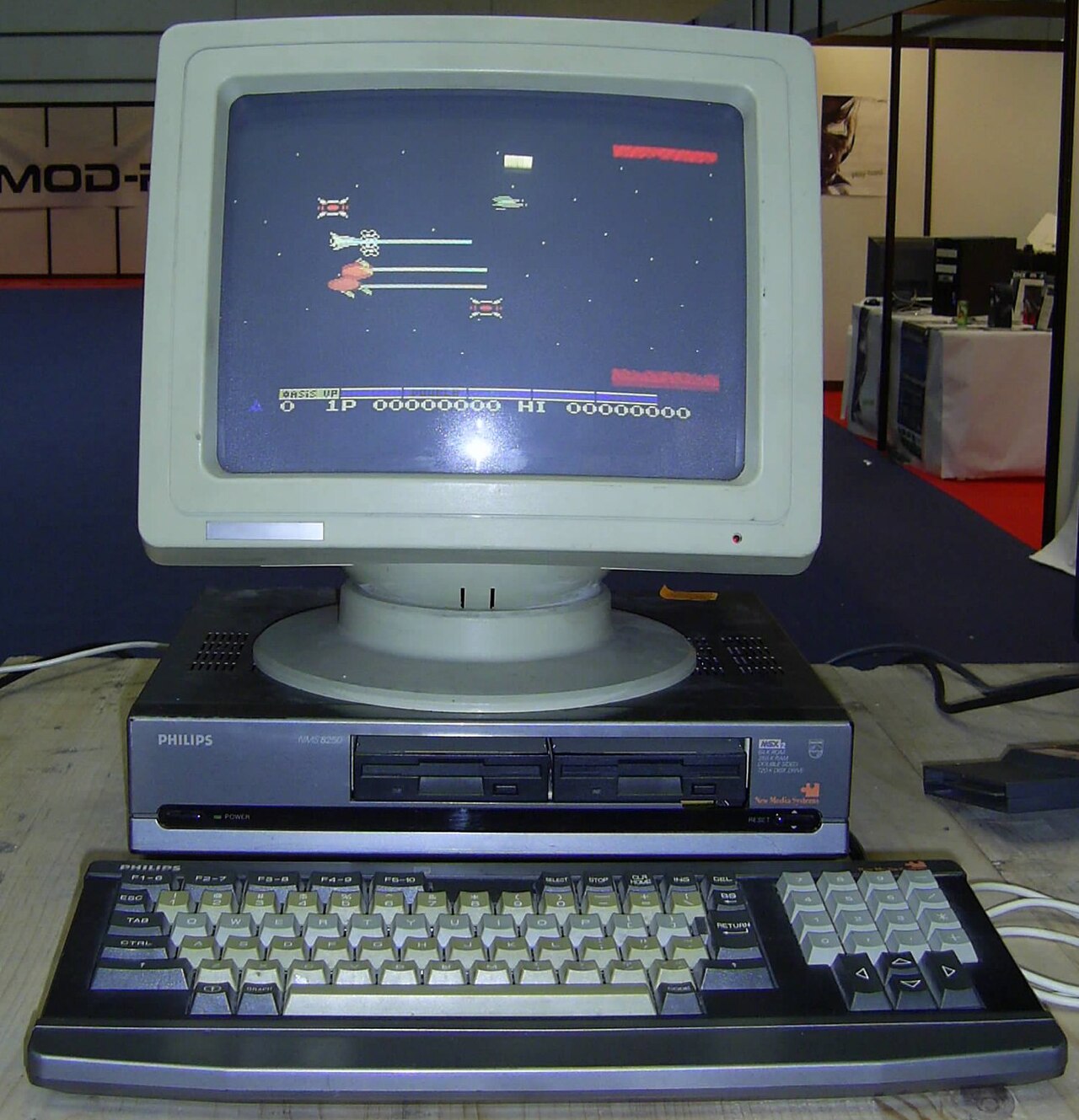
MSX2 is where the platform’s defining software lives. Metal Gear and Snatcher were MSX2-first. Compile’s Aleste (1988) set the template for the console shooter. Micro Cabin’s Xak trilogy and Princess Maker’s ancestors filled floppies. The V9938’s bitmap modes made the MSX2 a genuine graphics workstation in Japan, used for video titling and design — Pioneer’s Palcom machines even married the MSX to LaserDisc for interactive video, a multimedia decade before multimedia was a word. If MSX1 was the standard proving itself, MSX2 was the standard showing off.
The Music Machine: Yamaha, FM and the Sound Cartridges
Yamaha’s dual role — chip supplier and manufacturer — gave the MSX a musical soul no rival matched. Yamaha built the V9938 video chip and the platform’s defining audio silicon, and its own CX5M “MSX Music Computer” of 1984 shipped with a built-in FM synthesiser module and a music keyboard, an earnest attempt to make the home computer a home studio years before MIDI went mainstream. The standard grew around the idea: Yamaha’s SFG FM units, the MSX-MUSIC specification (built into MSX2+ and turbo R machines, and added to earlier ones by Panasonic’s FM-PAC cartridge), and MSX-AUDIO with its sampling gave composers a ladder of hardware to climb.

Konami answered with silicon of its own: the SCC chip, tucked inside cartridges like Nemesis 3, Salamander and Snatcher’s companion Sound Cartridge, added five wavetable channels that still make MSX music instantly recognisable — bright, chiming, impossibly energetic. The Sunrise MoonSound cartridge later brought Yamaha’s OPL4 to the platform, and the MSX’s chiptune scene — tracked, literally, in software like MoonBlaster — never really stopped. Ask an MSX fan to justify the platform in one sense and they won’t reach for sight. They’ll play you something.
Europe’s MSX: Philips Muscle and the Budget Shelves
Europe adopted the standard with regional accents. In the Netherlands the MSX became a national institution thanks to Philips, whose VG-8000 series and later NMS machines were designed and built on home soil; the Dutch scene’s clubs, fairs and disk magazines were still running decades later, and the Netherlands remains MSX’s European capital. Spain built a devoted scene around Sony and Philips imports and local software houses like Dinamic. France had its own publishers and the Canon and Yeno machines on shop shelves. Britain — Spectrum and Commodore territory, defended by ferocious price wars — was the standard’s hardest European market: Spectravideo, an American company whose SV-318 design had directly inspired the MSX spec, plus Toshiba, Sony and Sanyo machines arrived from late 1984, and though the UK never tipped, British MSX owners were served by dedicated magazines and a steady stream of Konami cartridges and budget conversions.
The European story also produced the platform’s strangest afterlives. In the Soviet Union and its successor states, Yamaha MSX2 machines were adopted as networked classroom computers — the КУВТ teaching complexes — seeding a Russian MSX scene that outlasted the USSR itself. In the Arab world, Kuwait’s Al Alamiah built the Sakhr line of Arabic-localised MSX machines, which taught a generation of children from Riyadh to Cairo. No other 8-bit platform can claim classrooms on four continents.
Brazil and Korea: The Standard’s Other Empires
If the MSX had a second Japan, it was Brazil. Under the country’s informatics policy, local manufacturing was everything, and two companies — Gradiente, with the Expert line, and Sharp, with the HotBit — built MSX into Brazil’s default home computer from 1985. Brazilian television advertised it, Brazilian schools taught on it, and a vast local software culture of translations, originals and, inevitably, piracy grew around it. When the 8-bit era ended elsewhere, Brazil’s MSX scene simply continued, evolving into one of the most technically ambitious retro communities on Earth — Brazilian engineers produced new hardware expansions, the Zemmix-like revivals and eventually the MSXVR, a modern MSX-compatible machine designed in Spain and embraced in Brazil.
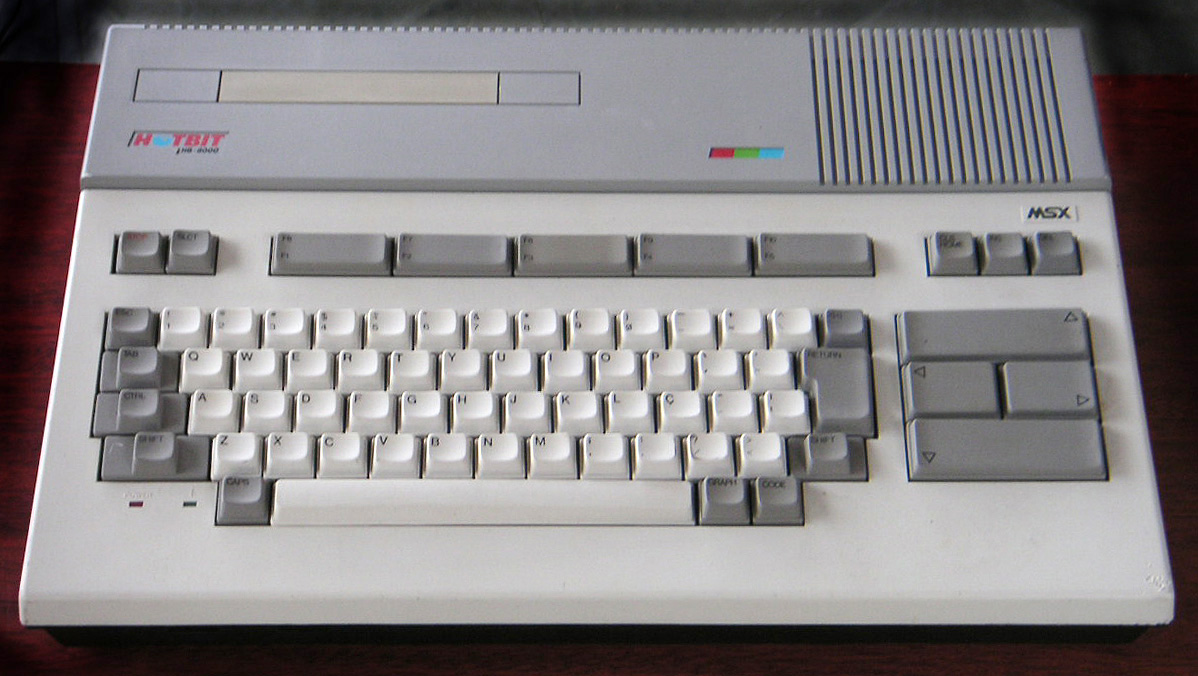
Korea’s story rhymes. GoldStar, Daewoo and Samsung-adjacent brands built MSX locally from 1984 — Daewoo’s CPC and IQ-1000 lines put the machines in Korean living rooms, and the standard’s cartridge slot fed a market hungry for games its own industry was just beginning to make. Korea’s most charming contribution came later and smaller: the Zemmix, a console-shaped MSX sold by Daewoo in 1991 that turned the computer into a pure games machine — and its name now rides again on the Zemmix Neo, a modern FPGA revival built by Korean fans. The standard Nishi designed for interchangeability proved culturally interchangeable too: every country that adopted it made it unmistakably their own.
MSX2+, Turbo R and the Last Machines
The standard’s final revisions came quickly and quietly. MSX2+ (1988) — from Sony, Sanyo and Panasonic — added smooth hardware scrolling in all modes, a 19,268-colour palette and MSX-MUSIC FM sound as standard, but it launched only in Japan, and arrived as the 16-bit tide was coming in. Then, in 1990, Panasonic shipped the turbo R: the FS-A1ST and FS-A1GT, built around the custom R800 processor, a RISC descendant of the Z80 running the standard at multiples of its original speed, with MSX-DOS2, FM sound and MIDI on the GT. They are magnificent machines — and they were the last. Panasonic was the only manufacturer to build the turbo R, and by 1991 the Japanese industry had consolidated behind NEC’s PC-98 and the coming Windows era. Total MSX sales are usually reckoned around five million machines — some estimates run higher — spread across more manufacturers than any rival platform ever assembled.
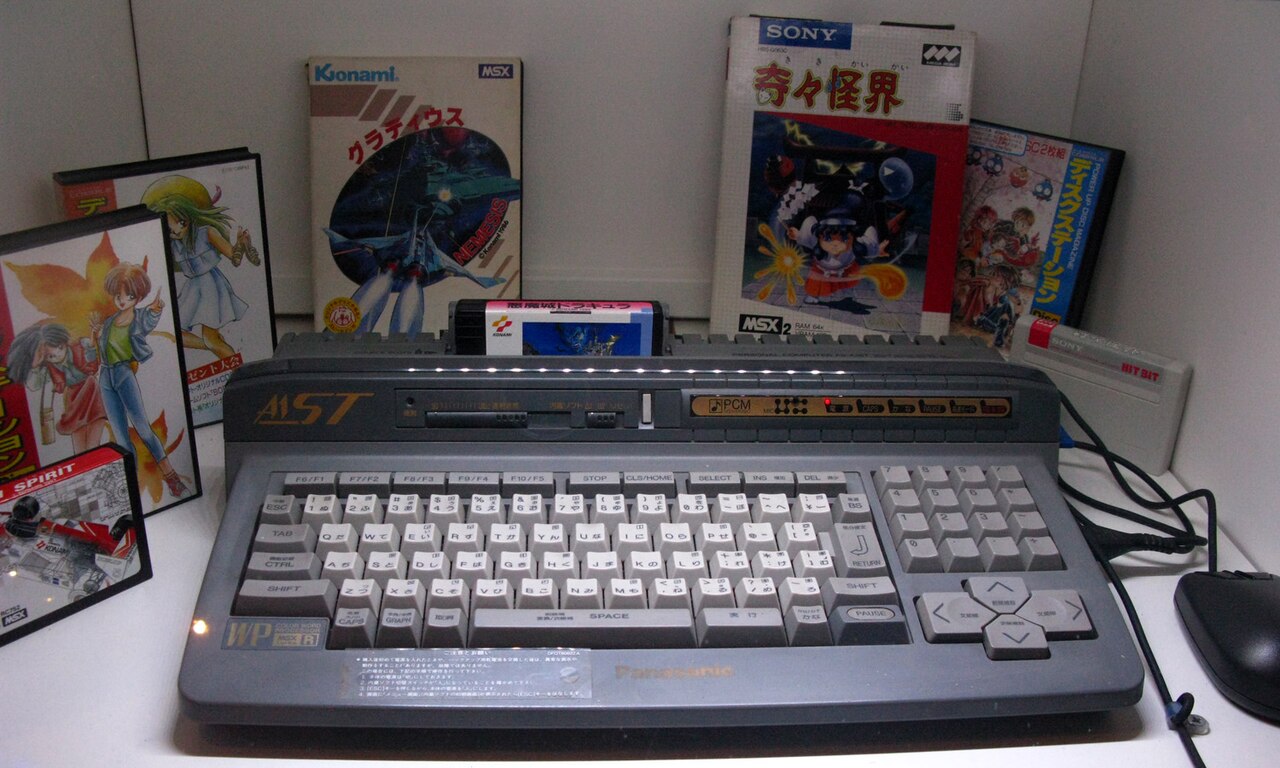
What killed the MSX wasn’t failure — it was arithmetic. The standard’s openness, its great strength, meant no single company owned its destiny the way Nintendo owned the NES or Commodore owned the C64’s price war. When the industry’s centre of gravity shifted to 16-bit consoles and IBM-compatible PCs, there was no MSX Inc. to fund a fighting successor. Nishi himself never stopped believing: ASCII’s MSX Association kept the flame, licensing the standard for the One Chip MSX — the entire platform re-implemented on a single FPGA chip in 2006, an official product and a love letter — and for later projects like MSX0 for the IoT age. The standard outlived its market because its fans refused to file it under history.
Afterlife: The Scene That Never Stopped
Which brings the story to the present tense, because the MSX is not a dead platform with a fan club; it is a living one with a release schedule. The MSXdev contest has run annual game jams since 2003, judged and prized like a tiny E3. Spain’s MSX RU meetings and the Nijmegen fair in the Netherlands still fill halls. Kai Magazine, Kralizec, Oniric Factor and a dozen other circles ship new cartridges — the homebrew features elsewhere on this very page, from the rescue-archaeology of The Rescue Expedition to the long-teased Feroz: Awaken, are dispatches from a scene that treats 1983 hardware as a current platform. FPGA cores made the MSX a citizen of the MiSTer age; the One Chip MSX, Zemmix Neo and MSXVR made it new hardware again; and every emulator from openMSX to blueMSX keeps the library one download away.
Start anywhere in that living library and the standard’s argument still makes itself: one format, forty years, no lockout, no landfill. The machines on the rest of this site each tell a company’s story. The MSX tells a stranger and better one — that for a decade, across four continents and dozens of rival boardrooms, the industry agreed on something, and the agreement produced Metal Gear, the Konami golden age, Brazil’s first programmers, Russia’s classrooms and a cartridge that still works in any machine with the right logo. This page is its home now. The standard deserves one.