
Arcade hardware is not supposed to live for fourteen years. Boards are built for a season, operators amortise them, manufacturers abandon them, and the whole ecosystem moves on to whatever renders more polygons. The Neo Geo MVS, launched by SNK in 1990, was still receiving new releases in 2004 — outliving the arcade era that created it, the company that built it in its original form, and several generations of supposedly superior hardware. It did so not by being the most powerful board in the room, but by being the most considerate: a system designed, at every level, around the people who had to buy it, house it and feed it coins. This is the story of the arcade board that outlived the arcade.


One Cabinet, Six Games, Zero Compromises
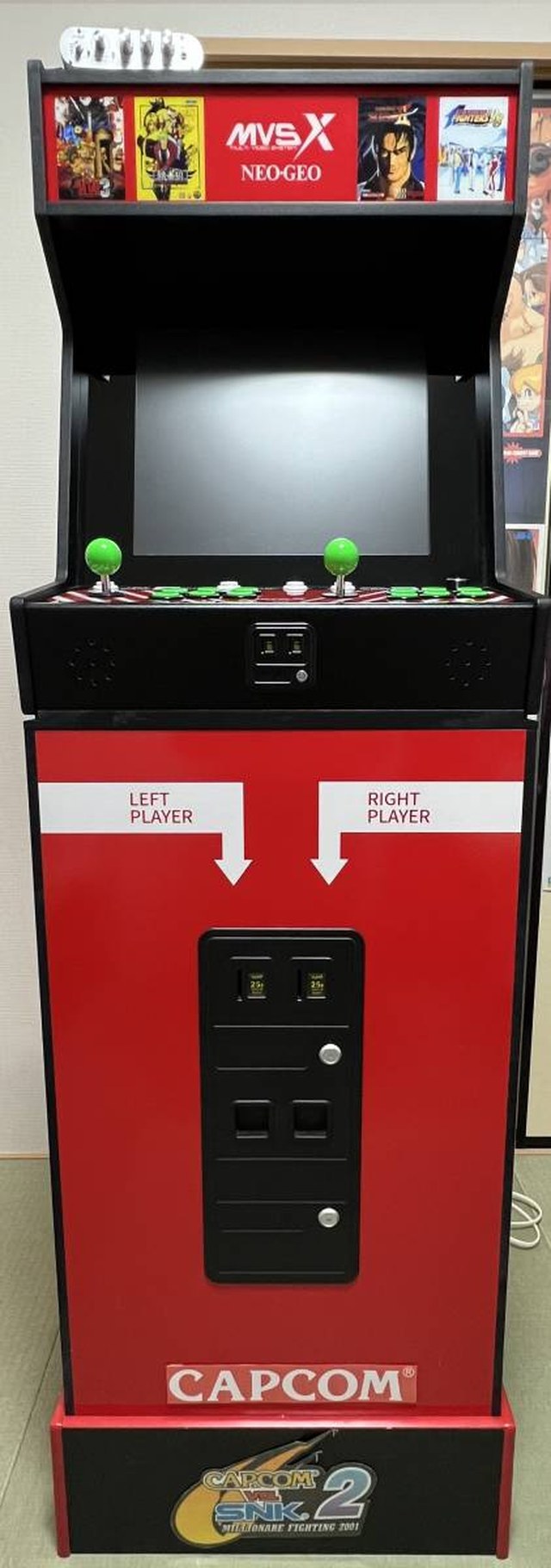
The MVS — Multi Video System — began with an insight about arcade economics. A traditional cabinet played one game; when that game cooled, the operator bought another board or another cabinet, and floor space, the scarcest resource in any arcade, sat hostage to yesterday’s hit. SNK’s answer was a cartridge system for arcades: a motherboard, housed in a cabinet, accepting swappable game cartridges — and, in the larger models, several at once. Multi-slot boards held two, four or six cartridges simultaneously, with a button on the cabinet letting players browse the installed games like channels. A six-slot cabinet was six games in one footprint, and refreshing it meant buying a cartridge, not a cabinet.
Operators loved it for reasons that compounded. New releases arrived as comparatively affordable cartridges rather than full board sets. A proven earner — a Metal Slug, a King of Fighters — could hold one slot for years while the other slots auditioned newcomers. Marquees and cabinet art were standardised, the hardware was famously robust, and SNK supported the platform with a breadth of genres no rival board could match: fighters by the dozen, run-and-guns, shooters, puzzlers, sports titles and oddities like the mahjong and quiz games that kept Japanese cabinets busy. The MVS was not a product so much as a utility — the arcade equivalent of a standard gauge railway — and utilities are very hard to kill.
The Memory Card: Home and Arcade, One Save
The MVS’s most forward-looking feature was also its most charming. Neo Geo cabinets included a slot for the same memory card used by the AES home system. A player could save their progress at the arcade — a run deep into Magician Lord, a season in progress, high-score and settings data — take the card home, and continue on their AES, or simply carry their arcade identity from cabinet to cabinet. In 1990, when a saved game meant a password scrawled on a receipt, this was close to science fiction: a portable, personal save file that treated the arcade and the living room as one continuous place to play.
That continuity was the Neo Geo concept entire. The MVS and AES ran the same games on fundamentally the same hardware, differing mainly in cartridge pinout — a physical incompatibility that frustrated generations of owners and spawned an aftermarket of adapters. But the philosophy was decades ahead of its time: buy the ecosystem once, play it wherever the hardware happens to be. Modern cross-save and cloud profiles are the MVS memory card, rebuilt at internet scale.

Why the Board Would Not Die
Longevity on that scale needs more than a good launch. The MVS survived because every incentive in its world pointed toward keeping it. Operators had cabinets and cartridge libraries they were reluctant to write off. Developers — SNK’s own teams, and third parties from Nazca and ADK to Saurus, Visco and later independents — had a decade of accumulated craft on the hardware, and could make a 1990 board sing in ways its designers never imagined; compare an early MVS title with Garou: Mark of the Wolves or Metal Slug 3 and you are looking at one of the great artistic learning curves in the medium. Players, particularly across Asia and Latin America, had grown up with the system’s games and kept feeding cabinets long after Western arcades pivoted to redemption machines and racers. In some regions, the MVS never really left — it simply became part of the furniture of public gaming, as permanent as pool tables.
The end, when it came in 2004, was less a defeat than a retirement. SNK itself had collapsed and been reborn in the interim, and the final official MVS releases closed a fourteen-year catalogue of several hundred titles. No arcade platform before or since has matched that span with a single hardware standard.
Consolized: The MVS Comes Home, Again
The MVS’s second life is the one many readers of this site are living. Because MVS motherboards were produced in arcade quantities and built to survive arcade abuse, they remain comparatively plentiful and affordable — and because the games are identical to their AES counterparts, a cottage industry grew up around the “consolized MVS”: an arcade board fitted with controller ports, home-friendly video output and a power supply, turning the operator’s workhorse into a home console that plays the same library as the fabulously expensive AES, using the far more affordable MVS cartridges. Enthusiast builders have refined the form over the years into machines that would not embarrass a design museum, and projects in the same spirit — superguns, modern enclosure kits, flash cartridges like the NeoSD MVS — keep lowering the barrier to entry.
What to Look for if You Are Buying In
For readers tempted by the consolized route, a few pieces of hard-won community wisdom are worth passing on. Single-slot and multi-slot boards differ in features as well as size — some boards offer controller ports, memory-card support or stereo output that others lack, so the specific board model matters more than the slot count. A socketed, replaceable BIOS — most famously via the enthusiast UniBIOS — unlocks region-free play and home/arcade mode switching, and is the single most valued modification in the scene. Original cartridges should be checked for the bootlegs discussed in our cartridge-pricing feature, and any consolized build is only as good as its power supply and video circuit, the two places where cheap builds cut corners. None of this is forbidding; the MVS community is one of retro gaming’s most helpful. It is simply a platform that rewards an hour of research with a decade of play.
The software library sealed the arrangement. Across its life the MVS accumulated several hundred titles — fighters in annual instalments, the Metal Slug series, beloved shooters, puzzlers and sports games, and a long tail of regional and genre experiments no home console would have risked. For an operator, that catalogue meant the platform never had a dead season; for a player, it meant any cabinet bearing the Neo Geo marquee might be running almost anything. Variety at that scale is its own form of hardware longevity, and SNK fed it relentlessly for fourteen years.
There is a pleasing symmetry in it. The MVS was designed to make arcade gaming cheaper and more flexible for the people who ran arcades. Thirty years later it does exactly the same job for the people who collect it — the last arcade board standing, still swapping cartridges, still earning its floor space. The arcade died around it. The board simply came home, and carried on.