
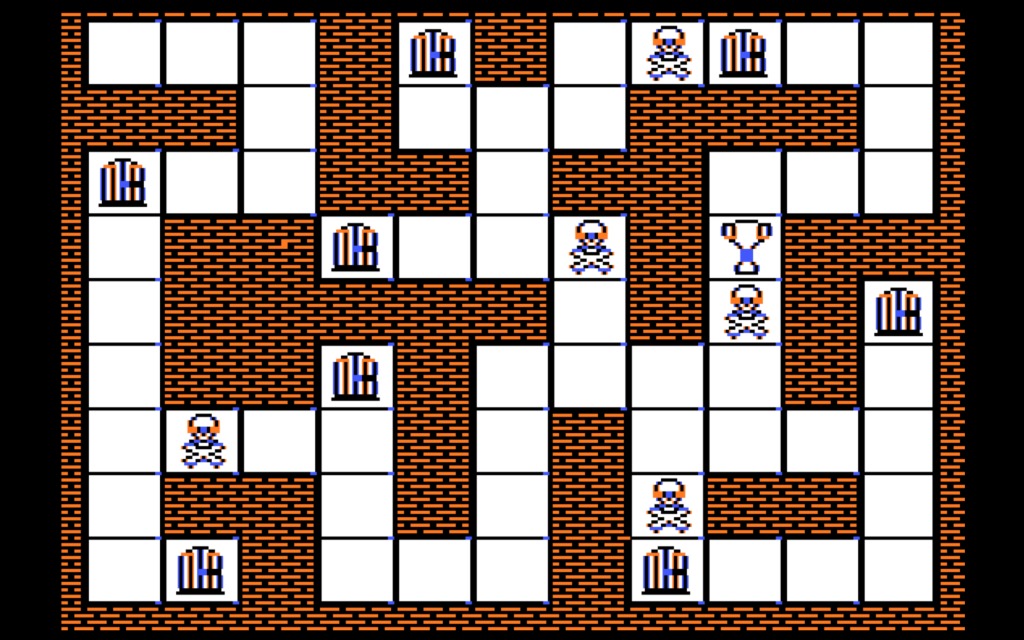
At a glance: Oubliette · Apple II · by Daniel Henderson, with Mockingboard sound help from Tom Porter · written entirely in Applesoft BASIC · 2019 · a knight’s dungeon: seven levels, an exit and a prize on each, secrets throughout · free disk image (OUB.dsk) from Call-A.P.P.L.E. — still live today
An oubliette is the cruelest room in the castle: a dungeon you enter through a trapdoor in the ceiling and leave, in theory, the same way. The name comes from the French oublier — to forget. It is a place designed to be forgotten about, which makes it a bold title for a homebrew game, and Daniel Henderson knew exactly what he was doing. His Oubliette, released for the Apple II in July 2019, drops a lone knight into seven levels of top-down dungeon and tasks him with the oldest job in the book: find the exit, collect the prize, and don’t let the dungeon’s tricks make a fool of you. It is also, from first byte to last, an argument — Henderson wrote the whole thing in Applesoft BASIC on a real Apple IIe, because he wanted to prove a point about the language everybody’s first computer came with.
Seven Levels Between a Knight and Fresh Air
The structure is clean enough to explain in a breath and deep enough to sting. Each level is a single screen of maze-like dungeon, viewed from above: chequered stone walls, white corridors, doors that may or may not help, and somewhere in the layout a prize to claim before the exit counts. Secrets hide in every level, and the game’s transporters became its early legend — the first players reported stepping onto one expecting a short cut and surfacing somewhere they never intended to be, which is very much in the spirit of a dungeon whose name means “forget it.” Henderson has described the game as a puzzler at heart: the knight is not hacking through waves of monsters so much as reading each room, learning its logic, and being quietly punished when he reads it wrong.
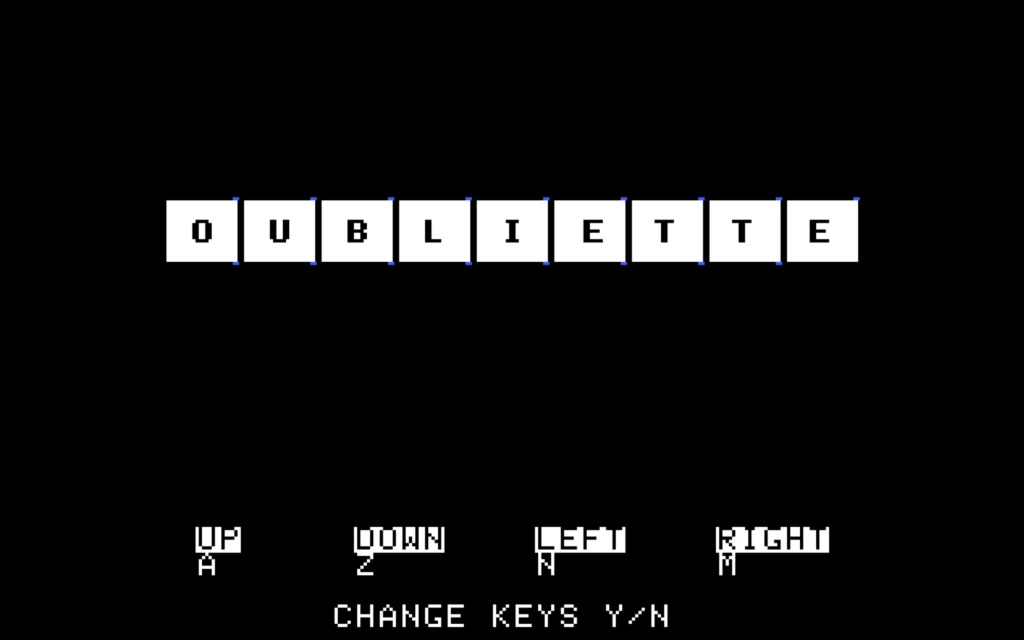
Control is keyboard-only and unapologetically period. The default keys are A and Z for up and down, N and M for left and right — the arrangement preserved on the game’s own opening screen, where you can redefine them before descending. One more instruction from the period, preserved in the game’s keyboard handler: Caps Lock stays on. It is a small, perfect detail. This is a game that wants your Apple II in its 1983 posture, uppercase and ready.
“You Can Do Anything in Basic”
The headline fact about Oubliette is the one Henderson led with himself: it was written entirely in Applesoft BASIC. Not BASIC with assembly helpers for the fast parts — BASIC, full stop, built from the language’s own drawing tools: shape tables for the knight and the dungeon furniture, data arrays for the levels, the whole game coaxed out of the interpreter that Wozniak-era Apple shipped in ROM. Henderson’s stated motivation was the reputation Applesoft carries as a language for beginners and type-in listings: he is, in his own words, a firm believer that “you can do anything in Basic”, and Oubliette is the exhibit he built to prove it. The development setup matched the philosophy — the game was written on an actual Apple IIe rather than an emulator, with a mouse attached, and its hi-res screens were drawn with 816 Paint before being folded into the program. The one concession to outside help came late and loud: fellow Apple II enthusiast Tom Porter assisted in adding sound for the Mockingboard card, giving the dungeon a voice the interpreter could not have managed alone.
“No assembly, no compiler, no excuses — one knight, seven levels, and the BASIC interpreter Apple shipped in 1979, holding the whole dungeon up by itself.”
Henderson gave the game away. The disk image, OUB.dsk, was posted free by Call-A.P.P.L.E., the long-running Apple users’ group that broke the release story in July 2019 — and, unusually for homebrew ephemera, the download is still sitting there today, ready to boot in an emulator or write back to real iron.
The Dungeon Kept Growing
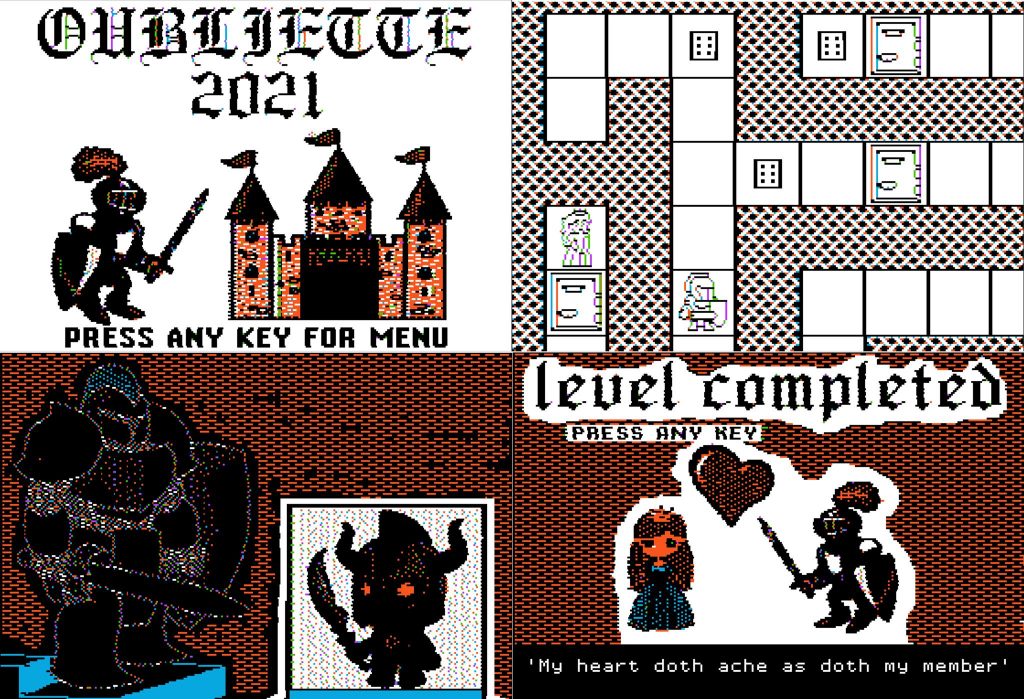
Plenty of 2019 homebrew releases evaporate within a year; Oubliette instead became a series. In January 2021 Henderson returned with Tom Porter for a full-scale expansion, Oubliette 2021: the dungeon rebuilt as a larger, tile-based game needing 128K and two disk sides, with a Mockingboard soundtrack of seven tunes plus speech samples, finer graphics, an automap, and a princess to rescue from a castle full of switch puzzles — a game big enough to justify a physical floppy release through 8-Bit Shack alongside the free download. By 2023 the numbering had reached Oubliette 4, a twelve-level quest written for the Vintage is the New Old site, in which the knight finally has a name — Sir Edward — and a quest object grander than a cup: the Golden Cup of Grenoble, stolen by a sorcerer with twelve levels of henchmen between him and justice.
All of which makes the 2019 original worth revisiting as the seed. It is a modest game by design — seven screens, one knight, one interpreter — and that modesty is the point of it. Henderson set out to show that the language a generation learned to type on was never the toy it was remembered as, and he made his case the honest way: not with a benchmark, but with a dungeon you’d actually want to escape from. The oubliette was built to be forgotten. This one has outlasted its own trapdoor.