At a glance: Ninja Spirit · TurboGrafx-16 HuCard · Irem, 1990 · Action platformer · Score: 9.0/10
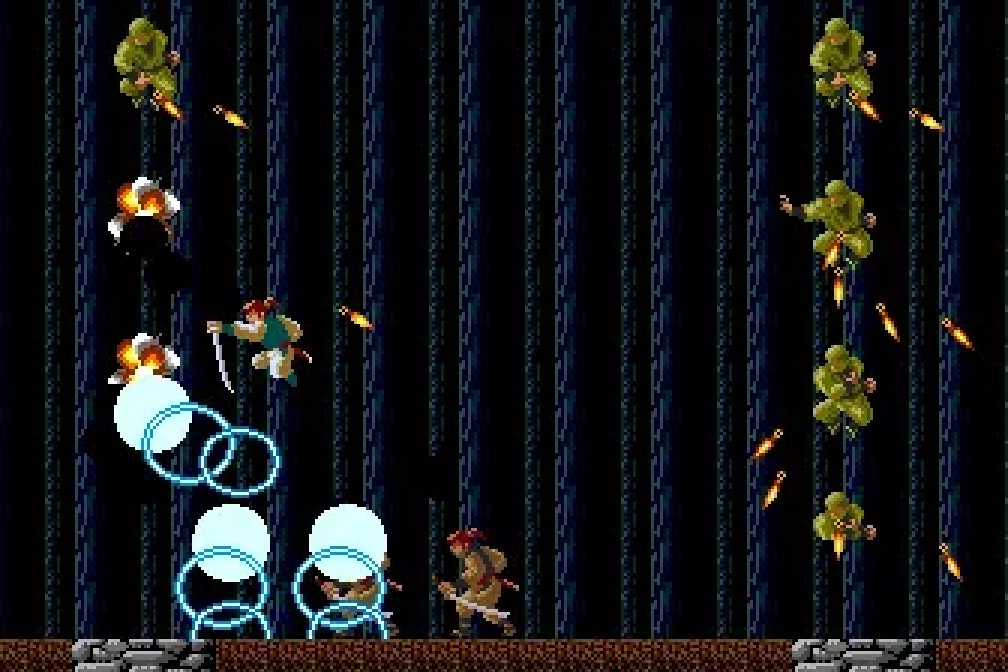
There is a moment, about ninety seconds into Ninja Spirit, when the screen fills with enemy ninjas dropping from a storm sky and your hero — Tsukikage, a young ninja avenging his father’s murder — splits into shadow clones that mirror his every move, and the whole screen becomes a choreography of blades. In the arcades in 1988 it was a showpiece. On the TurboGrafx-16 in 1990, in a conversion by Irem itself, it was something rarer: proof that a home port could keep an arcade game’s soul at full size. Ninja Spirit remains one of the finest action games on the system.
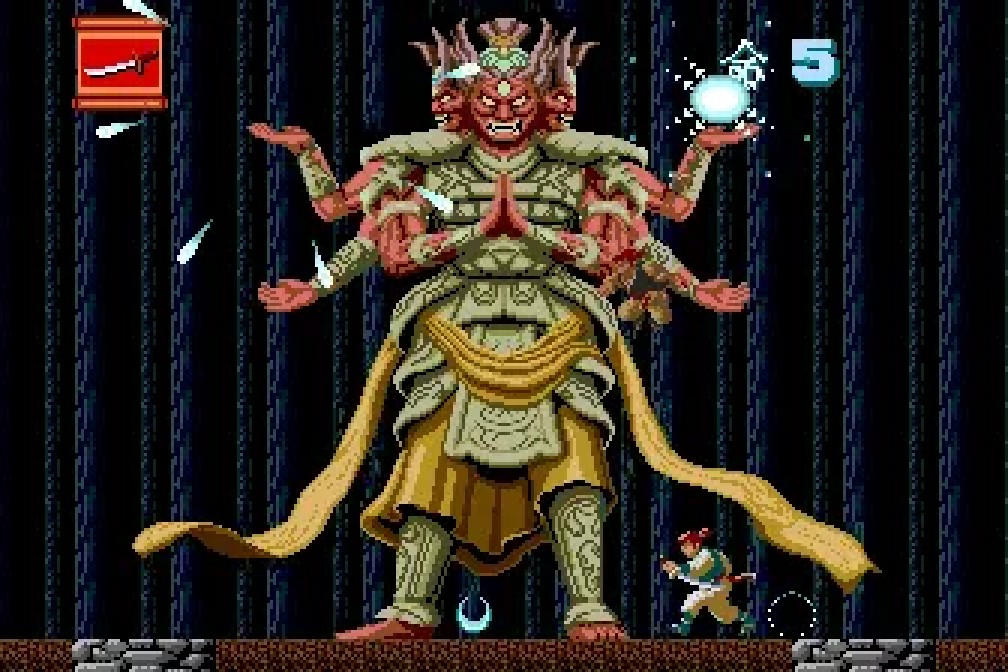
The structure is classic Irem: seven stages of side-scrolling combat through feudal-Japanese landscapes — temples, bamboo groves, cliffs, a battlefield of the dead — each ending in a boss of genuine spectacle, from a giant armoured warrior to sorcerers who fill the screen with themselves. What elevates it is the arsenal and the options wrapped around it.
Four weapons and a shadow army
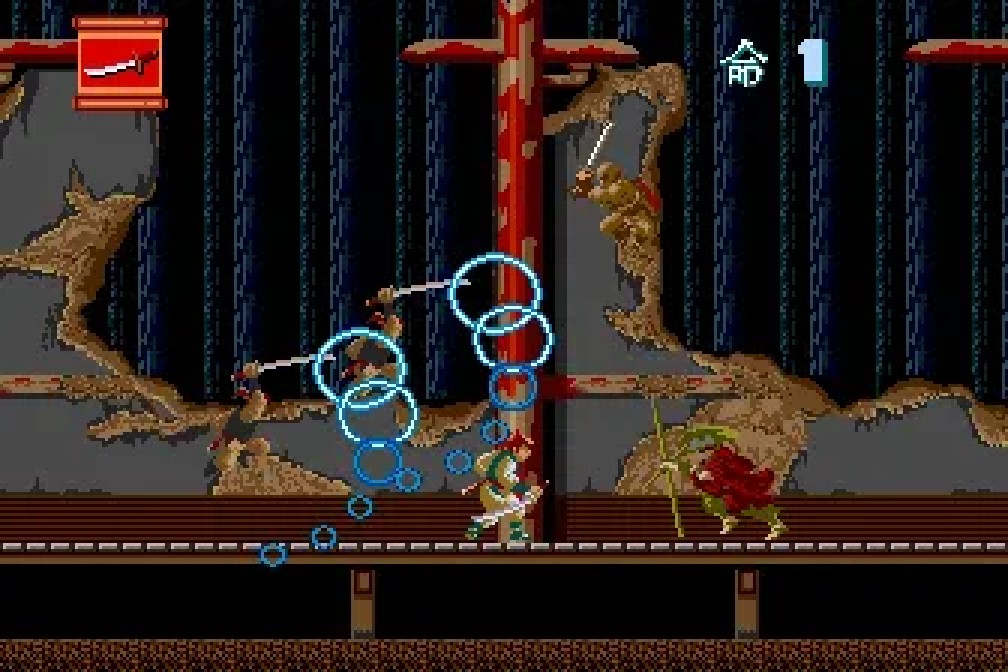
Tsukikage carries four weapons, switchable at will: the katana with its clean arc, shuriken for straight-line speed, bombs for arcing devastation, and the kusarigama — a sickle and chain that sweeps in a circle around him and remains one of the most satisfying weapons of the 16-bit era. Power-ups extend each weapon’s reach and, crucially, add shadow clones: up to two phantom ninjas who copy your movements and multiply your firepower, turning positioning into the game’s deepest skill. Where you stand stops mattering as much as the shape your three bodies make. Lose a clone to a hit and the formation collapses — the game’s tension in a single mechanic.
The port’s generosity is its two difficulty philosophies. PC Engine mode gives Tsukikage a life gauge — several hits before death — while Arcade mode restores the coin-op’s one-hit deaths for those who want the original’s discipline. It is an elegant solution that modern ports still copy: fidelity available, mercy default. Either way the controls are exact, the jump is committed and floaty in the right ninja way, and the famous descent stage — a free-fall down a cliff face dodging enemies and outcrops, ending in a landing that punishes the greedy — is present in all its palm-sweating glory.
Irem’s audiovisual signature
Irem’s arcade art direction survives the HuCard intact: huge sprites, layered storm clouds, silhouetted battles against burning skies, and a palette that leans into dusk and blood-orange. The bosses are the visual argument — multi-screen threats animated with an arcade budget’s confidence. The soundtrack is propulsive and percussive, with the kind of shamisen-tinged chip melodies that lodge permanently. Slowdown exists in the heaviest clone-filled firefights, as it did in the arcade; it reads as part of the storm rather than a failure of the port.
What the home version adds is context the coin-op never had room for: an opening that establishes the father’s death and the wolf-spirit mythology around Tsukikage’s birth, and an ending with genuine melancholy. The revenge story is simple, but Irem frames it with enough confidence that the final stages feel like fate rather than level seven.
The difficulty conversation
Make no mistake, this is a hard game. Enemy ninjas spawn with intent, the later stages layer projectile users over platforming, and the final boss is a war of attrition against your continues. But it is a fair hard game of the old school: patterns are learnable, weapons have correct answers to specific problems — the kusarigama owns the falling stages, bombs own the ground bosses — and the life-gauge mode means persistence is always a viable strategy. Players raised on the similarly structured Shinobi and Ninja Gaiden will find a sterner, more arcade-honest cousin here.
Weapons, matched to problems
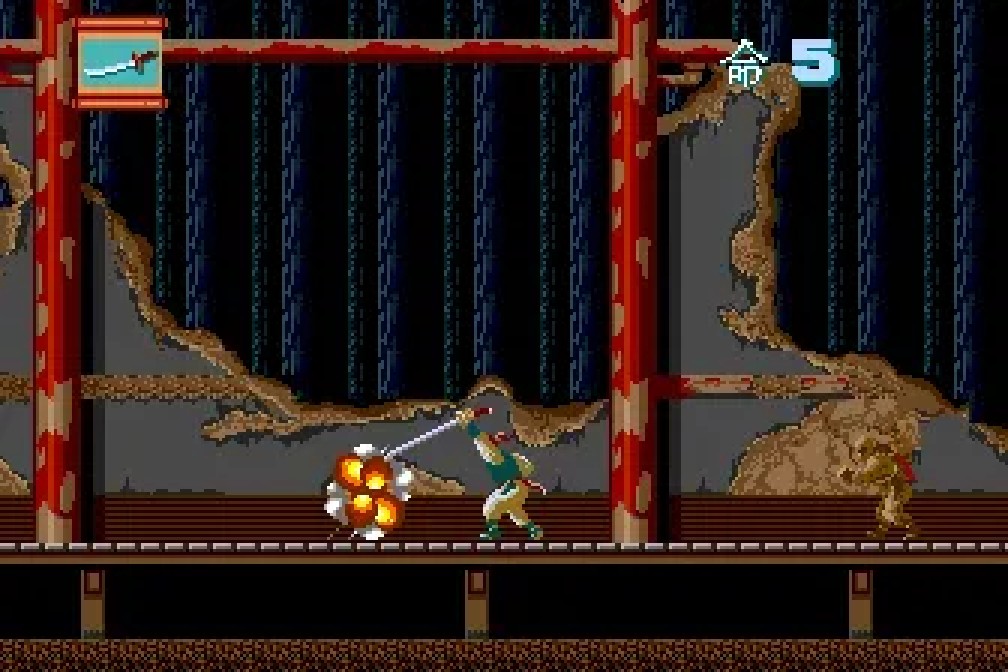
The four-weapon system deserves a field guide, because the game is secretly an examination in choosing correctly. The katana is the default and the duellist’s tool — short range, fast, devastating when your positioning is brave. Shuriken trade power for reach and speed, the safe answer to enemies that must die before they arrive. Bombs arc, and their arc is the point: they own enemies below you, ledges, and the bosses whose weak points sit under platforms. The kusarigama — the chain and sickle — sweeps a full defensive circle and is the connoisseur’s choice for the falling stages and the ninja swarms, where threats arrive from every compass point at once. Weapon power-ups extend range and add the shadow clones, and because a hit can strip your hard-won extensions, the game trains a protective style around your own firepower: you do not just defend Tsukikage, you defend the formation.
The clones deserve their own note, because they were the screenshot that sold the game and they are better than the screenshot. A clone copies your exact inputs with a fixed offset, which means your three bodies fire three patterns whose shape you design by moving. Stand still and you are a turret; strafe and you are a wave; jump and the formation stacks into a column of blades. Boss fights become geometry problems — where can all three of me hit the weak point while none of me touches the pattern? — and the famous swarm stages become crowd control by choreography. It is a mechanic with the depth of a fighting game’s stance system, hiding inside an arcade conversion.
The stages and their set-pieces
Seven stages, each with a signature. The temple opening teaches in rain and torchlight. The bamboo and cliff stages open the game upward, all verticality and ambush. The battlefield stage is the bleakest — a war among the dead, with the game’s colour palette at its most funereal — and the descent stage that follows is the one players describe to each other decades later: a sustained free-fall down a cliff, steering between outcrops and falling enemies, with a landing that must be judged to the pixel. The final approach to the sorcerer who murdered Tsukikage’s father strings the game’s whole vocabulary together and then examines you on it. None of the stages outstay their welcome; the whole campaign is an arcade evening, dense as a novella.
A word for the sound: the soundtrack’s driving, percussive score — taiko-flavoured chip work with melodies that accelerate with the stages — is a full partner in the game’s momentum, and the weapon effects have an unusually physical crack and swish. On a good setup, the falling stage’s wind and drum is one of the TurboGrafx’s great audio moments.
Two modes, two games
A final recommendation on how to approach it: begin in PC Engine mode, without shame. The life gauge lets you learn the stages’ geography and the weapons’ match-ups at a pace the arcade never permitted, and the game is generous enough that a first clear is a realistic weekend ambition. Then, when the routes are in your hands, switch to Arcade mode and discover the second game hiding inside the first — the same stages, the same bosses, but every hit a funeral and every clone a treasure. That the conversion includes both philosophies, faithfully, on one HuCard, is the measure of Irem’s respect for its own work and for the people playing it at home.
Verdict
Ninja Spirit is the TurboGrafx-16 arcade conversion at its peak: faithful where it counts, generous where it should be, and built around a clone mechanic that still feels inventive. If you own the system, this is not a hidden gem or a curiosity. It is a pillar.
Score: 9.0/10