
At a glance: Gorf · VIC-20 · Commodore, 1982 · Fixed shooter · Score: 7.5/10
Most arcade games of 1981 did one thing. Gorf did five. Midway’s coin-op strung together a series of missions — an Invaders-style battle, a laser-firing squadron attack, a warp tunnel gauntlet and a final duel with the Gorfian flagship — and wrapped them in taunting speech synthesis that mocked the player’s rank. Commodore’s VIC-20 cartridge cannot talk back, and the cartridge trims the mission list, but the core idea survives remarkably well: a shooter that keeps changing the rules every stage, on a home computer that had only just learned to do shooters at all. Your ship sits at the foot of the screen with its distinctive quirk intact — you can move into the lower battlefield rather than being pinned to the baseline, and an unfired shot can be cancelled by firing again, a mechanic lifted straight from the arcade’s unusual fire-button logic.
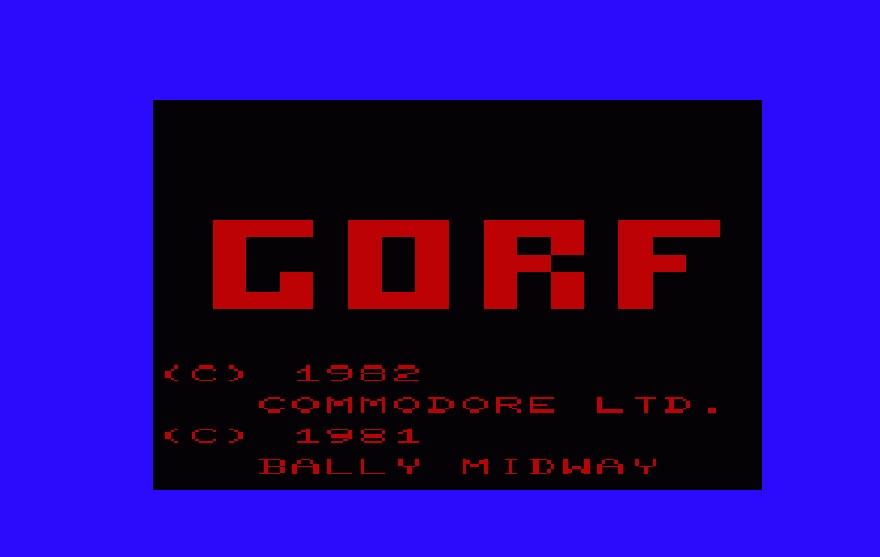
A compilation before compilations
The mission structure is Gorf’s whole appeal, and the VIC version honours it. The opening Astro Battles stage is Space Invaders with the serial numbers filed off — ranks of aliens, destructible shields, methodical fire. Then the game changes character: Laser Attack sends formations diving while a laser ship sweeps its beam across your zone, and the emphasis shifts from patience to evasion. Space Warp hurls you through a tunnel effect with ships spiralling out of the centre, and the Flag Ship finale strips the concept to a duel — a huge mothership behind a force field, its vulnerable core exposed only when the shield drops and its reactor vent opens. Variety like this was almost unheard of in a single VIC cartridge, and it keeps sessions fresh long after single-mode shooters have shown you everything.

Technically, the port is a respectable piece of squeezing. The VIC’s character graphics handle the ranked aliens and the flagship comfortably, each mission has its own palette and feel, and the pace is brisk without the slowdown that afflicts the machine’s more ambitious conversions. The famous Gorfian taunts are gone — no home version of the era could carry the arcade’s Votrax speech — and long-time players will notice the missing Galaxian-style mission that copyright kept out of the home ports. What remains still feels generous: four distinct challenges and a rank system that gives every game a narrative of promotion from Space Cadet upward.
Cadet to Space Avenger
That rank ladder is Gorf’s quiet hook. You do not simply survive; you get promoted, and the game makes sure you know your standing. It turns individual missions into a campaign and gives the cartridge an arcade authenticity that pure score-chasing lacks. The VIC version also benefits from the machine’s honest strengths: instant cartridge loading, a single joystick, and big, television-readable graphics. Played on a period CRT, the chunky aliens and garish colours look exactly like 1982 felt. Played now, it holds up as a variety pack from the moment arcade designers were experimenting with structure itself.
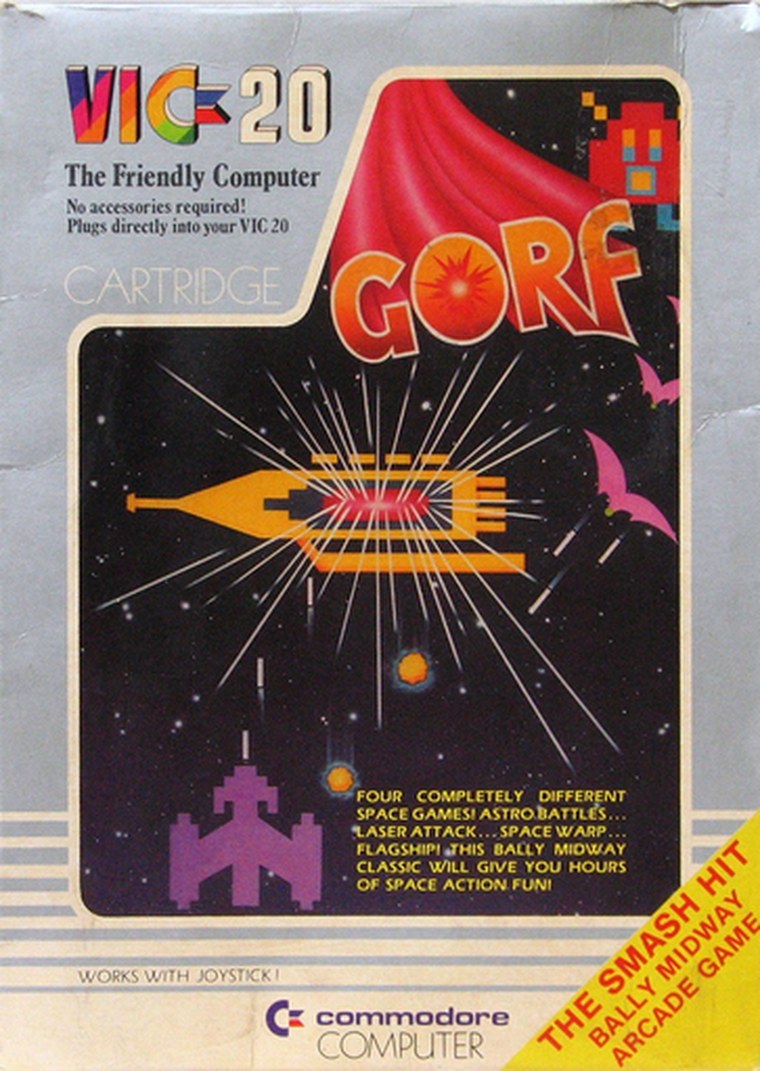
The honest caveats: the individual missions are simpler than the dedicated games they imitate — the Invaders stage will not replace a specialist clone, and the difficulty spikes unevenly between missions, with Space Warp’s spirals demanding reflexes the earlier stages never asked for. But judged as the VIC-20 version of Gorf — not against the arcade, not against the slicker ColecoVision edition — this is a cartridge that respects its source and its player. Commodore’s arcade licences were hit and miss; this one is a hit, and its mission-hopping format still makes it one of the easiest early VIC games to recommend to newcomers who want to see what variety the machine could offer.
Ranks, taunts and the Gorfian empire
The arcade Gorf’s other famous weapon was its voice — a synthesised Gorfian commander mocking the player through the cabinet speakers, one of the earliest talking games. The VIC-20 cartridge plays in silence on that front, and it is worth saying plainly what that costs: a slice of personality, and the era’s most memorable trash talk. What the home version keeps, though, is the structure that made the voice worth hearing — the rank ladder that the taunts were grading. Every mission cleared moves you up the Gorfian order of battle, and that progression turns a variety pack into a campaign. Plenty of VIC shooters are content to loop a single screen until your lives run out. Gorf always has a next thing, and the next thing is always different in kind, which is why its cartridge feels bigger than its memory footprint — because structurally, it is.
There is also pleasure in how unmistakably of-its-moment the package is. Gorf was Midway’s answer to everything at once — Invaders, Galaxian, a tunnel shooter, a boss fight — assembled in the brief era when arcade designers were inventing the grammar of the multi-stage game in public. The VIC-20 version is a time capsule of that experiment, preserved at television scale. Players who know the coin-op will enjoy spotting what survived the squeeze; players who do not will simply find a generous, varied shooter that never outstays its welcome in any single mode.
In the slot today
A note on versions, for the collector: Gorf’s home history is a small museum of the era’s licensing habits — multiple publishers, multiple machines, the Galaxian-derived mission quietly absent from the home editions, the voice left behind in the arcade. The VIC-20 cartridge stands up well in that company, neither the richest nor the poorest relation, and it has the advantage of its machine’s instant loading: the mission-hopping format and the cartridge format were made for each other, and sessions have a rhythm here that tape-based rivals could not match. If you collect one Midway licence for the VIC, the contest is between this and Omega Race — and the honest answer is that the shelf wants both, for opposite reasons.
Those opposite reasons are worth naming. Omega Race is depth through purity; Gorf is pleasure through variety. The VIC-20, a machine perpetually underestimated, hosted first-rate examples of both philosophies in its first two years, in its own publisher’s catalogue. That is not the library of a toy. That is the library of a computer that intended to be taken seriously — by cadets, and by everyone else.
Four distinct challenges and a rank ladder from Space Cadet upward — Gorf was a compilation before compilations existed.
Gorf on the VIC-20 is a generous, varied shooter that survives its missing speech and trimmed mission list with its personality intact. It will not be the deepest game in your cartridge box, but it may be the one that gets passed around most, because every few minutes it becomes a different game. For collectors it is also a key Commodore arcade licence, done properly.
Verdict: a multi-mission arcade port with real charm. Report for duty, Space Cadet — the flagship is waiting.
In a first-wave library heavy with single-idea cartridges, Gorf’s variety remains its recommendation. It is the game to lend the friend who claims early shooters are all the same: four missions later, the argument is over. The Gorfian empire has fallen a million times since 1982. It is still worth enlisting to make it fall once more.