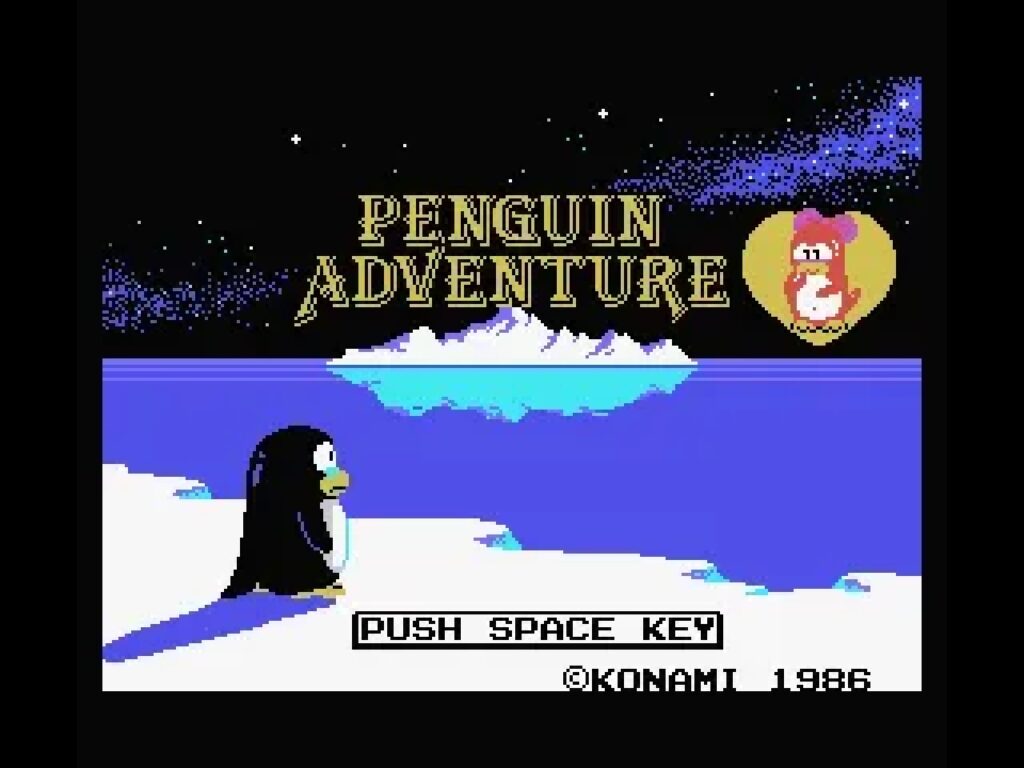
Two years before Metal Gear, a young Konami designer named Hideo Kojima worked on a game about a penguin. Penguin Adventure (1986) is the sequel to 1984’s charming Antarctic Adventure, inflated to epic scale: where the original was a delightful lap of the South Pole, this is a journey across an entire planet of stages — forests, caverns, rivers, the sea itself — to fetch a golden apple that can save the penguin princess Penguette. It remains one of the warmest games on the MSX.
At a glance: Konami, 1986 · MSX · Action-adventure · Penta’s big quest
A Lap Becomes an Odyssey
The core loop is pure Antarctic Adventure: Penta runs into the screen at speed, leaping cracks and enemies, against the clock. But Penguin Adventure multiplies everything. Dozens of stages span wildly varied terrain, stitched together by a world map that sells the scale of the quest; bonus stages break up the running; boss encounters — unthinkable in the gentle original — bar the road. Between stages, Penta can barter with merchants for equipment, trading fish for everything from speed shoes to a helmet, a light RPG economy that gives the journey texture and the player agency over the difficulty.

Kojima, in Feather Form
It is irresistible to read the designer’s future in this game: the cinematic framing, the obsession with systems that talk to each other, multiple endings — including the famous bittersweet twist that the quest’s success is not guaranteed, and that Penta’s story can end in failure and heartbreak if you dawdle. A penguin game with a sad ending was a quietly radical object in 1986. But you do not need the auteur angle to enjoy Penguin Adventure; you need it only to understand why a simple runner has this much soul.

The MSX at Its Most Joyful
Technically the game is a first-generation MSX title that behaves like it has something to prove: smooth pseudo-3D movement, big characterful sprites, and musical themes that stick like glue. The difficulty is honest — cracks arrive fast, and the clock is a real opponent — but continues and the merchant’s wares keep despair at bay. If Antarctic Adventure is the aperitif, this is the feast.
A Whole World of Weather
The stage variety deserves its own paragraph, because variety is this game’s engine. Penta’s road crosses the Antarctic ice of the original, then keeps going: pine forests where the path narrows to a red dirt track, caverns where the route must be felt out, rivers to cross, stages under black skies, and bonus rounds that interrupt the rhythm with brief, joyful chaos. Each world twists the runner formula — footing, visibility, enemy behavior — just enough that mastery keeps resetting. The merchant system threads through all of it: fish gathered on the road become boots that raise your speed, a helmet for protection, even a gun, absurd and wonderful, for the penguin who has had enough of dodging. Few 1986 games on any system sustain this much invention across this many stages.
Penta, Konami’s Unlikeliest Mascot
Penguin Adventure also cemented its hero in gaming’s permanent cast. Penta — and later his son Pentarou — became Konami’s recurring penguin, surfacing across the company’s catalog for decades, most flamboyantly in the Parodius shooters. It is easy to see why the company kept him. In an era of square-jawed space marines and interchangeable ninjas, a determined little penguin waddling into the screen at lethal speed had a silhouette no one else owned. This game is where he grew from a sprite in a charming lap-race into a character with a world, a sweetheart, and something to lose.
About That Ending
No review can dodge the famous close. Penguin Adventure grades your quest: dawdle, waste the journey’s precious time, and the golden apple arrives too late — the princess is gone, and the game ends in a grief that took 1986 players entirely by surprise and still lands like a stone. It is the earliest example of its young designer’s lifelong habit: hiding real emotional stakes inside genre machinery, daring the player to feel something at the end of an arcade romp. Earn the good ending and the game feels triumphant; miss it, and Penguin Adventure becomes unforgettable for the opposite reason. Either way, it refuses to be merely cute — and that refusal is precisely what makes it a classic.
The Clock Is the Villain
Strip away the charm and the game’s engine is time. Every stage is a sprint against a countdown that converts Antarctic Adventure’s gentle pressure into genuine dramatic architecture: dawdle for fish, detour for gear, fall in one crack too many, and the journey’s total cost accumulates toward that famous ending. This is why the merchant system matters beyond flavor — every purchase is a trade between the run’s speed and the quest’s resources, a small economy of urgency that keeps all forty-plus stages taut. It is also why the game teaches so well. Early stages forgive; later ones present their cracks and creatures in combinations that demand the lines you practiced hours ago; and the boss gates convert accumulated mastery into progress with a fairness that feels authored rather than generated. Beneath the feathers, this is one of the most carefully tuned action games of 1986 — on any system, in any country.
For Collectors and the Curious
Penguin Adventure is also, happily, one of the landmark MSX titles that remains genuinely attainable: a popular release in its day across Japan and Europe, it surfaces regularly in the retro market, and its cheerful box art has made it a shelf favorite even among collectors priced out of the platform’s rarer trophies. Play it on the hardware if you can — the MSX’s keyboard-and-joystick controls suit Penta’s momentum, and the CRT blur flatters those saturated worlds — but ensure you play it somehow. Every platform has a game that explains its soul in a single cartridge. The MSX’s is a penguin, late for the most important appointment of his life, running.
The Long Road, Revisited
Revisiting the game today — on the hardware, where its colors glow as intended, or through any of its afterlives — the surprise is how little dust has settled on it. The central sprint remains exhilarating, the world map still creates that delicious ache of a journey visibly unfinished, and the ending still administers its small, perfect heartbreak to anyone who has been treating the clock casually. Penguin Adventure is the MSX at its most generous: a big game, warmly made, confident that charm and rigor are the same quality viewed from different distances. If the platform’s evangelists are right that it deserved a wider world, this cartridge is their Exhibit A — a penguin who out-ran his era and is still, somehow, ahead of the pack.
Verdict
A runner with the heart of an epic — inventive, generous, and quietly moving. The MSX’s most lovable adventure.
Penguin Adventure is the rare sequel that honors a simple original by dreaming much bigger. For MSX owners it is essential; for Kojima completists, it is where the story starts — with a penguin, an apple, and a very long road home.
Why It Endures
Longevity in games is usually bought with complexity, and Penguin Adventure is the standing refutation: a runner about a penguin, built from speed, variety and heart, that players still finish with a lump in the throat forty years on. The MSX shelf has heavier cartridges. It has none more alive.