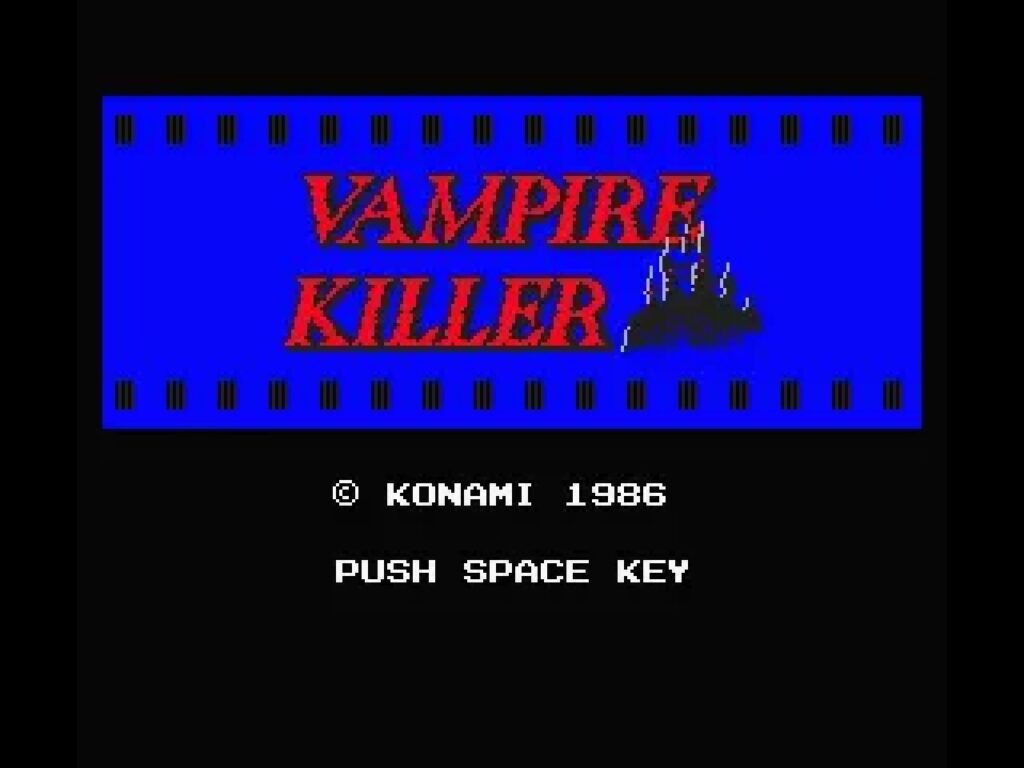
In 1986 Konami made Castlevania twice. While the Famicom Disk System version marched Simon Belmont down a linear gauntlet toward Dracula, the MSX2 received Vampire Killer: the same castle, the same whip, the same count — arranged into something structurally quite different. History crowned the other brother, and the linear design became the series’ DNA. But Vampire Killer is no rough draft. It is a fascinating alternative history, and a fine game in its own right.
At a glance: Konami, 1986 · MSX2 · Action-adventure · The parallel Castlevania
Same Castle, Different Floorplan
The difference announces itself immediately. Vampire Killer’s stages are not corridors but compact labyrinths: screens that loop and branch, with keys to find, merchants to haggle with, and secrets tucked behind the whip’s reach. You explore each stage to arm Simon and unlock its exit rather than simply surviving a march to the right. The result plays closer to an action-adventure than a pure action game — Metroid’s grammar in gothic dress, a full year before that comparison meant anything.

The Belmont Toolkit
The essentials are gloriously present: the Vampire Killer whip itself, upgradeable; holy water, axes and crosses as sub-weapons; hearts as currency and ammunition; and a bestiary of skeletons, bats, medusas and mermen deployed with Konami’s early mastery of unfair-seeming-but-fair placement. Simon’s stiff jump and deliberate movement will be familiar to series veterans — this is Castlevania’s particular brand of committed platforming, where every leap is a decision. The MSX2 hardware gives the castle a rich, saturated look quite distinct from the NES version’s palette, and the soundtrack, while it lacks the Famicom’s later-arranged fame, drives the hunt with real menace.

Where It Falters
The open structure has a cost: stages can feel like errands when a key hides a screen too far, and the looping layouts occasionally confuse where the NES game’s relentless forward motion never could. Boss encounters are briefer affairs than their console counterparts, and the whole is somewhat shorter than the quest it parallels. None of this is fatal. It is the price of an experiment — and an experiment that Metroidvania history would eventually vindicate wholesale.
Keys, Merchants and Candles
The details reward attention. Progress hinges on keys hoarded from the castle’s candle stands and guarded by its tougher residents — color-coded locks parcel the stages into a rhythm of exploration and payoff that the linear Castlevania never attempted. Merchants hidden in the walls sell Simon his edge: better whips, shields, holy water, the small arsenal of survival, paid for in hearts beaten out of the castle’s fixtures. It creates a loop that feels startlingly contemporary — explore, equip, unlock, descend — and it changes Simon’s relationship with the castle from intruder to something like a burglar with a map, casing a house that fights back. The bosses remain the era’s standard duels, but arriving at them stocked or starving is now partly your own doing, and that accountability is the game’s quiet revolution.
The Road That Led to Simon’s Quest
History tends to treat Castlevania II: Simon’s Quest as the moment the series experimented with openness — towns, merchants, day and night, a world to wander. Vampire Killer suggests the experiment had already run. A year before Simon’s Quest, the MSX2 game was blending exploration, commerce and action in Dracula’s castle, and whatever the internal lines of influence at Konami, the kinship is unmistakable: this is the branch of the family tree that leads to the exploratory Castlevanias, all the way down to Symphony of the Night’s castle-as-world. Playing Vampire Killer after the modern entries is a strange pleasure — like finding a rough sketch of a cathedral in the architect’s first notebook, the spires already reaching the right height.
Playing the Castle Today
Modern players arrive at Vampire Killer with a map drawn by its brother, and the first service this review can perform is a warning: leave the NES walkthrough at the door. The layouts, secrets and item placements are Vampire Killer’s own, and the game expects exploration — sweep every screen, whip the suspicious walls, and budget your hearts like currency, because here they literally are. The second service is a defense of the difficulty, which is real but legible: this is the era’s Castlevania contract, where progress is earned in knowledge rather than reflex upgrades, and a stage that murders you at lunch will be a formality by dinner once its key route is mapped. Emulation serves the game well; original hardware serves it better, the SCC-less PSG soundtrack growling through a television exactly as Konami intended. Either route, allow the game its opening hour of strangeness. The moment the looping stages click — the moment you stop marching and start casing — Vampire Killer stops being the other Castlevania and becomes the one you wish the series had made twice.
The Twin, Considered
It is fashionable in retrospective circles to call the NES game the “real” Castlevania and this its odd sibling, and the sales history makes the label understandable. But real is doing a lot of work in that sentence. Vampire Killer was developed for a computer audience that expected exploration, commerce and secrets from its adventures — an audience that had made the MSX the home of Dragon Slayer and Hydlide — and it delivered a Castlevania fluent in that dialect, shipped in the same season as the action original. Two dialects of the same gothic language: the series spent the next decade speaking the linear one, then spent the following three decades, from Symphony of the Night onward, speaking this one. The MSX2’s version simply got there first, in 1986, with a whip.
On Balance
Weighed fairly, Vampire Killer’s experiments cost it a little of its brother’s propulsive perfection and buy it a personality all its own — plus a genuine claim on the future, since the exploratory Castlevania it prototypes is the one the series ultimately became. The whip cracks, the candles pay out, the castle loops back on itself like a bad dream, and somewhere in Wallachia a count is learning that this Belmont, too, came prepared. Eight points, with honors for ambition: a landmark of the MSX2 library and a mandatory detour for anyone who thinks they know Castlevania’s story by heart. You know half of it. This is the other half, and it has aged like wine in a very dark cellar.
One further recommendation: play it in the dark, through the television speakers, with the lights low — the way a generation of Japanese and European players met it in 1986. Vampire Killer’s castle was designed for exactly that communion between player and machine, and its gothic heart still beats loudest at arm’s length from a glowing screen. Few cartridges justify a ritual. This one earns it, whip-crack by whip-crack, key by key, candle by candle.
Verdict
Castlevania as an exploration game, a year before exploration games — historically fascinating and still great fun.
For series devotees, Vampire Killer is required playing: the road not taken, paved surprisingly well. For MSX2 owners, it is simply one of the platform’s landmark action games.
A Final Word for Series Fans
If you collect Castlevania in any form, clear a space in the cabinet for this one — not as a curiosity, but as a cornerstone. The series has two birth certificates, and the MSX2’s is the one that predicted its future. Play it after the NES original and the pair becomes a dialogue about what an action game could be in 1986; the conversation has not finished yet, and this cartridge is still the most interesting voice in it.