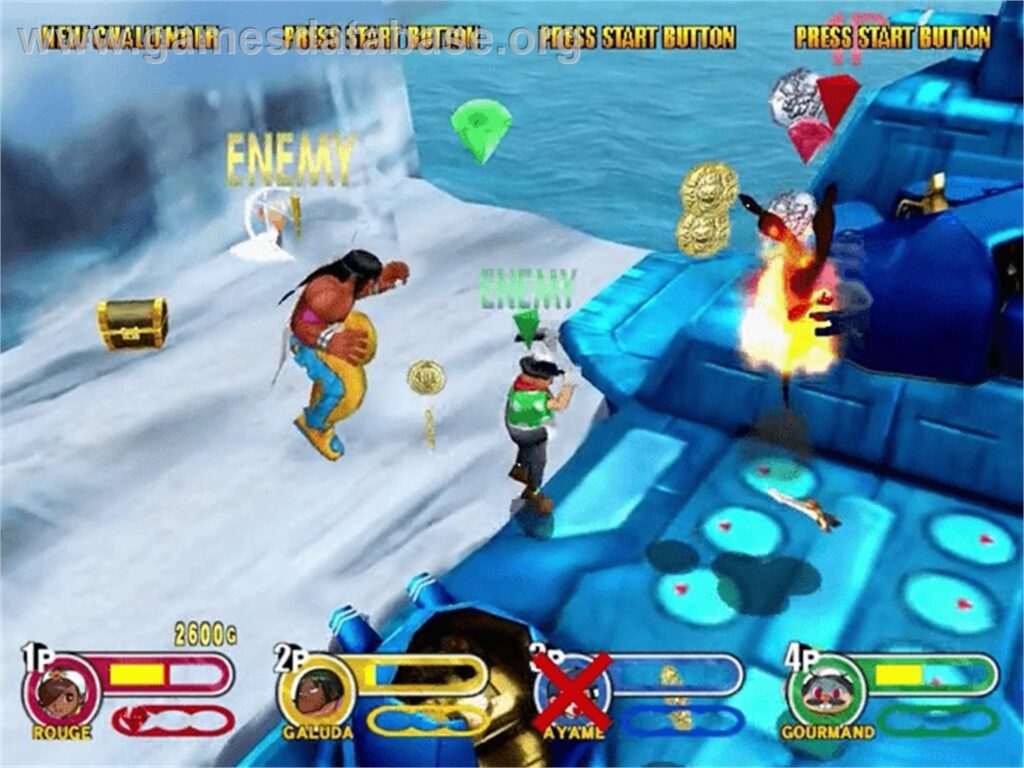
Fighting games in 2000 were getting serious. Combos grew longer, systems grew denser, and the genre’s centre of gravity moved toward the tournament. Capcom looked at all of that, shrugged, and released Power Stone 2: a four-player arena brawler where a stage can drop a sphinx on your head, the best strategy is often to steal a tank, and collecting three glowing gems turns you into a superhero mid-match. It is chaos with a rulebook hidden inside it — and it may be the most purely fun multiplayer game on the Dreamcast.
The formula expands the 1999 original in every direction. Where Power Stone was a one-on-one duel in a small arena, the sequel seats up to four fighters — any mix of humans and CPU — in large, multi-level stages that transform as the fight goes on: a floating fortress sheds its decks, a temple’s floor gives way, a sky stage scrolls as platforms crumble. The roster grows to fourteen with newcomers like the chef Gourmand, the young inventor Pete and the duellist Julia, with the mysterious Mel presiding over the item shop, joining Falcon, Rouge, Ayame, Gunrock and the rest of the original’s adventuring cast, all chasing the legendary Power Stones across a storybook world of deserts, castles and airships.
Everything Is a Weapon
The core combat is deliberately simple — punch, kick, jump, grab — because the arenas do the talking. Crates, barrels, benches, umbrellas, bazookas, ray guns, shields, skateboards: nearly everything on a stage can be picked up, thrown or fired, and new items rain in as battles escalate. The Power Stones remain the centre of gravity. Grab three and your fighter transforms — Falcon becomes a rocket-booted iron hero, Rouge a fire dancer — gaining a pair of screen-filling Power Drive and Power Fusion attacks that every other player immediately scrambles to avoid or interrupt. Those scrambles are the game: a transformation changes the entire politics of the arena, and alliances form and dissolve in seconds.
Depth hides in the margins for those who want it. Item management matters, the Adventure mode’s shop lets you buy, sell and combine items to cook up new weapons for versus play (with your VMU keeping your inventory), and stage knowledge — where the good items spawn, when the floor is about to vanish — separates veterans from button-mashers far more than combos do. But crucially, a first-time player can win rounds within minutes, and will be laughing while they do it.
A Party Game With a Capcom Finish
Visually it is vintage turn-of-the-century Capcom: chunky, saturated 3D, stages bursting with interactive clutter, and animation that sells every pratfall. The camera works overtime to keep four fighters framed, and mostly succeeds; in the largest stages, tiny distant characters can be hard to track, and the frame rate can dip when the screen fills with explosions and transformed fighters. Those are the honest costs. The single-player offering — Arcade and Adventure ladders — is entertaining but thinner than the versus game, and CPU partners are nobody’s idea of reliable.
What Power Stone 2 understood, years before the party-fighter boom, is that the best multiplayer games run on stories you tell afterwards: the match won from the brink by a falling umbrella, the friendship ended by a well-timed sphinx. Four controllers, one Dreamcast, this disc — that was a perfect Friday night in 2000, and remarkably, it still is.
Why Nothing Replaced It
The strangest thing about Power Stone 2 is how alone it remains. The party-fighter genre it anticipated exploded in the years after, yet almost nobody copied its actual recipe: no other major brawler fills its arenas with this much usable junk, transforms its own stages mid-fight, or lets a losing player steal the entire match by grabbing three stones and going gloriously super. Capcom itself never made a third — the series detoured to a PSP collection and then into the long sleep of beloved-but-dormant franchises, which is why the Dreamcast disc has become one of the system’s prized possessions and why its announcement for Capcom’s modern fighting collection was greeted like a pardon.
For Dreamcast owners, though, it never left. It is the game that comes out when non-gamers visit, because the controls take a minute to teach and the stories generate themselves; it is equally the game that veterans keep honest with, because the item economy and stage craft reward real knowledge. Few discs serve both audiences at once without boring one of them. Power Stone 2’s trick is that chaos is the leveller and mastery is the tiebreak — everyone is laughing at the flying bench, but the player who knew the bench was coming wins the round.
The sound design seals the party-game credentials: bright Capcom brass and percussion, announcers with their sleeves rolled up, and the glorious clatter of a stage’s worth of furniture changing owners. Character voices are pure Saturday-morning cartoon, in several languages’ worth of enthusiasm. Load times are snappy, menus are instant, and the game never keeps four impatient players waiting — a discipline modern party games, bloated with accounts and updates, would do well to relearn. Everything about Power Stone 2 is engineered to get you to the next match faster, and the next match is always the one where somebody finally lands the umbrella.
Stages That Fight Back
Give the stage designers their own paragraph, because Power Stone 2’s arenas are co-stars. The Dark Castle splits and sinks as the battle rages; the Pharaoh’s stage wheels out a sphinx with strong opinions; the airship level turns its deck into a scrambling exercise as the floor plan shrinks beneath you. Every stage transition resets the fight’s geography and item economy at once, so no lead is ever purely safe — the player in last place is one stage-change and one lucky crate away from a comeback, and everyone at the table knows it. This is level design as drama direction, and it is why matches that should be foregone conclusions end in photo-finishes and rematch demands. Capcom’s artists stuffed each arena with period detail, too — market stalls, temple carvings, airship brass — so that even the scenery you are busy destroying looks like it was painted with love.
One small feature sums the game up: the Adventure mode’s item shop, run by Mel, where winnings become experiments — combine two mundane items, receive something gloriously unreasonable, take it into versus and watch your friends’ faces. Power Stone 2 trusts players to make their own fun and then hands them a workshop. That trust, more than any single mechanic, is why the rematch button might as well be welded down.
The Verdict
If your Dreamcast only ever hosts one four-player night a year, make this the disc. Few games from any era convert a roomful of sceptics faster, and fewer still keep converting them at hour three — by which point the rivalries have histories, the item-shop experiments have produced legends, and somebody is demanding a deciding match for the evening. That is not nostalgia talking. That is engineering.
Score: 8.5 / 10 — The Dreamcast’s finest multiplayer brawler: simple to join, gloriously chaotic, and engineered for rematches. Somebody is getting hit with a bench.