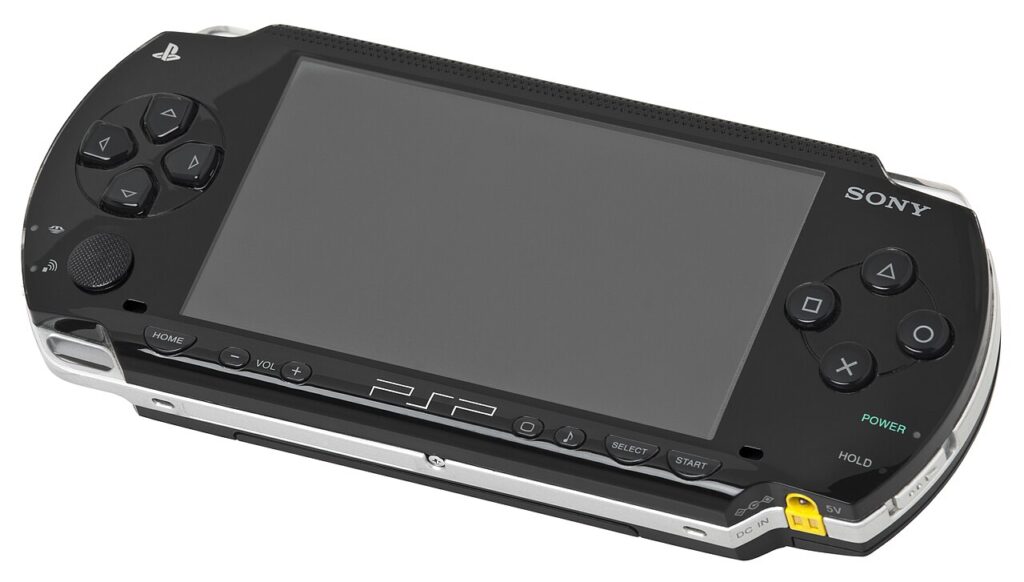
The PlayStation Portable is the most successful failure in handheld history – except it wasn’t a failure at all. Sony’s black slab sold more than 80 million units, made portable gaming respectable for adults, carried the Monster Hunter phenomenon that ruled Japanese commuter trains for half a decade, played movies, music and the entire PlayStation 1 catalogue, and became the most enthusiastically hacked mainstream device ever shipped. And it “lost” – to the Nintendo DS’s 154 million, in a war whose terms (price, battery, touch, Pokemon) the PSP never contested on purpose. Judged on its own ambitions, the PSP is a landmark: the first handheld designed as a media machine, the blueprint for every games slab since, and the last great dedicated portable of the pre-smartphone world. This is its complete story.
The Walkman Invasion: 2004 and the Screen That Sold a Dream
Ken Kutaragi announced the PSP at E3 2003 as the “Walkman of the 21st century,” and the pitch was pure Sony-era confidence: the company that owned portable music would now own portable everything. The hardware unveiled at E3 2004 justified the swagger. A 4.3-inch, 480×272 widescreen LCD – still the reference point for how a handheld could look – wrapped around near-PlayStation 2 graphical power, built-in Wi-Fi in 2004, a disc drive, and a single analogue nub, all in a piano-black slab that looked like consumer electronics for grown-ups next to the DS’s toyetic clamshell. It launched in Japan in December 2004 and in America in March 2005 at $249 – expensive for a handheld, cheap for what it claimed to be. The launch library understood the assignment: Ridge Racer as the graphics flex, Wipeout Pure (a pioneer of downloadable content) as the tech demo, and Lumines, Tetsuya Mizuguchi’s synaesthetic puzzler, as the sleeper masterpiece. Sony sold a dream of convergence – games, films, music, photos, the internet, in one beautiful object – and for its first years the PSP’s western story is that dream colliding with two unplanned realities: a movie format nobody wanted, and a hacking scene nobody could stop.
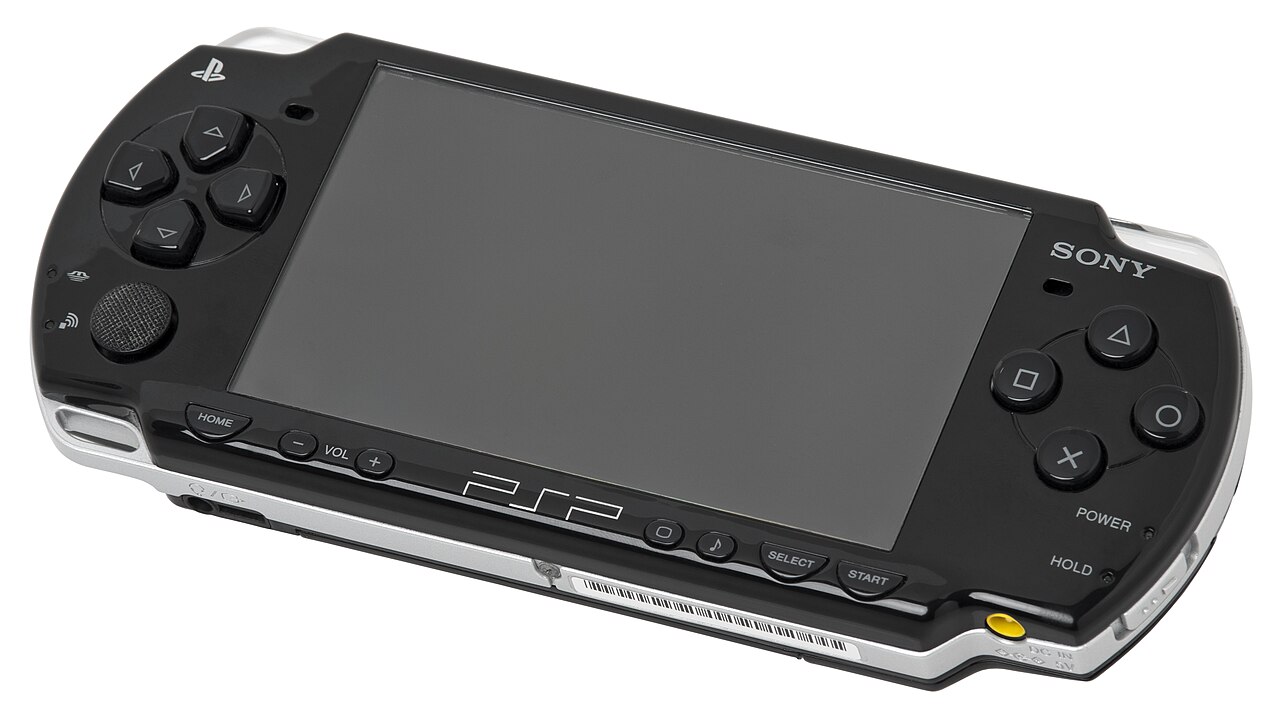
The launch itself was a culture moment Sony hadn’t enjoyed since the PS2: midnight queues, a $249 “Value Pack” with a Spider-Man 2 UMD riding along, mainstream press treating a games handheld as a technology event – and the era’s inevitable blemish, a dead-pixel controversy in which Sony’s initial warranty stance (a few dead pixels were within tolerance) generated more heat than the screen generated light. The battery was the other launch argument, good for perhaps four hours of full-throttle play against the DS’s ten-plus, a real-world reminder that convergence has a power bill. Sony shipped the dream anyway, and for its first western year the PSP outsold every expectation set for it – the fade, when it came, was a software and smartphone story, not a launch one.
UMD: The Format That Died, and the Piracy War
The Universal Media Disc was the PSP’s original sin and its most Sony artefact: a proprietary optical format in a protective caddy, designed as much for control as for games. For a year, UMD movies were a genuine retail phenomenon – major studios released films on the format, and the PSP was briefly a portable cinema. Then the economics collapsed: UMD films cost more than DVDs and played on exactly one device, studios withdrew through 2006, and retailers cleared the shelves; the format survives as a punchline and a collector’s niche (this site’s own PSP Collector’s Guide lovingly catalogues the shelf). The games stayed on UMD, but the disc had a second problem – it could be read. The PSP’s firmware became the decade’s great cat-and-mouse war: the 1.50 firmware’s homebrew opening, the custom firmwares of Dark_AleX (whose Open Edition and M33 releases turned PSPs into open platforms), the Pandora battery that unbricked and unlocked anything. Sony shipped revision after revision; the scene routed around every one. The consequence was the PSP’s dual identity – in the West, piracy is routinely blamed for the platform’s anaemic software attach rate; in the same years, the PSP was simultaneously the greatest emulation handheld ever sold, a perfect portable PlayStation 1, and the machine a generation of tinkerers learned on. Sony built a walled garden and accidentally shipped the era’s best open platform.
Monster Hunter’s Japan and the West’s Slow Fade
Two PSP stories ran in parallel, and geography decided which one you lived. In Japan, the PSP became a mass social phenomenon on the back of Capcom’s Monster Hunter Portable series: the ad-hoc multiplayer hunts – teenagers gathering in fast-food restaurants and train stations, four PSPs to a table – made the platform a fixture of youth culture, and by 2008-2010 the PSP was outselling the DS in Japan for long stretches, an achievement no other handheld has managed anywhere against peak Nintendo. The Japanese library deepened accordingly – RPGs, visual novels, and oddities that never travelled (this site’s 7th Dragon 2020 feature, the Sega RPG a fan carried west, is one survivor’s story). In the West, the catalogue was top-heavy with proofs of concept: Grand Theft Auto: Liberty City Stories, the system’s best-selling western title, proved console GTA worked in a pocket (then undercut the platform by porting to PS2); Ready at Dawn’s God of War games were technical miracles; Crisis Core: Final Fantasy VII and Kojima’s Metal Gear Solid: Peace Walker (2010) are still cited among the generation’s best games, period. But between the piracy tax, $40 price tags against $1 phone apps after 2008, and Nintendo’s casual ocean, western third parties cooled. The PSP in America and Europe became a beloved gadget with a software problem – bought as a media player as much as a console, a proto-smartphone slab in an age about to be overrun by actual smartphones.
The Games Shelf: A Handheld Canon
The PSP library’s top shelf rewards the version of the platform Japan and the enthusiasts saw. The launch wave (Ridge Racer, Wipeout Pure, Lumines) remains the strongest any handheld has fielded; the middle years delivered conversion-era depth: Tekken: Dark Resurrection and Soulcalibur: Broken Destiny as near-perfect portable fighters, Grand Theft Auto’s two Stories games, Bend Studio’s superb Syphon Filter pair (Dark Mirror, Logan’s Shadow) and Daxter, Ready at Dawn’s God of War duo, Killzone: Liberation’s isometric reinvention, and Ratchet & Clank: Size Matters. The connoisseur shelf is deeper still: Level-5’s Jeanne d’Arc, the strategy gem America nearly skipped; Persona 3 Portable, for many the definitive version of a classic; Tactics Ogre: Let Us Cling Together, the remake that set the genre’s preservation standard; Final Fantasy Tactics: The War of the Lions (slowdown and all); Dissidia’s fan-service arena; Kingdom Hearts: Birth by Sleep; Half-Minute Hero’s whole RPG in thirty-second bursts; and Japan Studio’s Patapon and LocoRoco, rhythm and tilt experiments with a handmade charm no other platform holder was producing. Above them all in Japan, the Monster Hunter Portable trilogy, whose third entry became the platform’s best-selling game anywhere. It is a catalogue with a peculiar fate: universally respected, unevenly owned, and still being rediscovered title by title – a library that was always better than its western reputation.
The Media Machine: A Smartphone Before Smartphones
To understand the PSP’s sales, remember that for years it was many owners’ best screen. It played MP3s and movies from Memory Sticks, browsed the web (heroically, through a browser that rendered the 2005 internet at walking pace), took photos with a camera attachment, made Skype calls on later models, offered GPS in Japan and Europe, streamed a PS3’s interface over Remote Play – a second-screen trick a full product cycle before the Wii U – and sold digital comics from Marvel and DC through its own store. Sony marketed the convergence hard, sometimes disastrously: the December 2006 “all I want for Xmas is a PSP” scandal, in which a marketing agency’s fake fan blog was exposed within days, became the textbook case of viral marketing fraud and a defining embarrassment of the platform’s brashest era. But the strategy was sound and the numbers prove it – a meaningful share of those 80 million buyers were purchasing a media slab that also played remarkable games, in the last years when such an object could exist before the iPhone (2007) and its app economy annexed the category. The PSP’s media ambitions are usually told as dilution of its games mission. Retrospect suggests the opposite: the PSP was a rough draft of the device that would eat the world, written by a games company.
The War by the Numbers: PSP Versus DS
The PSP’s defining relationship was with a machine playing a different sport. Nintendo’s DS – cheaper ($149), longer-lasting on a charge, armed with a touchscreen, Pokemon and the Touch Generations line (Brain Age, Nintendogs) that expanded “gamers” to include everyone’s parents – sold 154 million units and is, by hardware numbers, the winner of the last great handheld war by a distance. The comparison flatters and misleads in equal measure. Sony never aimed the PSP at the DS’s audience: it priced for adults, specified for spectacle, and sold its 80 million into a demographic Nintendo had never held, while Nintendo’s machine, for all its oceans of casual sales, never took the enthusiast core the PSP owned outright. The honest verdict is a partition, not a defeat – two handhelds dividing the portable world along lines of age and taste, and both thriving by the other’s standards until the smartphone dissolved the whole category beneath them. The war’s ironies are the good part: Rockstar built the DS its own Grand Theft Auto (Chinatown Wars, 2009) and then ported it to the PSP anyway; Sony’s marketing for the “adult” machine produced the era’s most notorious advertising fiasco (a Dutch billboard contrasting the white and black PSP models in terms that drew accusations of racism and a swift apology); and the PSP’s Japanese heartland, the Monster Hunter commuter culture, turned out to be the one gaming behaviour the DS’s Japan never matched. When the Vita and 3DS succeeded them both in 2011, they inherited a market already shrinking toward the phone – the PSP/DS war was the category’s golden age precisely because neither side knew it was the last one at full scale.
Connected Before It Was Normal: Ad Hoc, XLink and the PS3 Bridge
The PSP was a networked device in an era when handhelds were not, and its connectivity culture was years ahead of the infrastructure meant to serve it. Wi-Fi shipped in every unit from 2004; infrastructure online play arrived in titles like SOCOM: Fireteam Bravo and Twisted Metal: Head-On, but the platform’s beating heart was ad hoc – local wireless, the mode Monster Hunter turned into a social institution. The community refused the locality limit: XLink Kai’s tunnelling software routed ad hoc traffic over the internet from PCs, creating a shadow online service for games Sony had designed for a train carriage, and Sony itself eventually conceded the point with Adhoc Party (2008 in Japan), a PS3 application that did the same tunnelling officially. The PS3 bridge ran deeper than that: Resistance: Retribution could be “infected” by a connected PS3 running Resistance 2 to unlock an alternate mode and intel – cross-platform connectivity tricks the industry would later rebrand as innovations – and Remote Play made the PSP a portable window into the PS3’s media library. The digital storefront evolved in step (a PC-based store in 2007, a native on-device store in 2008) and with it the first serious console-handheld download business: PSone Classics, PSP minis, and full-game downloads that the Go would soon bet everything on. Re-read now, the PSP’s connectivity stack is a rough sketch of modern platform life – accounts, downloads, tunnelling, second screens – assembled half a decade before the audience’s habits caught up, by owners who mostly just wanted to hunt monsters together.
Five Models and the Go: A Beautiful Failure
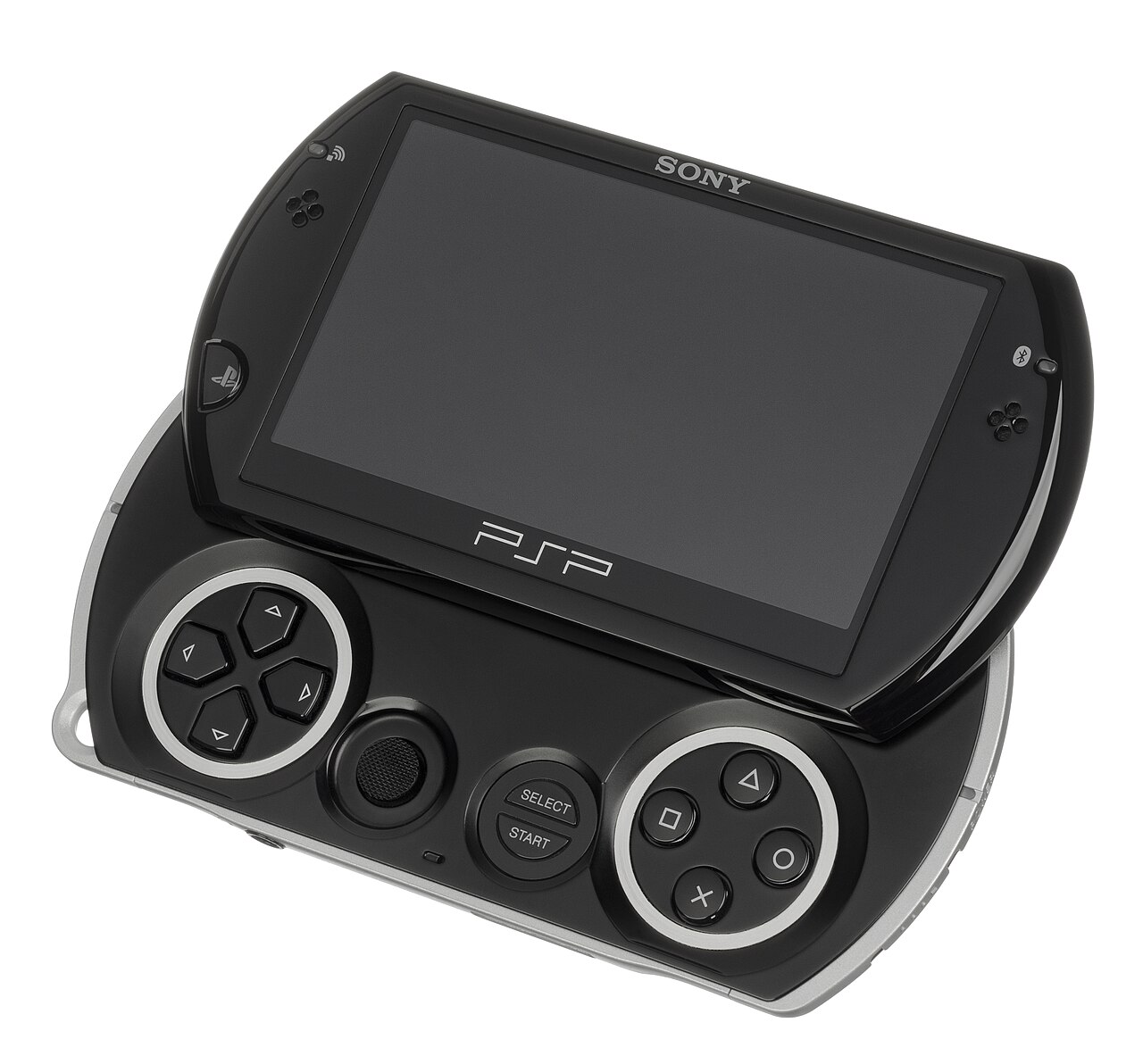
Sony iterated the PSP like a phone line. The PSP-2000 (2007) slimmed the slab, doubled the RAM and added TV-out; the PSP-3000 (2008) brightened the screen into a minor controversy; the PSP-E1000 “Street” (2011) stripped it to a budget essential for emerging markets. Between them sits the PSP Go (2009), the platform’s most interesting artefact: a smaller, sliding-screen, download-only PSP with no UMD drive at all. As prophecy it was flawless – the all-digital, store-bought, carry-your-library future, precisely as the industry would eventually live it. As a 2009 product it was punished: $249 at launch (the same as the bigger model), incompatible with the UMD libraries its buyers already owned, dependent on a store whose prices undercut nobody, and loathed by the retailers asked to sell a machine that excluded them. The Go was quietly discontinued outside Japan by 2011 and is now the collector’s favourite – a beautiful failure that demonstrated the industry’s digital future had to wait for its audience to arrive. The base PSP line, meanwhile, kept selling quietly for years – production ended in 2014, a decade after launch – as PSone Classics turned the machine into Sony’s own nostalgia business and Japan Studio’s charm offensive (Patapon, LocoRoco, the system’s most original first-party work) gave the catalogue its playful counterweight.
The line’s longevity surprised even Sony: Japanese production ran to June 2014, nearly a decade, because Japanese software support – God Eater 2 launched on PSP (alongside Vita) as late as 2013 – kept the installed base buying long after the West moved on. The PSP’s last years were thus a mirror of its prime: a platform sustained by Japan, misunderstood as finished by a Western industry that had already written its obituary twice.
Afterlife: The Modder’s Forever Machine
The PSP’s afterlife was guaranteed by its hacking history: a platform that spent a decade being opened does not close. Custom firmware turned every PSP into a flawless portable PlayStation 1, an emulation suite and a homebrew library, and the modding scene simply never stopped – the PSP remains the default recommendation for a cheap, beautiful retro handheld, its collector market (chronicled in this site’s Ultimate PSP Collector’s Guide) steadily appreciating the special editions and the UMD oddities. The institutional legacy is subtler and larger: the PSP established the template – media slab, digital storefront, console-scale games in a pocket, iterative hardware revisions – that the Vita would refine and the Switch would finally perfect in hybrid form. It also taught Sony the limits of the approach: 80-plus million sold, a Japanese phenomenon, a western “failure” only by the impossible standard of the DS – and still not enough, in the smartphone era, to keep Sony in handhelds beyond one more generation. The Walkman of the 21st century didn’t take over the world. It just showed everyone what the world would look like – a beautiful black slab, a store in your pocket, your whole library with you, and a community that would spend twenty years refusing to put it down. Every handheld since, Sony’s own Vita included, has been a footnote to the argument the PSP started.