At a glance: R-Type · TurboGrafx-16 HuCard · Irem / Hudson Soft, 1989 · Horizontal scrolling shooter · Score: 8.5/10
There are faster shooters on the TurboGrafx-16, friendlier ones, louder ones. There is no more important one than R-Type. Irem’s 1987 arcade game rewrote the horizontal shooter around a single invention — the Force, an invulnerable pod that attaches to your ship’s nose or tail, blocks enemy fire, and can be launched into the enemy as a weapon in its own right — and around a design philosophy of deliberate, memorised, almost puzzle-like stages. Hudson’s TurboGrafx-16 conversion, released in North America in 1989 among the system’s launch-window titles, did something its Japanese counterpart had not: where the PC Engine release was split across two HuCards, R-Type I and II, the North American card contains the complete eight-stage game.
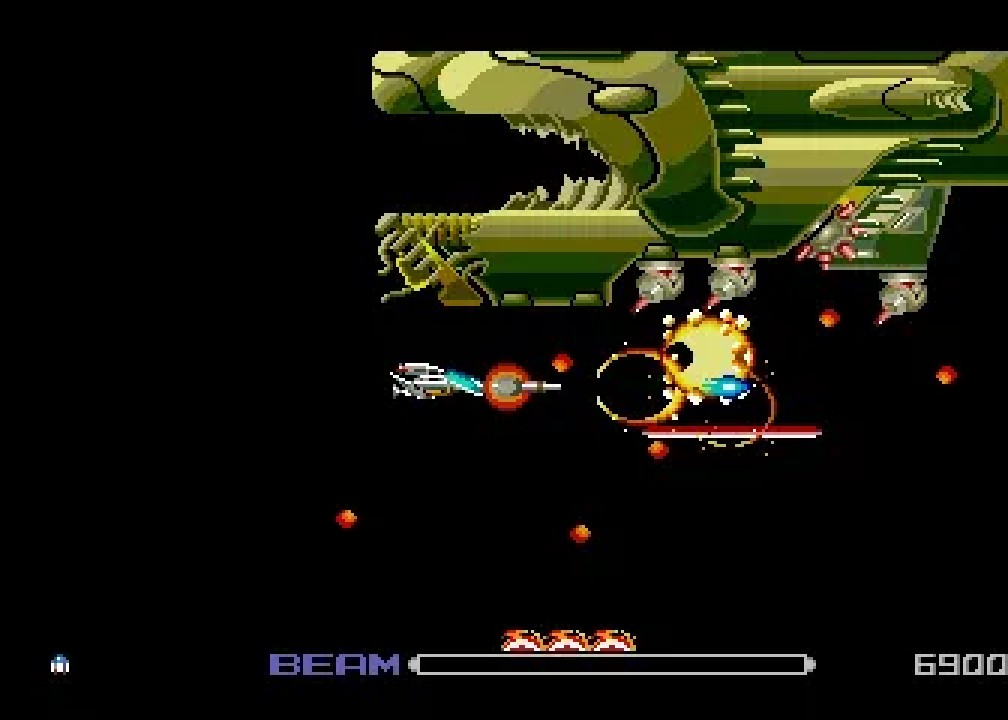
The Bydo Empire awaits, as it has in every version: an organic-mechanical horror of a civilisation, all chitin, cabling and vast biomechanical dread, rendered here with a fidelity that made contemporary owners of other consoles quietly put their ports down. The R-9 Arrowhead is a small ship in a huge, hostile architecture, and the game’s scale — stages that are places, bosses that are environments — survives the HuCard intact.
The Force, and what it does to your brain
Every shooter since owes the Force a royalty of the mind. Attached forward, it is shield and spearhead, absorbing the frontal fire that the game throws in sheets. Attached aft, it guards the tail the level design loves to attack. Detached, it becomes an autonomous turret, parked in a boss’s weak point or a corridor’s throat while you fight from somewhere survivable — and your charged Wave Cannon, built by holding fire, fires through it, so positioning the pod is positioning your heaviest weapon. Add the three weapon pick-ups — the reflecting blue laser that owns corridors, the red anti-air arcs, the yellow ground-crawling shots — plus missiles and speed-ups, and R-Type becomes a game of loadout reasoning under fire. Death strips it all, and the game’s checkpoints are famously willing to restart you, naked, in places that assumed you were armed. This is the cruelty and the curriculum in one.
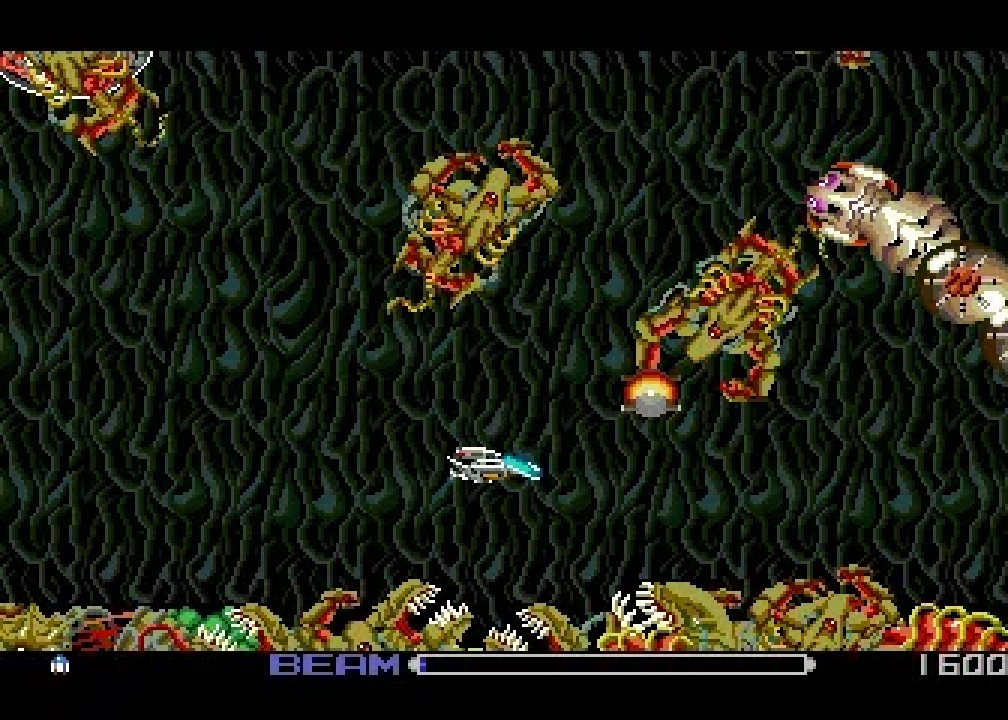
The conversion’s quality is the story. Sprites are arcade-sized, the famous first-stage ring boss and the third stage — fought along and inside a colossal battleship — arrive whole, and the slowdown and flicker that appear in the heaviest traffic are close to the coin-op’s own behaviour. Hudson and Irem between them produced what was, on release, arguably the best home version of the game anywhere, and the reference point against which the system’s shooter reputation was built. This is the port that sold the TurboGrafx-16 to arcade players.
Methodical, not fast — and proud of it
New players should calibrate: R-Type is a memorisation shooter. Enemy waves arrive from behind as a philosophy. Stages are gauntlets of specific problems with specific answers — where to park the Force, when to charge, which weapon the next corridor demands. It does not want your reflexes first; it wants your homework, and then your reflexes. For players raised on its descendants, from Gradius veterans to modern precision shooters, that contract is the pleasure. For everyone else, the first three stages are a complete, magnificent game in themselves, and the fourth is where legends separate.

The presentation holds its age with dignity. The Bydo designs — H.R. Giger’s influence worn openly — remain genuinely unsettling, the colour work is restrained and mechanical in exactly the right way, and the soundtrack’s moody chip compositions suit a game that is more dread than adrenaline. If the Wave Cannon’s charge whistle doesn’t live in your head after an evening, check your pulse.
Versions, briefly
One caution for collectors: the Japanese PC Engine edition’s two-card split means a complete Japanese R-Type is two purchases, and the second card is the scarcer. The North American TurboGrafx-16 release reviewed here is the whole game on one card — one of the few times the Western version of a PC Engine title is straightforwardly the more convenient original.

The stages as examinations
A walk of the eight stages shows the design’s discipline. The first is the tutorial the game never admits to being: the ring-shaped Dobkeratops at its end teaches Force management — attach, detach, park, charge — in a single fight that has introduced more players to this series than any other. The second stage turns organic, all Bydo growth and enemies that punish a nose-mounted Force left carelessly forward. The third is the legend: an entire stage fought against, along and inside a gigantic battleship, its guns and hangars a level-sized boss years before that was a genre trope. The middle stages weaponise the game’s own systems — water, machinery, enemies arriving from the rear as a matter of doctrine — and the final approach through the Bydo’s heart is a memory test administered at gunpoint. Every stage is short. Every stage is dense enough to feel long. That ratio is the whole art.
The weapon set, examined closely, is a study in situational design. The red weapon’s anti-air arcs own the stages where threats dive; the blue reflection laser turns corridors into ricochet puzzles and is the connoisseur’s choice indoors; the yellow ground-hugger answers the floor turrets that otherwise demand suicidal positioning. Missiles and bits extend the logic, and the Wave Cannon’s charge — that rising whistle, the screen-shaking discharge through a parked Force — remains one of gaming’s most satisfying verbs. Losing the set to a death, and being restarted at a checkpoint the designers chose with malice aforethought, is the game’s famous cruelty; learning to recover a run from naked is, veterans insist, the actual R-Type, and they are not wrong.
The port in the system’s story
One more piece of context for the score. In 1989 the home-conversion league table was a console war weapon, and R-Type was among its most contested titles — versions appeared everywhere, and most were compromises you could see from the sofa. The TurboGrafx-16’s complete, single-card, arcade-faithful edition was a genuine competitive event: it told arcade players that this odd new machine, with its little cards, was the serious one. The system’s shooter legend — the library this site’s TurboGrafx shelf is built on — begins with the credibility this conversion bought. Playing it now, on the original card, is playing the moment the TurboGrafx-16 announced what it intended to be.
Survival notes for the Bydo frontier
Three disciplines carry new pilots further than reflexes alone. Keep the Force forward through frontal barrages and learn the exact moment a stage starts attacking your tail — the switch, made a second early, is this game’s core skill in miniature. Fire the Wave Cannon on rhythm, not on panic: a charged shot held through a wave’s opening is worth three fired in desperation. And when death strips you at a checkpoint, treat the recovery as the stage’s real beginning — the designers placed those restarts as examinations, and generations of players have passed them unarmed by learning the next thirty seconds perfectly. The Bydo Empire is patient. Out-patient it.
Verdict
A landmark conversion of a landmark game: complete, faithful and still formidable. R-Type on TurboGrafx-16 is where the system’s shooter legend starts, and it has not been surpassed for sheer design authority since.
Score: 8.5/10