
At a glance: Bonk’s Adventure · TurboGrafx-16 HuCard · Hudson Soft / Red Company, 1989 (Japan) / 1990 (North America) · Platformer · Score: 8.5/10
Every console of the mascot era needed a face, and the TurboGrafx-16’s was a forehead. Bonk’s Adventure — PC Genjin in Japan, a pun on PC Engine that tells you how central he was — stars a bald, big-headed caveboy who attacks the world the direct way: by head-butting it. Released in Japan in December 1989 and North America in 1990, Red Company and Hudson’s platformer had to do the hardest job in games at the time, which was to give a new console an identity against Mario and Sonic. It could not out-Mario Mario. So it out-weirded him, and built one of the most charming platformers of its generation around a single, perfect verb.
The kingdom of Moonland has been taken by King Drool and his dinosaur minions, and Princess Za is, in the era’s tradition, kidnapped. Bonk’s route there crosses five rounds of prehistoric platforming — plains, deserts, inside a dinosaur, across the sea — each divided into stages with their own gimmicks, mini-bosses and the occasional swimming or climbing section, ending in a boss rush and Drool himself.
The bonk is a complete moveset
Bonk’s head does everything. On the ground it is the attack, a lunging head-butt with a satisfying arc. In the air it becomes a spin — tap the button and Bonk flips end over end, slowing his fall and damaging anything he lands on, which turns jumping from a hazard into an offensive glide. Against walls it is a climbing tool, biting and bonking up surfaces other platform heroes would need a power-up to scale. And it is a juggling system: a bonked enemy bounces, and keeping fruit, vegetables and score icons aloft with repeated bonks is a skill game inside the platforming. One button’s worth of ideas, explored for five rounds without repetition fatigue. That is design economy most mascot games never approached.

Meat is the power-up, because of course it is. Small meat enrages Bonk — faster, invincible-tempered, doing double damage with steam coming out of his ears. Large meat transforms him entirely into an invulnerable, earth-shaking form that ploughs through stages like a headline. The series’ food chain — flowers that spring you skyward, fruit for score, smiling bonus pick-ups — is all present in this first outing, along with the bonus stages: juggling challenges, waterfall climbs and head-butt target ranges that break up the campaign with Hudson’s arcade instincts.
Colour, character and a real sense of place
The TurboGrafx palette serves Red Company’s art beautifully. Bonk himself is a masterclass in readable character design — huge head, tiny body, expressions that swing from determination to cross-eyed dizziness — and the enemy dinosaurs have the same cartoon confidence. Backgrounds shift from sunny plains to the genuinely inventive interior of a giant dinosaur, complete with stomach-acid hazards, one of the era’s great level concepts delivered as a joke the game commits to completely. The music bounces along in bright chip melodies that have aged into genuine nostalgia triggers for anyone who owned the system.

Honesty section: Bonk is not a fast hero, and his ground speed will feel stately to players raised on hedgehogs. The campaign is a comfortable length — an evening, more with the bonus stages and score play — and the difficulty is welcoming until a late spike around the boss rush. Some jumps demand commitment to the spin-glide earlier than the game formally teaches it. These are period truths, and the game’s warmth covers most of them.
The sequels and the crown
Bonk’s Revenge would refine the formula and Bonk 3 would supersize it, and the series history is its own story — but the original’s role is foundational. It proved the TurboGrafx-16 could originate a mascot with genuine personality rather than import one, gave NEC its advertising face, and gave the system the flagship platformer its launch years needed. Zonk, his cyber descendant, inherited the attitude; this is where it was born.
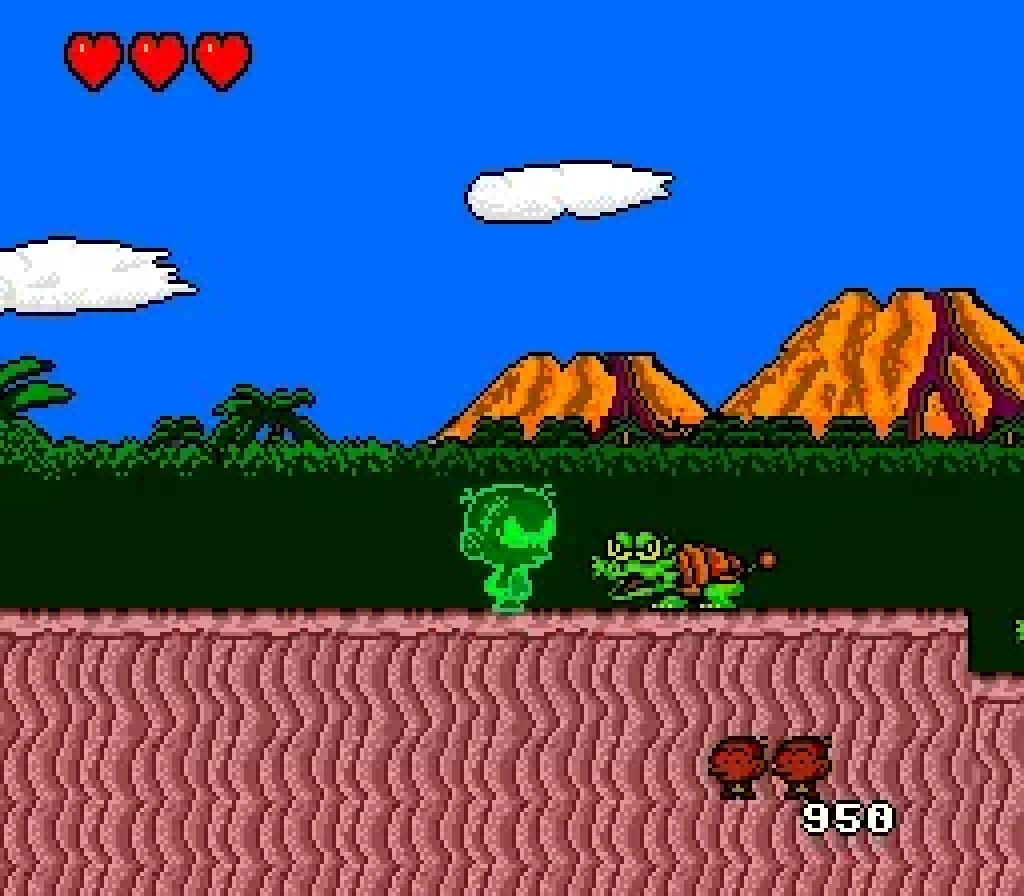
The rounds, and Bonk’s bag of tricks
The five rounds are a small world tour with a designer’s sense of escalation. The opening plains are pure teaching — enemies placed to be bonked, flowers placed to be bounced on, the spin-glide discovered by accident and then by intention. The desert and water rounds complicate the footing and introduce swimming, where Bonk’s head-first logic turns amphibious without missing a beat. The dinosaur’s interior is the centrepiece everyone remembers, and rightly: a stage built inside a living creature, with the anatomy as level design and the gross-out humour worn proudly. The final rounds gather the vocabulary — climbing, gliding, juggling, boss patterns — into the boss rush and King Drool, a finale that tests the whole moveset rather than a single trick.
Two systems reward a closer look. The juggling is not decoration: keeping enemies and fruit airborne with successive bonks builds score and, more importantly, trains the aerial control that the late game demands — it is a tutorial disguised as a party trick, Hudson’s teaching style in miniature. And the meat economy is a small masterpiece of risk design. Small meat’s enraged Bonk is faster and stronger but harder to finesse; large meat’s transformation is a limited invincibility that begs to be spent immediately and rewards the player who saves it for the screen that deserves it. Platformers of the era handed out power-ups as gifts. Bonk’s are decisions.
Mascot economics, and why Bonk won his war
The historical frame matters to the score. NEC did not merely need a platformer in 1989; it needed a character who could stand on a box next to a plumber and a hedgehog and be recognised at twenty paces. Bonk’s design — one enormous head, one verb, a face that could sell a console in a single advertisement frame — solved that problem so completely that he headlined the system’s American marketing, fronted its magazine, and eventually gave his name, in cyber form, to the TurboDuo’s mascot era as Zonk. The games had to justify the silhouette, and this first one does: it is not the deepest platformer of its generation, but it may be the most personality-dense, a game in which the hero’s body is the mechanic, the joke and the logo at once. Sequels refined it; this is the one that invented it, and invention is the rarest thing a mascot game can contain.
The first bonk is the deepest
A last word for players meeting Bonk here for the first time: give the moveset one full round to teach itself. The ground bonk will feel simple, the spin-glide accidental, the climbing strange — and somewhere in the second round the three will fuse into a single way of moving that no other platformer offers, and the game will suddenly be playing at the speed it always intended. That click, when it comes, is the same one that sold consoles in 1990. Bonk did not become a mascot by looking distinctive in advertisements, though he did. He became one because a generation of players felt that click, and never forgot the shape of it.
Verdict
Charming, inventive and mechanically singular, Bonk’s Adventure is the TurboGrafx-16 platformer — a mascot game with a real idea at its centre and the confidence to bonk everything with it.
Score: 8.5/10