
At a glance: Ratchet & Clank Future: Tools of Destruction · PlayStation 3 · Insomniac Games / Sony Computer Entertainment, 2007 · Action platformer · Score: 8.5/10
Tools of Destruction was the game that told PlayStation 3 owners the console was going to be all right. Arriving in October 2007, after a first year of ports and promises, Insomniac’s fifth Ratchet & Clank was a full-blooded demonstration of everything the hardware had been bought for: worlds dense with traffic and machinery, a draw distance that swallowed cities, effects layered like a Pixar firework show, and the series’ signature arsenal upgraded into high definition without losing a drop of its silliness. It is still, nearly two decades on, one of the most purely likeable games on the system — a Saturday-morning cartoon with a weapons budget.
The Lombax, the robot and the cragmite
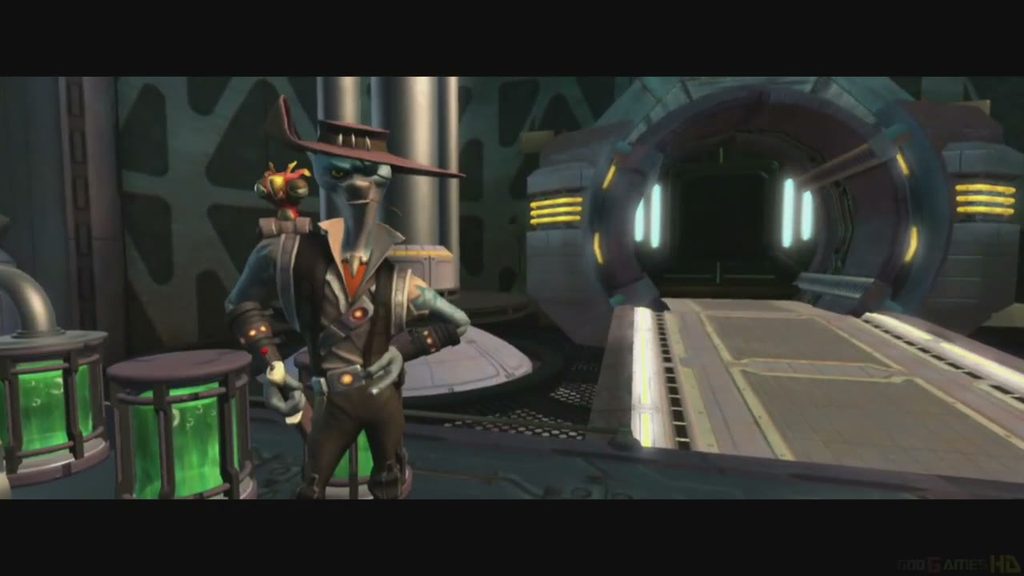
The Future trilogy’s opener gives Ratchet something the PS2 games only hinted at: a past. Emperor Tachyon, last of the cragmites — the race the Lombaxes once banished — has spent his life hunting the species that wronged him, and Ratchet, apparently the last Lombax in the universe, is the final name on the list. The chase crosses a galaxy of Insomniac’s best locations: the vertical freeways of Metropolis, a pirate-haunted asteroid field, the dinosaur wilds of Sargasso, a prison break, a casino planet — and threaded through it, Clank begins glimpsing the Zoni, time-keeping beings invisible to everyone else, setting up a mystery the trilogy would take two more games to pay off. The writing is the series at its warmest and funniest, with Captain Qwark’s cowardice redeploying like a renewable resource and the Plumber, as ever, knowing more than he says.

Guns that throw parties
The arsenal is the game, as always. The Combuster and Fusion Grenade carry the early hours; then the inventions escalate — the Tornado Launcher, which fires a whirlwind you steer by tilting the controller, hoovering enemies into a screaming vortex; the Groovitron, a disco ball that makes every enemy in range dance while you work; the Gelanator, squirting cubes of gel to climb; Mr. Zurkon, a hovering robot bodyguard with a one-line vocabulary of threats. Weapons level up with use into more absurd final forms, a second raritanium upgrade grid adds build choices, and the sheer particle density of a maxed-out battlefield was, in 2007, a genuinely new visual experience: bolts — the currency, thousands of them, fountaining out of every crate — bouncing in physicalised arcs the PS2 could never have afforded. Sixaxis motion turns up in skydiving, tornado-steering and a hacking minigame; it is used with a light touch that mostly survives its era.
Tools of Destruction is a fireworks display with a plot threaded through it — and the fireworks are the plot’s delivery system, its reward structure and its sense of humour, all at once.
Platforming at blockbuster scale
Between the shootouts, the platforming is classic Ratchet refined: grind rails through collapsing space stations, hoverboot-free but full of swingshots, spring pads, and arena fights staged like game-show rounds. The game’s structure — planet-hopping in an order with some freedom, each world a self-contained toybox of missions — is the series template at its most confident. Difficulty is welcoming, death is cheap, and the challenge lives in the optional arenas, the gold-bolt hunt and the skill-point list that veterans treat as the real game. A full run is twelve hours of relentless production value, with not one grey corridor in it.

The first-year flex
Technically, this was the PS3’s early flagship and it wears the role honestly: 720p, a frame rate that aims at sixty and mostly holds under a blizzard of effects, crowds of background machinery and flying traffic that made other 2007 games look empty, and characters whose fur, chrome and cloth finally matched the series’ cutscene ambitions. The score — big, brassy, orchestral — matches the new scale. If Resistance proved Insomniac could do war, Tools of Destruction proved the studio could do wonder, and the PS3’s identity is built from those two proofs arriving a year apart from the same team.
The trilogy it started
Tools of Destruction is act one of three — the downloadable Quest for Booty bridged it, and A Crack in Time, one of the series’ very best, completed the Future arc — and it is best played as the opening movement it is: complete in its own chase plot, generous with its setups, and leaving Clank’s visions and the Lombax mystery hanging exactly where a trilogy should. Newcomers to the series could hardly start better anywhere on the console; veterans rate the sequel higher for its time puzzles, and they have a case, but the sheer arrival energy of this one, in 2007, is unrepeatable.
The importance of being silly
A word, finally, for tone — because tone is this game’s historical contribution. The PS3’s early library leaned hard toward the gravel-voiced and the gunmetal; the console’s identity in 2007 was in danger of being entirely written by war games. Tools of Destruction was the counter-argument with a disco ball: proof that the new hardware’s power could be spent on jokes, on crowds of robots doing background slapstick, on a weapon whose entire function is to make a pirate armada do the hustle while you reload. Insomniac understood that processing power is morally neutral and expressively total — it can render mud on a lens or confetti in a zero-gravity casino with the same chips — and they spent theirs on joy at a moment when joy was going out of fashion at the top of the charts. The series’ later entries would go bigger, sadder and more cinematic, and one of them would eventually headline a new console’s launch. But the Future trilogy’s opener remains the purest dose of the original recipe: a cat, a robot, a wrench, a galaxy of preposterous guns, and not a single grey corridor in twelve hours. In the PS3’s story, that is not a footnote. It is half the thesis.
For the shelf
One practical note for collectors: because Tools of Destruction never received a port or remaster, the second-hand disc is the whole afterlife of this game, and it was pressed in healthy numbers — clean copies are common and fairly priced. Buy the black-label original if the shelf cares about such things, check the disc for the era’s characteristic light scratching, and pair it with Quest for Booty and A Crack in Time to hold the complete Future trilogy in its native format.
It is also, not incidentally, one of the finest co-operative couch arguments ever manufactured — pass the controller at every death and a twelve-hour campaign becomes a tournament. The galaxy can wait. The rematch cannot.
The verdict
Tools of Destruction is the PS3’s essential family blockbuster: a gorgeous, funny, generous action platformer with the console’s most joyful arsenal, from the studio that defined the machine’s early years twice over. It has not left the PS3 since — no port, no remaster — which makes the original disc not just the best version but the only one. Keep it on the shelf.
Score: 8.5/10 — Bolts, bombs and a disco ball. Insomniac’s HD debut is still a blast.