
At a glance: Gran Turismo 5 · PlayStation 3 · Polyphony Digital / Sony Computer Entertainment, 2010 · Racing simulation · Score: 8.5/10
Gran Turismo 5 took five years, cost a fortune, missed its dates in public, and arrived in November 2010 carrying more expectation than any racing game in history. It shipped with over a thousand cars, a feature list that read like a motor show programme, damage modelling the series had dodged for a decade, NASCAR, rallying, karting, night racing, a course maker and a photo mode still being used for desktop wallpapers today. It was also, famously, uneven — a masterpiece and a mess sharing one enormous disc. Fifteen years on, with its online services long retired and its used-car cycle frozen in amber, the verdict has settled: GT5 is the most ambitious driving game of its generation, and the PS3’s racing monument.
A thousand cars, two classes of citizen
The headline number concealed the game’s great controversy. Of the thousand-plus cars, roughly two hundred are Premium models — built for the PS3, with modelled interiors, working headlights you can flash, and detail down to the stitching — while the rest are Standard cars, ported and polished from the PS2-era library, without cockpit views. Purists fumed; players, mostly, drove. The roster’s breadth remains absurd: kei cars and concept cars, the Le Mans prototypes, a loving museum of Japanese metal, the X2010 fantasy prototype designed with Red Bull’s Adrian Newey as an answer to the question of what a racing car unbound by regulations could do. The used-car dealership’s rotating stock — the series’ beloved junkyard economy — turned logging in into a ritual, and the whole game is built around collecting as much as winning: this is a car museum that lets you race the exhibits.
The driving itself
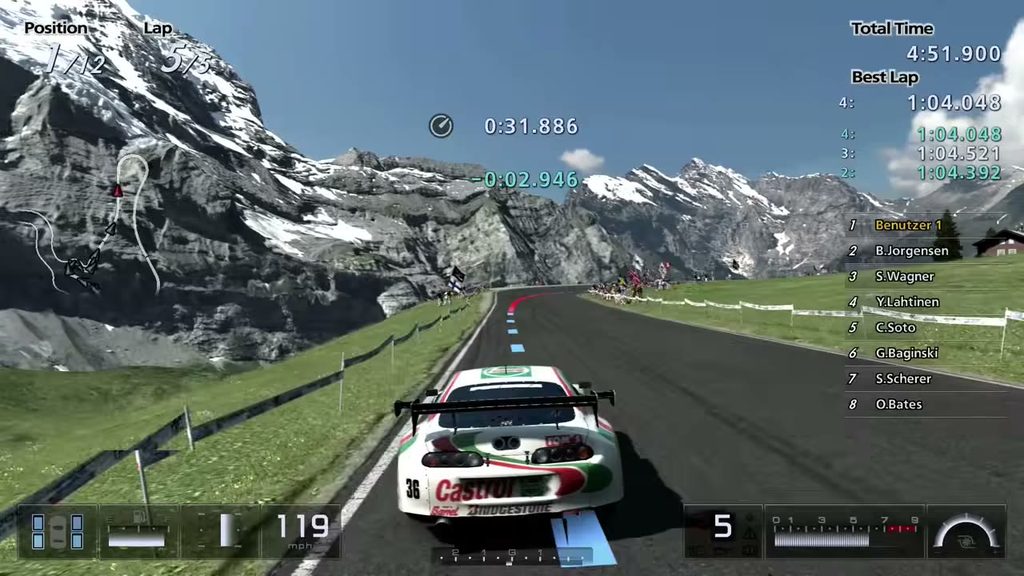
Underneath the content mountain, Polyphony’s simulation made its generational leap. The physics model — new tyre behaviour, weight transfer, proper slip angles — rewards smoothness and punishes the series’ old bumper-car habits, and with a force-feedback wheel (the game shipped alongside a generation of them, and supports them superbly) GT5 is a genuinely convincing drive: you feel a front-engined car’s reluctance to turn and a mid-engined car’s eagerness to rotate in your hands. The AI remained the series’ wooden spoon — rivals running a polite parade line, braking where no human brakes — and rolling starts spaced the field into time trials with traffic. But as an act of driving, against the clock, on the Nordschleife at dawn in the rain, nothing on the console touched it. The licence tests and Special Events — karting, the Top Gear test track with its own challenges, rally stages, the AMG driving academy at the Nürburgring, a moonlit NASCAR school — remain the finest structured curriculum the series ever built, and the Sebastian Vettel challenges still sort the obsessed from the merely skilled.
Gran Turismo 5 is less a racing game than a national car culture with a physics engine — a thousand exhibits, each one drivable, in a museum that occasionally lets the visitors hold a grand prix.
The spectacle and the scaffolding
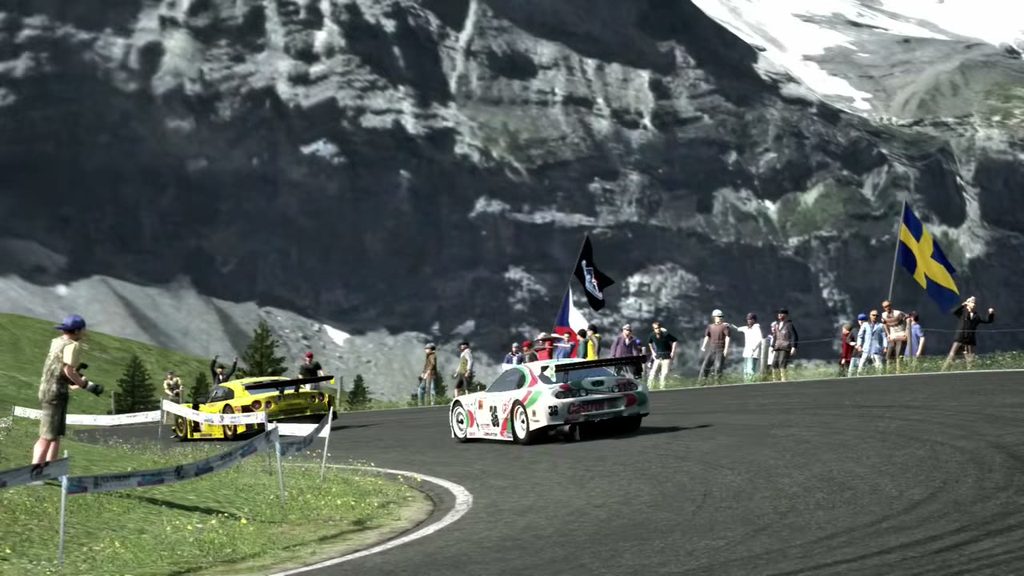
At its best, GT5 was the PS3’s most beautiful game: the Premium cars in photo mode, rain on the windshield at the Circuit de la Sarthe at night, snow at Chamonix, the Tokyo expressways under neon. Kazunori Yamauchi’s team built dynamic time and weather for flagship circuits and a damage system that bent panels and, on Premium cars, tore bumpers loose. Around that core, the scaffolding creaked: menus that loaded like filing cabinets, an interface of heroic clunkiness, installations and patches that consumed evenings, and a career structure — A-Spec and the team-managing B-Spec, levelling gates on content — that felt assembled from three different design documents. The online suite, when it lived, was the console’s deepest: open lobbies, seasonal events, remote B-Spec racing through a web browser. Its closure in 2014 froze the game into its single-player form, which is what a disc offers today: still enormous, still absorbing, missing a limb it was proud of.
The Prologue in the room
GT5 cannot be judged without its strange gestation: Gran Turismo 5 Prologue, the paid preview of 2008, was itself one of the PS3’s best-selling games, and the full release’s job was to justify a three-year wait after it. Judged that way it stumbled — the Standard cars, the menus, the AI were all Prologue-era problems left standing. Judged as the object it is — the largest, most content-dense driving game ever shipped on a console disc at that time, from a studio whose perfectionism is both its engine and its brake — it is a landmark with scratches. Its successor refined the formula on the same hardware; the series’ modern form descends directly from this game’s ambitions.
Playing it now
Today’s GT5 is a single-player colossus: the full A-Spec career, licence tests, special events, arcade mode, two-player split-screen, the course maker and that photo mode, with the used-car rotation cycling on the internal calendar. Patch it fully before a fresh start if your console can — the final versions smoothed the worst loading and added features — settle in with a wheel if you have one, and give it the one thing it always demanded: time.

The community that would not park
One more chapter belongs in any honest history: the afterlife. When Sony closed GT5’s servers in May 2014 — barely three and a half years after launch, with the sequel already out — it might have been the end of the story. Instead the game became a case study in how a big disc ages gracefully. The seasonal-event structure had trained its players into weekly rituals; deprived of them, the community built its own, trading course-maker tracks and photo-mode shots, maintaining tuning databases of a depth that would shame most full-time wikis, and keeping the used-car cycle’s folklore alive long after the online stock froze. The photo mode deserves its own sentence in that story: travel locations rendered as miniature dioramas, aperture and shutter simulation, results that circulated for years as proof of the PS3’s graphical ceiling. GT5’s flaws were the flaws of a studio that wanted to ship an institution; its longevity is the institution actually working. Students of the series still argue about whether GT6’s refinements or GT5’s sprawl make the better PS3 game. The sprawl is why this one gets the monument: nobody else, on any console of the era, attempted to put a nation’s entire car culture — its history, its junkyards, its racing schools, its moonlit endurance races — onto a single disc and dare you to finish it. Most players never did. Most players never wanted to stop, either.
One disc, kept
It also remains, simply, the most content a single PS3 disc ever held — a fact worth weighing when shelf space and a Saturday afternoon are the real currencies. Very few games from 2010 can still absorb a winter. This one can absorb several.
The verdict
Gran Turismo 5 is the PlayStation 3’s definitive racing game — overreaching, uneven and magnificent, a thousand-car argument that driving games could be cultural institutions. Its flaws are documented and real; so is the fact that nothing else on the console, or its rivals, attempted this much. The museum is still open.
Score: 8.5/10 — A flawed colossus. The most ambitious racing game of its generation, and the PS3’s driving monument.