
At a glance: Valkyria Chronicles · PlayStation 3 · Sega, 2008 · Strategy role-playing game · Score: 9.0/10
Valkyria Chronicles looks like a watercolour painting that learned to fight a war. Sega’s 2008 strategy RPG renders its alternate-1930s Europe through an engine called CANVAS, which draws every frame as if it were being sketched and washed in colour as you watch — pencil lines on the uniforms, hatching in the smoke — and then asks you to command a militia squad through a war story with real grief in it. It was a critical darling and a commercial whisper on release, rescued by word of mouth, a price cut and one of the most devoted fan communities of the PS3 era. It deserves every rescue it got. This is the finest strategy game on the console, and it is not close.
Europa, 1935, at war again
The Second Europan War pits an autocratic Empire against an Atlantic Federation over ragnite, the ore that powers the age. Between them sits tiny, neutral Gallia — windmills, tulips, universal conscription — and when the Empire invades, Welkin Gunther, a nature-obsessed university graduate who would rather be sketching beetles, inherits command of Squad 7 of the Gallian Militia. His lieutenant is Alicia Melchiott, a baker’s daughter and crack shot; his tank, the Edelweiss, was his father’s prototype. The war story that follows is unusually literate: it handles occupation, collaboration, a Darcsen minority whose persecution mirrors the darkest chapters of the real 1930s, and the legend of the Valkyrur, the blue-flamed warrior women of ancient Europa, whose return is the war’s terrible secret. It is anime in style and entirely serious in intent.

BLiTZ: the battle system that should have conquered the genre
Combat runs on Sega’s BLiTZ system, and it remains a design of rare elegance. In Command Mode you survey the map like a general’s table — flat, iconic, beautiful — and spend command points to activate individual soldiers. The camera then dives into the watercolour, third-person and real-time: you run the soldier through the battlefield yourself, under fire that ticks health as you move, take position, and fire in a paused aim with a targeting circle that rewards headshots and punishes greed. Then the enemy phase plays the same rules back at you. Classes interlock like a good squad should — scouts run far and spot, shocktroopers shred at close range, lancers kill tanks, engineers repair and resupply, snipers end arguments at distance — and every soldier is a named person with a biography, likes and dislikes that change their stats beside certain comrades, and potentials that trigger in battle: allergies, fancies, fears, pride. Losing a soldier to a critical state and failing to reach them in time means losing them permanently, with a memorial page in the squad’s book. The system manufactures attachment and then prices it.
Every strategy game gives you units. Valkyria Chronicles gives you twenty neighbours, a book of their lives, and a war that can take any of them. The tactics are excellent. The accountability is the masterpiece.
Missions with a novelist’s sense of escalation
The campaign’s battles are set-pieces in tactics form: a bridge assault against a super-heavy tank the size of a building, a forest ambush in fog, a desert duel, a desperate defence of a refugee camp whose moral weight the game refuses to soften, and late-game confrontations with the Valkyria herself that test everything the system taught. Grading rewards speed, which creates the game’s one design argument — the best rank often means a scout sprint rather than a combined-arms masterclass, and purists have grumbled, fairly, since 2008. The skirmish maps and New Game Plus absorb the perfectionists; the story absorbs everyone else. Difficulty is honest, spiking at two or three famous chapters, and the between-battle structure — a literal storybook whose chapters you tab through, funding research, training classes at the camp, and reading the squad’s growing journal — is presentation as warm as the war is cold.
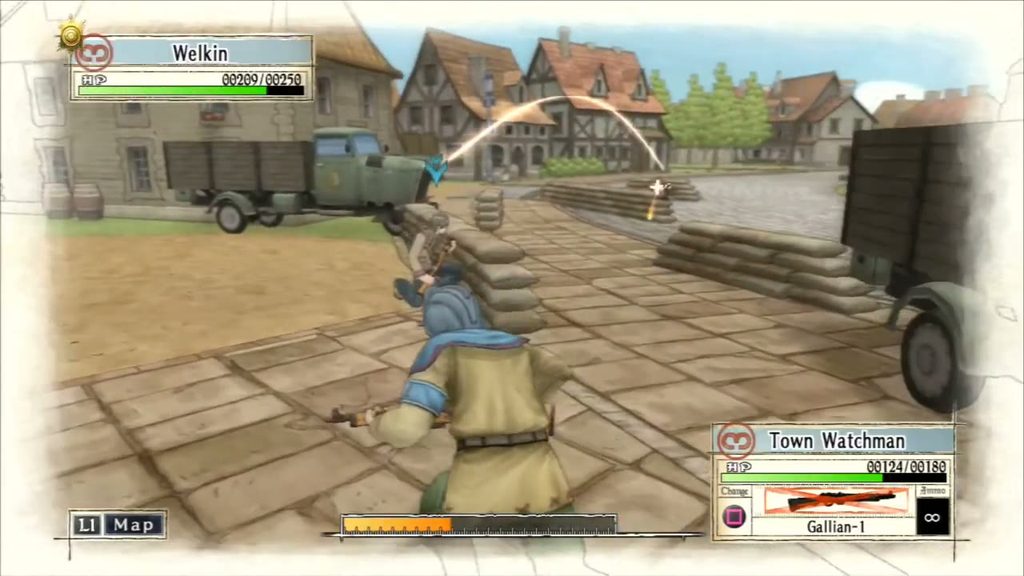
The look that never dates
CANVAS was the point of the exercise and it worked forever: because the game never chased realism, it never fell off realism’s cliff. The PS3 original at 720p is still lovely, its sketch lines and watercolour washes intact, with the caveat of its era — load times between phases, and a frame rate that minds its manners except in the largest explosions. Hitoshi Sakimoto’s score gives the war a proper orchestral melancholy. The English dub is strong, the Japanese track is included, and the whole production has the confidence of a studio that knew exactly what object it was making.
Afterlife
The sequels went to portables and changed the formula’s scale; the remaster brought this original to modern machines and PC and found the audience the PS3 release deserved, years late. But the PS3 disc is the source — the game that proved a major publisher could still ship a watercolour tactics epic about a small country’s war and have it become, slowly and then all at once, a classic. Its influence runs through the modern tactics revival like a watermark.

The book of Squad 7
One structural decision deserves a final salute, because it shapes the whole experience: the game is presented as a history book, “On the Gallian Front,” which you read a chapter at a time, turning tabs for battles, briefings, personnel files and the journalist Ellet’s interviews. The framing does quiet, constant work. It makes the war feel remembered rather than merely played; it lets the game honour its dead in a memorial register; and it gives the between-mission management — training, research, equipment, the cemetery visits — the feeling of tending a record rather than grinding a menu. When a soldier falls permanently, their page in the book changes, and players remember the first time they saw that happen the way they remember scenes in novels. Tactics games have borrowed Valkyria’s camera, its action points and its painterly confidence in the years since; the ones that understood it best borrowed this too — the sense that a squad is a document, kept by someone who loved them. On the PS3, in 2008, essentially nobody bought it. The book stayed open anyway, and the readers kept arriving, year after year, which is how classics actually happen.
Playing order and extras
New players should take the campaign straight, resist the famous temptation to over-level scouts in skirmishes, and save the challenge downloadable missions — the Edy detachment’s side story and the Selvaria campaign that lets you fight for the Empire — for after the credits, when their difficulty and their ironies both land properly. The book has more pages than the war needs, and that generosity is the point.
Bring tissues for the chapters everyone warns you about, and bring patience for the two or three battles that test the system hardest. Both investments pay interest.
The verdict
Valkyria Chronicles is the PlayStation 3’s strategy masterpiece: a humane war story, a battle system of genius, a cast you will protect with your own command points, and an art style that will look this good forever. Essential in the strongest sense — the shelf is wrong without it.
Score: 9.0/10 — A watercolour war with a steel core. Sega’s finest hour on the PS3.