
In February 1993, Midway released a two-on-two basketball game with digitised players, no fouls, and a commentator who screamed like the building was on fire. Within a year, NBA Jam had done something no arcade machine had ever done: it earned, by the commonly cited Retro Gamer account, around a billion dollars in quarters in its first twelve months. This is the story of how a basketball game with a man who literally caught fire became the highest-grossing arcade phenomenon of its generation — and why its fingerprints are still on every sports game you play.

Mark Turmell’s beautiful heresy
The designer-programmer behind it was Mark Turmell, and the heresy was in what he removed. Real basketball has fouls, goaltending rules, stamina, substitutions and eleven careful tactical decisions a minute. NBA Jam kept the baskets. Two players per team, a turbo button, shoving that would end real careers, and dunks launched from distances that violate both the rulebook and several laws of physics. Crucially, everything was written in assembly language, wringing the hardware for the speed the concept demanded: this was a game about velocity, and it could not afford to wait for its own code.
The presentation ran on digitised actors — real performers filmed and shrunk into sprites, giving the players a photographic swagger no hand-drawn game of the era could match. Onto those sprites Midway mapped actual NBA rosters, two stars per team, licensed officially in an era when sports licensing was still the Wild West. The result landed in arcades like a transmission from the future: basketball, but at the speed of a highlight reel that never ended.
The fire mechanic and the voice of God
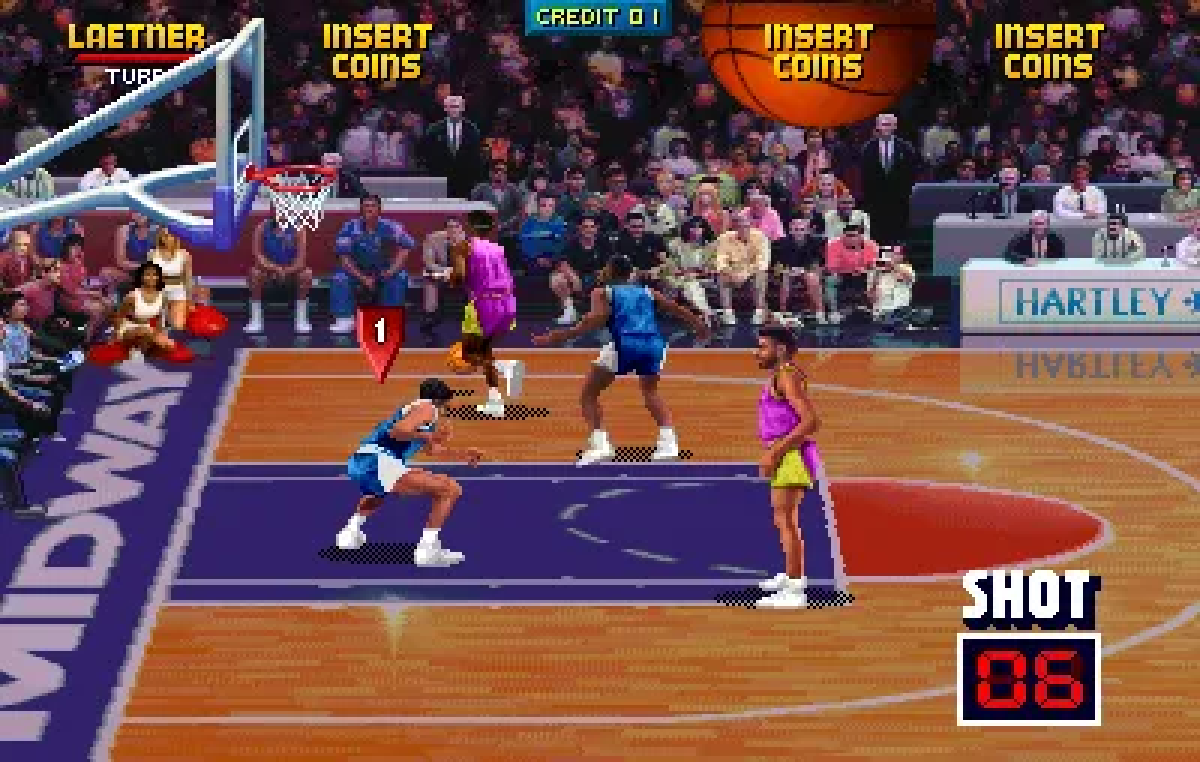
Two inventions turned a hit into a religion. The first was On Fire: sink three consecutive baskets and your player ignited — unlimited turbo, boosted accuracy, the ball literally trailing flames — a comeback mechanism and a spectacle in one. Rubber-band AI quietly tilted the court to keep games close, which real players suspected, resented, and secretly benefited from, because Jam’s genius was engineering the last-second finish. Matches did not conclude; they detonated.
The second invention was a voice. Tim Kitzrow, a Chicago actor and improv performer, recorded a few hundred lines of play-by-play that became the game’s soul: “He’s heating up!” “He’s on fire!” “Boomshakalaka!” — the last borrowed from Sly and the Family Stone by way of pure instinct. Kitzrow’s delivery was the sound of your older brother commentating from the couch, and it proved so durable that he remains the voice of arcade sports more than thirty years later, reprising the role in revival after revival. NBA Jam without that voice is a silent film of a shouting match.
The Jordan-shaped hole, and the ghost in the machine
The most famous player in the world was not in it. Michael Jordan had carved his likeness out of the NBA’s group licensing deal and licensed himself separately, so the biggest name in basketball simply does not exist in NBA Jam’s Chicago — an absence that defined the game almost as much as its inclusions, and that home versions could only underline. Jordan did play Jam, though: he was among the many who had personalised cabinets, and Shaq — who is in the game — famously bought two machines, hauling one on the road. When your arcade game’s user base includes the actual league, you have built something beyond a game.
Then there is the ghost. Dražen Petrović, the Croatian star of the New Jersey Nets, was killed in a car crash in June 1993, months after the game’s release. A legend grew that if you entered his initials, strange things happened — the rim rejecting shots, an eerie presence on court. Turmell addressed the story years later with the perfect designer’s answer: the team had coded the announcer’s “Petrovic” samples, the game shipped, and the machine’s quirks did the rest — a ghost story the community wrote into a game that had left them just enough silence to hear one in. Whether or not a single line of haunted code exists, the legend is now part of the artefact: the great arcade game with a real ghost.
Secrets, tanks and the home invasion
Jam’s other legacy is density. The arcade original hid a full tank game — a Battlezone homage — behind a ritual of joystick movements during the matchup screen, waiting for the one player in a thousand obsessive enough to find it. Secret characters sprawled from mascots to the US President. A proposed Godzilla and Bart Simpson were designed and cut, licensing reality intervening. This was a game stuffed like a Sunday roast, in an era when home ports were supposed to be the compromised versions — and yet the SNES and Mega Drive conversions, arriving in March 1994, were triumphs that moved consoles and shifted the industry’s sense of what a port could be. Tournament Edition followed in 1994, deepening rosters and adding injuries, hot spots and a third player per team, and the series’ descendants — the NFL Blitz and NHL Hitz games, the 2010 EA revival with Kitzrow back in the booth — kept the formula’s torch lit for decades.
The session economy: why the quarters never stopped
Ask arcade operators of the era what made Jam different and they will not mention the dunks first. They will mention the session length. A Jam match was short, loud and engineered to end in heartbreak — the rubber-band logic and catch-up mechanics meant a losing player was always one fire streak from glory, and a winning player was never safe enough to walk away. Both players, win or lose, finished the game convinced the next one would go the other way. That is the psychology of the perfect coin-op, and Jam may be its purest expression: a machine that converted near-misses into revenue at a rate the industry had never seen. The billion-dollar figure gets quoted as trivia, but it is better understood as measurement — the sound of a design so precisely tuned to human competitiveness that it briefly outperformed the entire rest of the arcade.
The home conversions inherited the psychology intact, which is why they sold systems. On the SNES and Mega Drive, Jam became the default multiplayer fixture of the mid-nineties living room — the game that justified four-player adapters, settled arguments and emptied Friday nights. Even the Game Boy version, shrunk to monochrome, kept the fire mechanic and therefore kept the point. In retrospect, 1994’s home Jam was a preview of where sports gaming was heading: away from the solitary season mode and towards the couch rivalry, the rematch, the best-of-seven against your brother. FIFA and Madden would build empires there. Jam drew the map.
So what, in the end, did NBA Jam do to earn its billion? It understood something the sports genre keeps forgetting and relearning: a sports game is not a simulation contest. It is an argument between two friends, staged at maximum volume, in which physics is negotiable and humiliation must always be one turbo-dunk away. Every arcade sports game since — every big-head mode, every fire streak, every commentator screaming over a friendly match — is living in the building Jam built. Boomshakalaka, indeed.