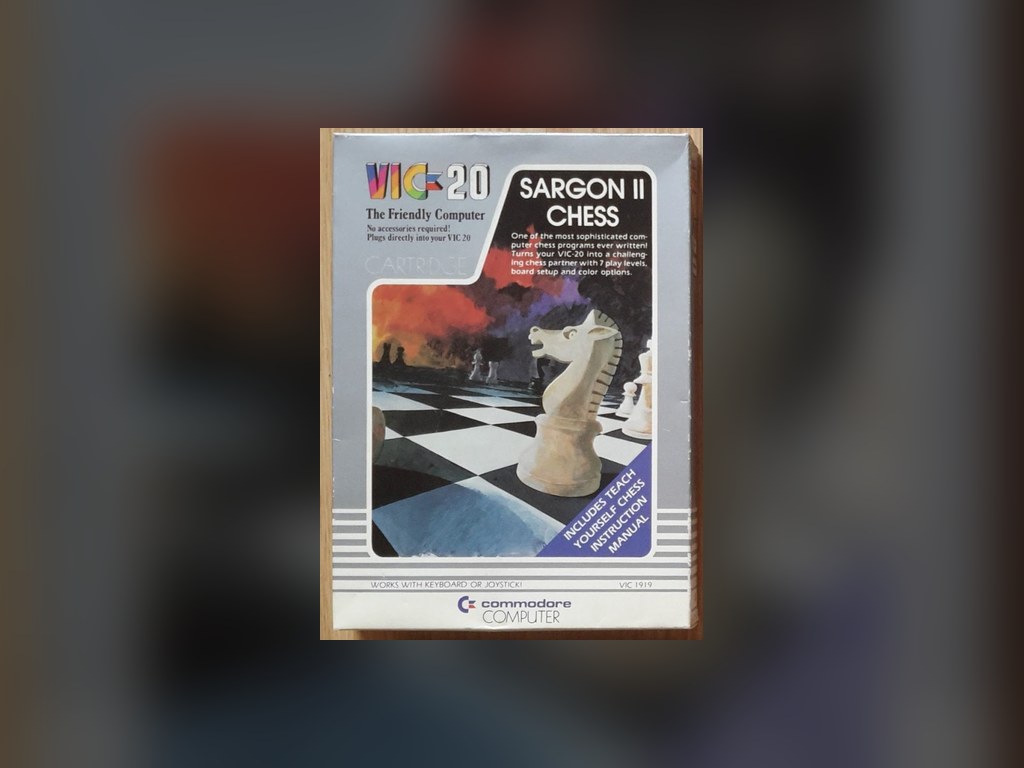
At a glance: Sargon II Chess · VIC-20 · Commodore, 1981 · Chess · Score: 7.5/10
Sargon II was not a toy chess set; it was a champion. Dan and Kathe Spracklen’s program had won computer chess tournaments at the turn of the decade, and its arrival on the VIC-20 — published by Commodore among the machine’s early cartridges — made a serious claim: the friendly computer on your television could out-think you. The VIC version presents a clean character-graphic board, offers multiple levels of play, and sets about its work with the methodical menace of a program that evaluates positions rather than guessing at them. On a machine sold on games of reflex, Sargon II was the cartridge of reflection — the one that stayed in the slot when the arcade crowd went home, grinding through its search trees while the house went quiet.

Patience as a feature
Honesty first: Sargon II on the VIC-20 is slow, and its slowness is the authentic price of its strength. At the lower levels it replies quickly enough for casual play; push the level up and the VIC’s 1MHz processor needs minutes to search to the depth that made Sargon’s reputation. That was the bargain of early computer chess everywhere, and the VIC version is no worse than its contemporaries — but new players should choose their level with their evening in mind. What you get for your patience is a genuinely instructive opponent: Sargon plays proper chess, with an opening repertoire, tactical sharpness in the middle game, and endgame technique that will punish sloppy kings. Beating it at a middle level is an achievement a club player can respect.

The presentation serves the chess rather than decorating it. The board is large and legible — the VIC’s chunky characters are no handicap for chessmen — move entry is straightforward, and the program handles the rules completely, from castling to promotion. As a VIC-20 program, it is also a small wonder of economy: a tournament-grade engine folded into a cartridge for a 5K machine, in an era when chess computers were dedicated hardware costing serious money. Commodore’s decision to publish it said something important about the VIC’s ambitions. This was never only a games machine, and Sargon II was the cartridge you showed the sceptic who said so.
The quiet cartridge
Its audience is specific and it serves them well. For the solo chess player of 1981, Sargon II was close to miraculous — an endlessly patient opponent, available at midnight, that never tired and never took back a blunder out of politeness. For today’s retro player, it offers something rarer than nostalgia: a historically important chess engine in its natural habitat, playable in an evening’s session at sensible levels, with the low levels friendly enough for learners and the high levels standing as a monument to what 1MHz could be made to think.

It will not convert the reflex crowd, and the higher levels’ thinking times belong to a more patient age. But the VIC-20 library is richer for having a heavyweight thinker in it, and Sargon II remains the machine’s definitive chess cartridge. Set up the board, pour something warming, and take your time. Sargon certainly will.
Chess, the VIC way
Sargon II’s place in the VIC-20 story is worth one more consideration, because it cuts against the machine’s marketing in the most productive way. The friendly computer was sold on accessibility — and here is a cartridge that is accessible exactly once, at the moment of purchase, and then demands everything: patience, calculation, humility. That tension is healthy, and Commodore knew it; the same catalogue that offered Mole Attack for the youngest players offered Sargon for their parents, and the household that owned both understood the VIC’s range better than any advertisement could explain it. A computer, unlike a console, was supposed to grow with its family. Sargon II is that promise, compiled.
The program’s tournament pedigree is not marketing garnish, either. The Spracklens’ engine was a genuine landmark of microcomputer chess — a program that had beaten dedicated machines and mainframe-descended rivals — and its presence on the cheapest computer in the shop remains one of the era’s great democratisations. In 1981, the strongest chess you could buy for the price of a cartridge lived here, in 22 columns, on a television. That fact alone earns the cartridge its place in any serious VIC library.
In the slot today
For players who meet Sargon II through modern emulation or a collector’s cartridge, set the scene properly for maximum effect: a real board beside the screen is not required, but a scoresheet is recommended, because Sargon keeps you honest in a way casual computer chess often does not. Note your games. The program’s personality emerges across a match rather than a position — solid, unafraid, quietly accumulative — and reviewing a lost game against it is a genuine education, the kind club players once paid for in petrol and hall hire. That a VIC-20 cartridge can still deliver that education, at kitchen-table convenience, is the strongest practical argument for its score here.
It is also the library’s best ambassador to the non-gaming household member, then and now. Chess needs no cultural translation. Sit a sceptic in front of Sargon II and the friendly computer’s case is made in a language older than computing: the little machine thinks, visibly and well. Commodore’s marketers could not have bought that credibility. The Spracklens built it, one search tree at a time.
A note on the program’s manners, because Sargon’s sportsmanship is part of its legend among early owners: it does not gloat, stall or cheat the clock; it simply plays, at the level you chose, with a consistency that flatters the intelligence of its opponent. Beaten by it — and at the honest levels, most of us are beaten by it — you lose to a better calculation, cleanly delivered. Beating it, on the rare and shining occasion, produces the particular joy that only a worthy silicon opponent can give: no luck to discount the win, no handicap to apologise for it. Just you, the board, and a 5K computer that made you earn it. That joy was new in the world in 1981. Sargon II bottled it for the VIC-20, and the bottle has never emptied.
A tournament-grade engine folded into a cartridge for a 5K machine — Sargon II was the one you showed the sceptics.
Sargon II Chess is a serious program wearing a cartridge’s clothes: strong, complete and patient to a fault at its upper levels. Chess players will find a real opponent and a piece of computing history; everyone else will find the VIC-20’s most thoughtful hour. The definitive chess title on the machine.
Verdict: bring your best game and a comfortable chair. The Spracklens’ champion is still thinking.
So set the level honestly, accept the wait at the deep end, and let the little machine think. Sargon II is the VIC-20’s proof that friendly never meant shallow — the quiet cartridge that out-thinks the room.