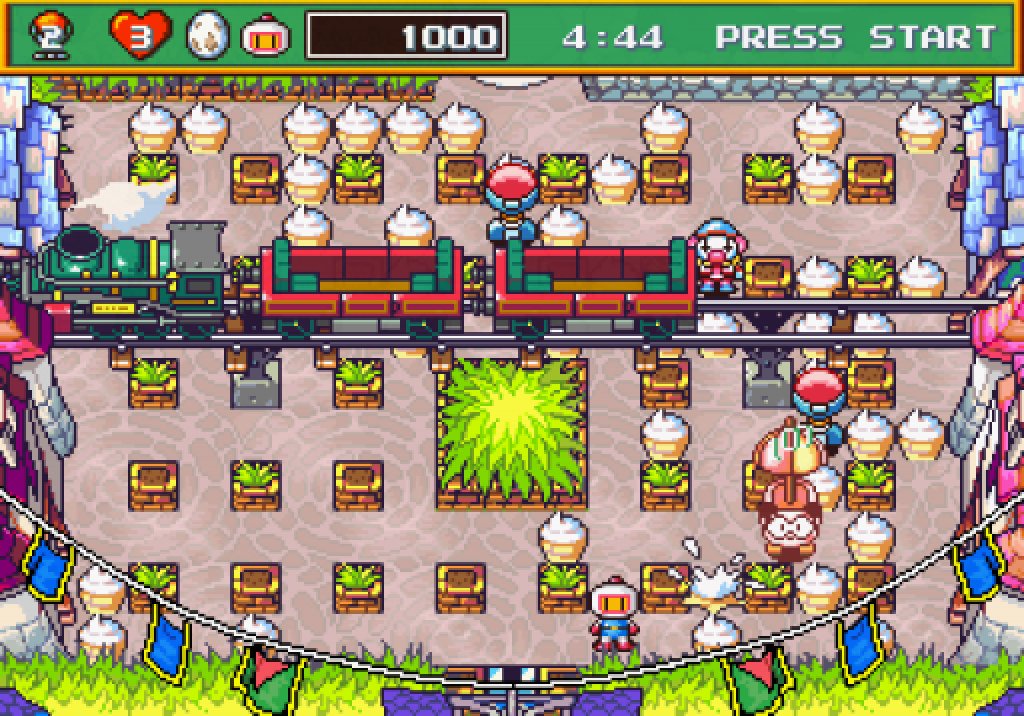
At a glance: Saturn Bomberman · Sega Saturn · Hudson Soft, 1997 · Action / party multiplayer · Score: 9.0/10
Every console gets the multiplayer game it deserves, and the Saturn — a machine with two controller ports and a multitap dream — got the best Bomberman ever made. Saturn Bomberman takes Hudson’s perfect little formula of grids, bombs and betrayal and scales it to absurdity: ten players on one screen, on one console, in one room, with the wide Master stage zooming out to hold them all. It also happens to contain a story mode with dinosaur mounts, a battle mode with the finest arenas in the series, and online play in Japan via SegaNet that predicted the future while the West wasn’t looking. As a Saturn game, it is close to perfect. As a party, it has no equal on any 1990s hardware.
The core needs no introduction, but it deserves respect: you are a Bomberman, the arena is a grid of hard blocks and soft blocks, your bombs blast in crosses, and the last bomber standing wins. Power-ups lengthen flames, add bombs, add speed, add the kick, the throw, the remote detonator; skulls curse you with reversed controls or a bomb that will not stop coming. What Saturn Bomberman understands, and what lesser entries forget, is pace. Rounds are short, deaths are funny, sudden death shrinks the walls and drops the ceiling, and the loser of a ten-player round is spectating for ninety seconds at most before the next fuse is lit. The Master stage — a vast arena viewed from a pulled-back camera — turns ten-player matches into something between a battle royale and a weather system, all crossing blast lines and dawning horror as the grid fills with fire.

The multiplayer engineering is the legend, and it is real. The Saturn multitap takes six pads; chain two and the game accepts ten human beings, each with a colour, a grudge and a corner of the grid. No split-screen, no slowdown worth mentioning, no compromise in the blast effects — the Saturn’s sprite hardware treats a screen full of explosions the way it treats everything 2D: as a birthright. In Japan, the SegaNet edition and the XBAND service took the same matches online in 1996, on dial-up, which makes Saturn Bomberman one of the first console games to be a genuinely online game. The West never got that piece, but the local version’s completeness is its own argument: this is the fullest Bomberman package Hudson ever shipped, before or since.
And a proper single-player game, too
What elevates Saturn Bomberman above pure party status is that the solo and co-op content is a real game, not a training mode with delusions. The story campaign sends Bomberman across themed worlds — a festival, a desert, a haunted house, a factory — clearing arenas of enemies, rescuing the little dinosaurs who then serve as mounts, each colour granting an ability: speed, a kick, a dash. Two players can run the whole campaign together, which quietly makes this one of the Saturn’s best co-op games full stop. Bosses close each world, the difficulty is honest, and the presentation is storybook-bright, with a soundtrack that bounces and art that pops off a CRT the way Saturn 2D always did when a team cared.
Ten players, one screen, no hiding: Saturn Bomberman is the sound of a room full of adults screaming at a cartoon bomb, and it is the best multiplayer the decade produced.
Criticisms, then, because even legends file paperwork. The ten-player dream requires two multitaps and ten working Saturn pads, a hardware pilgrimage few households completed in 1997 and fewer can now — though the game gracefully accepts any crowd from two upward, and eight on one multitap is already glorious. The Master stage’s pulled-back view makes its bombers small enough to lose in the chaos, which some players call atmosphere and others call eyesight tax. The story mode, charming as it is, will not trouble anyone’s list of great campaigns, and the AI opponents in solo battle mode have the traditional Bomberman habit of being either harmless or clairvoyant. None of it survives contact with a full room. The game’s natural habitat is people, and with people it is flawless fun on a timer of about four seconds per laugh.

The Saturn’s party crown
Context seals it. The Saturn’s Western reputation rests on fighters, shooters and RPGs — solo arts, mostly — while its rival down the road was building a four-port party machine. Saturn Bomberman is the counter-argument: with multitaps it out-partied the PlayStation and matched anything the Nintendo 64’s four ports produced, in a series-perfect package that has never been re-released in this exact form. Later Bomberman games added gimmicks, polygons and online lobbies; none recaptured the density of this one — the arenas, the mounts, the ten chairs around one television. Collectors know it, too: the Western release came late in the console’s life and the complete package is a shelf trophy, which is fitting for a game that was always about getting the whole room onto the shelf-side of the screen.
One practical note for modern players: the game scales to your gathering. Two players get the intimate duel version, all feints and trap-setting. Five or six get the classic scrum. Ten get the legend. The Saturn’s pad, with its responsive D-pad — grid movement lives or dies on D-pad precision — is exactly the tool required, and Hudson’s grid logic has the snap that the analogue era sometimes fumbled. It is, in the best sense, a finished thing: a formula perfected, a console flattered, a room entertained.

The arenas are the argument
Battle-mode veterans judge a Bomberman by its stages, and Saturn Bomberman’s set is the series’ finest portfolio. The standard arenas iterate the classic grid with gimmicks that earn their place — conveyor belts that move bombs and bombers alike, trampolines, warp holes, a football-flavoured stage — each one changing the geometry of betrayal just enough to demand new habits. Sudden death is handled with unusual wit: rather than simply shrinking the arena, the game rains blocks and closes the sky, turning the last thirty seconds of a ten-player match into a cartoon of compression in which everyone is suddenly adjacent to everyone else’s bombs. The revenge mechanic, letting dead players lob bombs in from the sidelines, keeps the eliminated in the game and the living paranoid, which is precisely the emotional register the series aims for. And beneath the variety sits the unglamorous excellence that makes it all work: bomb kick physics that never lie, blast propagation you can read at a glance, controls with zero ambiguity. Hudson had been refining this formula for a decade and a half by 1997. Saturn Bomberman is what a formula looks like at the exact moment of its perfection — the last, best word before the series went looking for new ones it did not need.
Verdict
Saturn Bomberman is the best version of one of gaming’s most durable ideas, built on the hardware that flattered it most. Ten-player local multiplayer, a co-op campaign with dinosaur mounts, series-best arenas and — in Japan — a glimpse of console gaming’s online future: the package is complete in a way modern re-releases keep failing to match. If your Saturn ever hosts a room full of people, this is the disc it should be spinning. The fuse is lit. It always was.