The Virtual Boy has no screen. That is the first thing to understand about it, and the thing almost everyone gets wrong. There is no LCD panel inside the visor, no grid of pixels waiting to light up. Each eye instead faces a single column of 224 tiny red light-emitting diodes — a line, not a picture — and a mirror vibrating fifty times a second. Everything the Virtual Boy ever showed anyone, every game, every sprite, every wireframe corridor, was painted by that one column of light, swept across your vision by a shaking mirror faster than your eye could follow the trick. It is one of the most ingenious display mechanisms ever sold in a consumer product, and understanding it explains nearly everything about the machine: the red, the depth, the battery life, the cost — and the headaches.
A display made of timing
The technology came from Reflection Technology Inc., a company in Massachusetts that had developed the Private Eye, a head-mounted display built around what it called a Scanned Linear Array. The principle borrows from the oscilloscope and the laser printer at once. Take a vertical column of LEDs — 224 of them, one for each row of the intended image. Now vibrate a mirror so that it sweeps that column horizontally across the field of view. Light the LEDs at the right instants as the mirror moves, and persistence of vision assembles the flashes into a complete image, 384 columns wide. The picture never exists all at once. It exists as a sequence of illuminated slices, and your visual system does the final manufacturing step for free.
The Virtual Boy doubled the mechanism: two complete display units, one per eye, each with its own LED column and mirror, driven in synchrony. Feed the left unit an image rendered from a viewpoint slightly left of centre, and the right unit the same scene from slightly right, and the brain fuses them into stereoscopic depth — real depth, of the same kind your eyes construct from the world. The two red ‘screens’ people remember are these twin scanned images, each 384 by 224, refreshed at roughly 50 frames per second by the mirrors’ oscillation.
Why red? Why only red?
The red was not an aesthetic choice; it was an invoice. In the early 1990s, LEDs were not equal. Red LEDs were mature, cheap, bright and miserly with power — Gallium Arsenide Phosphide devices that industry could make by the million. Blue LEDs were laboratory novelties (the efficient blue LED breakthrough came in the mid-1990s, too late and too expensive), and a full-colour scanned display would have needed three columns per eye, three times the cost, three times the power, and alignment tolerances a mass-market toy-price console could not carry. Gunpei Yokoi’s team at Nintendo R&D1 chose the brightest, cheapest, most reliable light available and accepted monochrome as the price of a machine that could sell for under two hundred dollars and run for hours on six AA batteries.
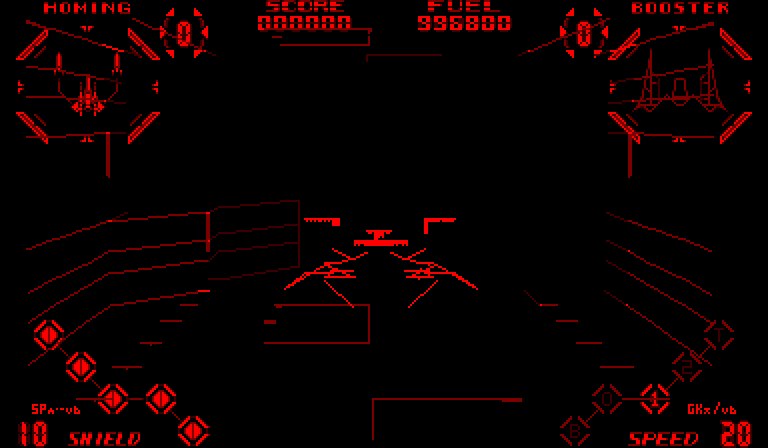
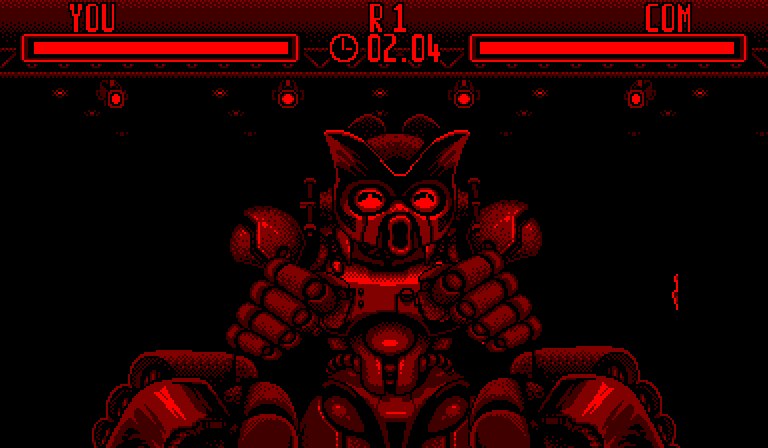
The depth of that monochrome deserves its own note, because the Virtual Boy is not strictly one colour. Its LEDs can be driven at different intensities, and games work with four shades — from a dim ember red through to the full scarlet glare — plus black, where the LED simply stays off. Those four shades carry the entire visual language of the library: the shading on Teleroboxer’s robots, the contouring of Mario’s Tennis court, the ghost-dim far layer in Vertical Force. Artists who mastered the four reds could suggest volume, distance and material. It is a palette the size of a postage stamp, and the best Virtual Boy art is a masterclass in living inside it.
The mirrors, and what they cost
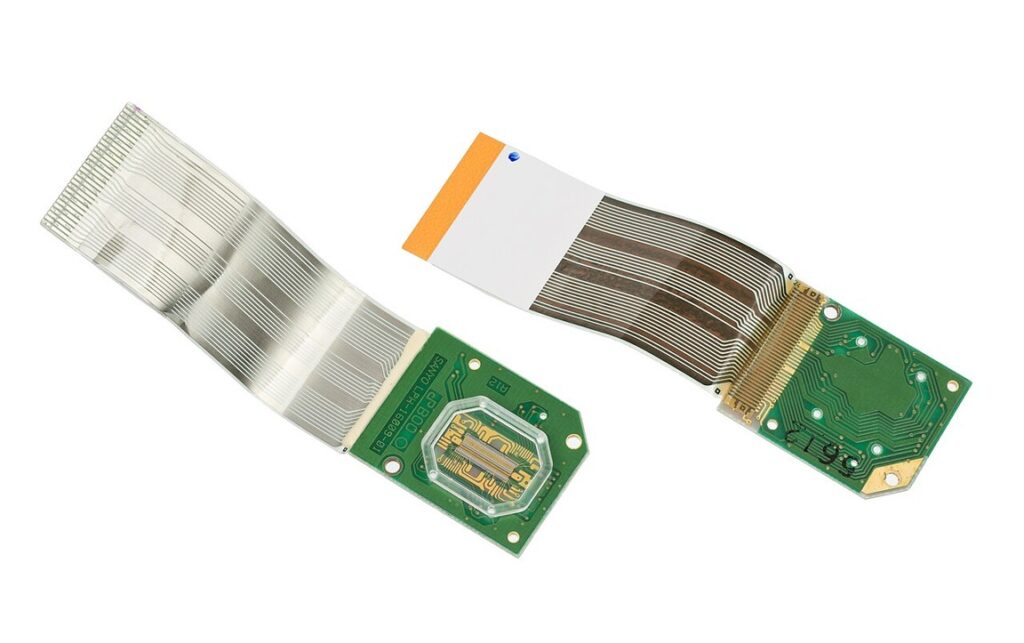
The oscillating mirrors are the mechanism’s genius and its fragility in one part. Each mirror is driven by a voice-coil-like actuator — the same family of technology as a loudspeaker — and must sweep with metronomic consistency, because any variation in the sweep is a variation in the image: columns bunching, stretching, tearing. Nintendo’s engineers added a feedback system measuring the mirror’s motion and correcting the LED timing against it, which is why Virtual Boy images are rock-stable when the system is healthy — and why the machines are so sensitive, thirty years on, to the ribbon cables that carry the display signals, whose failing solder joints produce the famous glitchy-lines fault that now defines Virtual Boy ownership and repair.
The mirrors also set the frame rate and, with it, part of the comfort story. Fifty sweeps a second is above conscious flicker perception for most people, but it sits at the low edge of comfort for a bright image held centimetres from the eye, and it interacts with eye movement in ways a static panel does not: move your eyes during a sweep and the image can smear or break into its component columns. Add the vergence problem — your eyes converging on virtual objects at simulated distances while your focus stays locked on the fixed image plane — and the eyestrain that built the machine’s reputation has a mechanical explanation, not a mysterious one. The display was asking the visual system to do something genuinely new, at the edge of several tolerances at once.
What the trick made possible
It is easy, thirty years on, to file the scanned display under ‘dead ends’. It deserves better. The mechanism gave Nintendo a stereoscopic display with effectively zero crosstalk — the bane of every later 3D technology from shutter glasses to the 3DS’s parallax barrier — because each eye physically receives only its own image. It drew almost no power. It had no pixels to die in the conventional sense, and its resolution per eye, 384 by 224, was remarkable for a 1995 device that cost less than a Super Nintendo bundle. The games that understood it — that built their art from clean lines, layered planes and the four reds — still look like nothing else in the medium.
And the idea did not entirely die. Scanned and swept displays recur wherever engineers need an image without a panel — in laser projection, in modern AR glasses that scan light into the eye, in the retinal-projection experiments that surface every few years promising the Virtual Boy’s dream with better physics. Reflection Technology’s linear array was a 1990s answer to a permanent question: what is the least machinery that can put a picture in front of an eye? Nintendo’s answer shipped in red, failed in the market, and remains, as engineering, one of the boldest objects the company ever sold.
Four shades of scarlet
A word more about those four shades, because they are the Virtual Boy’s entire visual grammar and its artists’ whole education. The LED column can be driven at several brightness levels, and the system’s graphics hardware works in four shades of red against true black. In practice this means every Virtual Boy image is an exercise in value rather than hue: near objects burn brightest, distance dims, and the ‘fog’ that other 3D games of 1995 rendered with polygons and palettes the Virtual Boy renders with a step down in brightness. The great Virtual Boy art — the looming robots of Teleroboxer, the dimmed far layer of Vertical Force, the ember glow of Innsmouth’s corridors — is value painting, chiaroscuro in a single colour. It is closer to printmaking than to the colour 3D its contemporaries were chasing, and it is why the library’s best-looking games still look intentional today while early textured 3D looks like an accident.
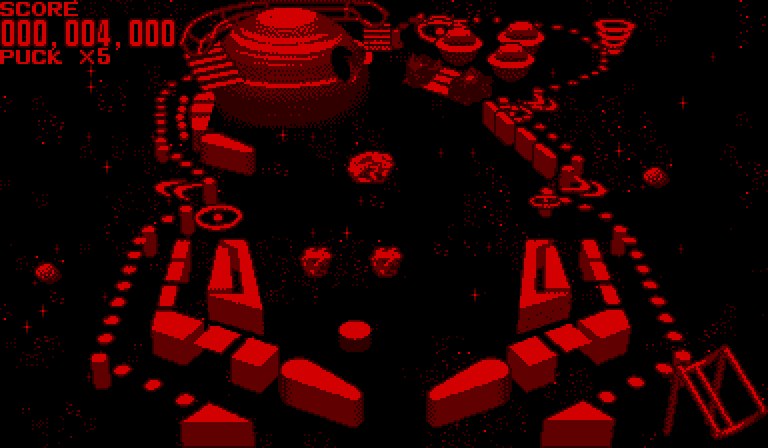
The resolution deserves the same respect. At 384 by 224 per eye, the Virtual Boy out-resolved the Game Boy by a wide margin and stood comparison with the home consoles of its day; through the scanned display, with no visible pixel grid in the conventional sense, its images have a smoothness that screenshots — which freeze the columns into a grid the eye never actually sees — do not fully convey. This is the open secret of Virtual Boy emulation: the games look harsher flattened into stills than they ever did inside the visor, where the image was light, motion and persistence, assembled fresh by your own visual system fifty times a second.
The Virtual Boy’s image is a magic trick performed by a vibrating mirror, fifty times a second, in a single colour of light. Seeing red was never the limitation. It was the technology itself, made visible.